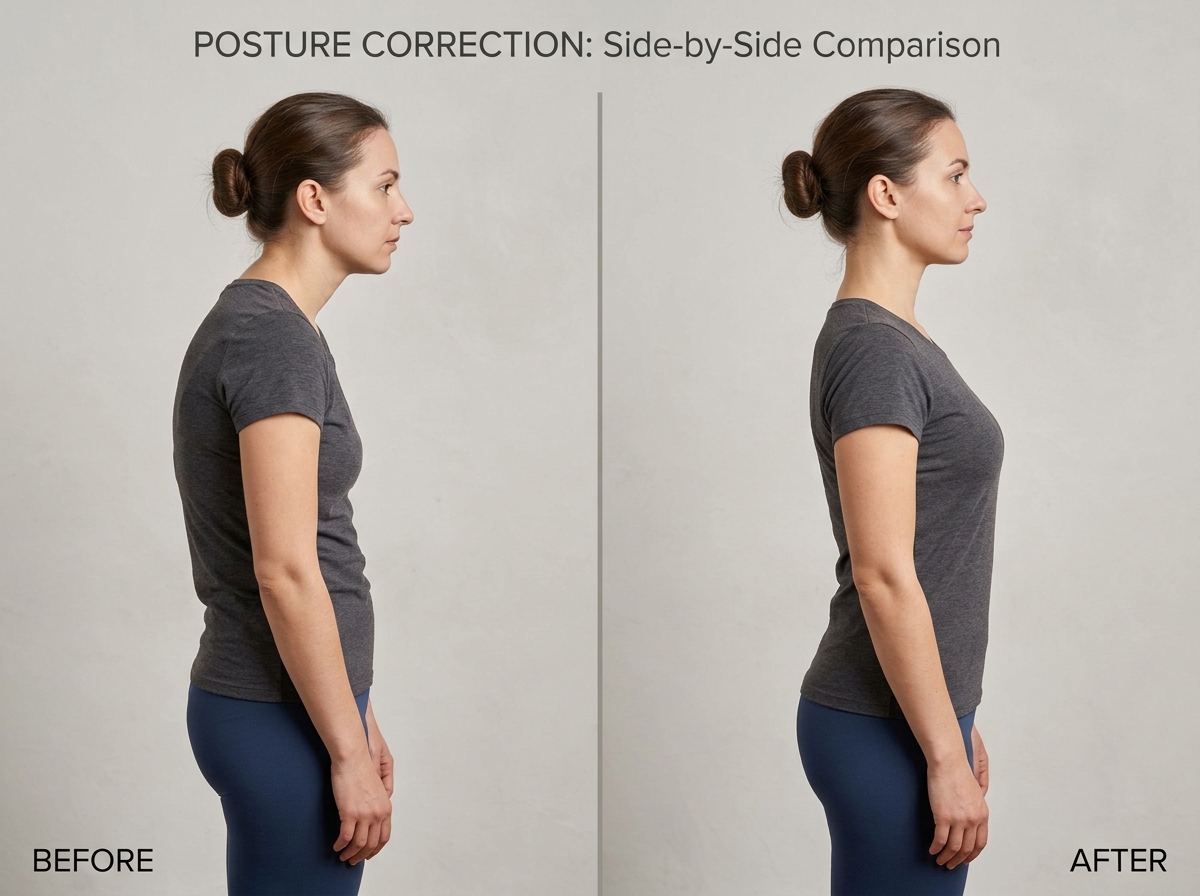
Hunchback Be Gone: The Best Stretches for a Straighter Spine
Why So Many People Want to Get Rid of Hunch Back — And What Actually Works
If you want to get rid of hunch back, here’s a quick overview of what works:
- Stretch tight muscles — especially your chest and neck (doorway stretch, chin tucks)
- Strengthen weak muscles — upper back, rhomboids, and core (scapular squeezes, wall angels)
- Fix your daily posture — keep screens at eye level, take movement breaks every 30 minutes
- Use a posture corrector — as a reminder tool, paired with exercise
- See a specialist — if pain is severe, the curve is worsening, or self-care isn’t helping
That rounded hump at the base of your neck didn’t appear overnight. For most people, it builds slowly — from years of looking down at phones, slouching at desks, or simply aging. Medically, it’s called kyphosis: an excessive forward curve of the upper spine exceeding 50 degrees. The milder, everyday version is often called a Dowager’s Hump.
It’s more common than most people realize. Kyphosis affects over 3 million Americans per year, and between 20% and 40% of older adults live with it. And here’s the thing — for many people, it’s not permanent.
Postural kyphosis, the kind caused by bad habits and muscle imbalances, can often be significantly improved — or even reversed — with the right combination of stretches, strengthening, and lifestyle changes.
I’m Dr. Sarah Yovino, MD, and my background in pain management gives me a unique perspective on how to effectively help patients get rid of hunch back through both non-invasive strategies and, when appropriate, clinical intervention. Let’s walk through exactly what you can do.

Key terms for get rid of hunch back:
Understanding Kyphosis and the Dowager’s Hump
To effectively get rid of hunch back, we first need to understand what is happening beneath the skin. The thoracic spine is the middle section of your back, consisting of twelve vertebrae. A healthy spine has a natural curve between 20 and 45 degrees. However, when this curve exceeds 50 degrees, it is clinically classified as kyphosis.

There are two primary categories we look at:
- Postural Kyphosis: This is the most common form, often resulting from “slouching.” Over time, the muscles in the front of the chest become tight, while the muscles in the upper back become weak and overstretched. This imbalance pulls the spine forward.
- Structural Kyphosis: This involves actual changes to the bone. For example, Scheuermann’s disease causes vertebrae to grow into a wedge shape during adolescence. In older adults, osteoporosis can lead to compression fractures that cause the spine to collapse forward.
Research shows that the prevalence of kyphosis in older adults is quite high, ranging from 20% to 40%. This often leads to “Forward Head Posture,” where the head juts out in front of the shoulders. For every inch your head moves forward, it adds an extra 10 pounds of force on your neck muscles!
Differentiating Dowager’s Hump from Buffalo Hump
It is incredibly common for people to confuse a Dowager’s Hump with a Buffalo Hump, but they are very different issues. A Dowager’s Hump is a skeletal and muscular issue involving the curvature of the spine.
In contrast, a “Buffalo Hump” is a localized deposition of fat at the base of the neck. This can be caused by obesity, certain medications, or Cushing’s disease, where excess cortisol levels trigger fat production. If your hump feels soft and fatty rather than bony, you may want to explore more info about buffalo hump causes to see if fat removal is a better path for you than spinal stretching.
Effective Strategies to Get Rid of Hunch Back
The good news is that if your hunchback is postural, it is often reversible. The goal is muscle retraining: we need to lengthen the muscles that are pulling you forward and strengthen the muscles that pull you back.
At Ideal Face & Body, we often see that a complete guide to fixing a dowager’s hump requires a two-pronged approach. You cannot just stretch; you must also build scapular stability (the ability to hold your shoulder blades in place) and core strength to support your upright spine.
| Goal | Exercise Type | Primary Benefit |
|---|---|---|
| Open the Front | Stretching | Relieves tension in the chest and front of the neck. |
| Support the Back | Strengthening | Builds the “postural muscles” that hold you upright. |
| Improve Range | Mobility | Increases the flexibility of the thoracic vertebrae. |
Targeted Stretches to Get Rid of Hunch Back
If you are wondering how to get rid of a neck hump, consistency is your best friend. We recommend performing these daily:
- Chin Tucks: Sit tall and look straight ahead. Without tilting your head up or down, pull your chin straight back as if making a “double chin.” This aligns the cervical spine over the shoulders. Repeat 10–15 times.
- Wall Angels: Stand with your back flat against a wall. Raise your arms to a “goalpost” position, ensuring your elbows and wrists touch the wall. Slowly slide your arms up and down like you’re making a snow angel.
- Doorway Stretches: Stand in a doorway with your forearms on the doorframe at a 90-degree angle. Step forward gently until you feel a stretch in your chest. This pectoral expansion is vital for allowing the shoulders to move back.
- Scapular Squeezes: While sitting or standing, imagine there is a lemon between your shoulder blades. Squeeze them together and hold for 5 seconds. Repeat 10 times.
Yoga and Pilates for Spinal Mobility
Yoga and Pilates are fantastic because they focus on spinal extension—the opposite of the “hunch.” Incorporating yoga for hunchback correction can help restore the natural fluidity of your back.
- Cat-Cow Pose: On your hands and knees, inhale as you arch your back and look up (Cow), then exhale as you round your spine toward the ceiling (Cat). This “massages” the vertebrae.
- Cobra Stretch: Lying on your stomach, gently lift your chest off the floor using your back muscles. This strengthens the spinal extensors.
- Bird Dog: From all fours, extend your opposite arm and leg simultaneously. This builds the core stability necessary to maintain an upright posture throughout the day.
Lifestyle and Ergonomic Adjustments
You can do all the stretches in the world, but if you spend eight hours a day hunched over a laptop, you will struggle to get rid of hunch back. We live in a world designed to make us slouch, so we have to be intentional about our environment.
Prevention is a key part of any neck hump elimination guide. Start by adjusting your workstation:
- Eye-Level Devices: Your monitor should be at a height where the top third of the screen is at eye level. If you use a laptop, get a stand and an external keyboard.
- Lumbar Support: Use a chair that supports the natural curve of your lower back. If your lower back slumps, your upper back will naturally follow.
- Standing Desks: Alternating between sitting and standing can prevent the “static loading” that leads to muscle fatigue and slouching.
Can Lifestyle Changes Help Get Rid of Hunch Back?
Absolutely. Small tweaks can yield big results over time. For instance, your sleep posture matters. Using contoured pillows can help maintain the cervical curve while you sleep.
Mindfulness is also a powerful tool. Many of our patients in Beverly Hills find success using posture apps that provide haptic feedback (a small vibration) whenever they start to slouch. Additionally, taking a “movement break” every 30 minutes to do a quick set of scapular squeezes can prevent muscles from locking into a hunched position.
Professional Treatment and Medical Intervention
While many cases are postural, some humps require a medical touch. If your hunchback is caused by osteoporosis or compression fractures, a physical therapy referral is the first step. In these cases, we focus on bone density management and gentle bracing to prevent further curvature.
If the “hump” is actually a collection of stubborn fat (a Buffalo Hump), stretching will not resolve it. At Ideal Face & Body, we specialize in buffalo hump removal options using our signature Precision Sculpt technique. This is an “awake” liposuction procedure that allows Dr. Justin Yovino to precisely contour the area with minimal downtime. It is a highly effective way to permanently remove the fatty tissue that creates a humped appearance.
When to See a Specialist
It is important to know when self-care isn’t enough. You should consult a specialist if you experience:
- Chronic or worsening back and neck pain.
- Breathing difficulties (severe kyphosis can compress the lungs).
- Neurological symptoms like numbness, tingling, or weakness in the arms.
- A curve that is rapidly worsening despite exercise.
In severe structural cases, surgical options for neck humps may be discussed to stabilize the spine. Our team in Beverly Hills, CA, is dedicated to helping you determine if your hump is postural, fatty, or structural so we can create the right plan for you.
Conclusion
Whether you are dealing with “tech neck” or a more significant spinal curve, the journey to get rid of hunch back starts with awareness. By combining targeted stretches, ergonomic fixes, and professional guidance, you can stand taller and feel more confident.
At Ideal Face & Body, Dr. Sarah Yovino and Dr. Justin Yovino provide a comprehensive range of solutions, from postural advice to advanced Precision Sculpt fat removal. If you’re ready to reclaim your profile, schedule a consultation for neck hump removal surgery or a postural evaluation today.
Frequently Asked Questions
How long does it take to see results from hunchback exercises? Consistency is the most important factor. While you might feel temporary relief immediately after stretching, visible changes in posture usually take 6 to 12 weeks of daily effort. This time is needed to build muscle memory and physically strengthen the tissues that support your spine.
Are posture correctors effective for treating a hunchback? Posture correctors can be a helpful “reminder” tool. They provide gentle guidance to help you realize when you are slouching. However, they should not be worn 24/7. Use them for 1–2 hours a day while performing exercises to ensure your muscles are doing the work, rather than becoming dependent on the brace.
Can a hunchback be completely reversed? If the cause is postural (muscle imbalance), it can often be completely reversed or significantly improved. If the cause is structural (bone changes or Scheuermann’s), the goal is usually management and preventing the curve from getting worse. Exploring neck hump treatment options early is the best way to ensure the highest degree of reversibility.