
You had a BBL because you wanted more shape, but the result now feels too projected, uneven, or disconnected from the rest of your body. Clothes may fit differently than expected, sitting may feel uncomfortable, or your preferences may have changed. Wanting a smaller or softer contour doesn't mean the original decision was wrong. It means your current goals deserve a fresh evaluation.

BBL reduction cost varies because reduction is usually a revision body-contouring procedure, not a simple reversal. The plan may involve removing fat from the buttocks, refining the waist or flanks, smoothing transitions into the thighs, or addressing skin and scar-related changes. This guide explains what shapes the overall scope, how awake office-based care compares with general anesthesia, what recovery may involve, and how to evaluate a surgeon in Beverly Hills.
Table of Contents
- Introduction to BBL Reduction and Why Patients Consider It
- Understanding What BBL Reduction and Revision Involve
- Key Factors That Influence BBL Reduction Cost
- Comparing Awake Office Based Revision and OR Based Revision
- Recovery Follow Up and What to Expect After BBL Reduction
- Risks Potential Additional Care and Financing Considerations
- How to Choose a Qualified Surgeon for BBL Reduction in Beverly Hills
Introduction to BBL Reduction and Why Patients Consider It
A patient might arrive for consultation with a clear but difficult request: “I want to look like myself again, just more balanced.” She may still appreciate some of the original shape, yet feel that the projection is too strong. Another patient may be concerned about asymmetry, a visible shelf, fullness in one area, or a contour that no longer suits changes in lifestyle or body weight.
These concerns are common reasons to explore BBL reduction, correction, or reversal. The desired outcome isn't necessarily a complete return to the preoperative body. Often, the goal is more selective: reduce excess volume, soften an exaggerated curve, or create a smoother relationship between the buttocks, waist, hips, and thighs.
A useful mindset: Revision isn't about erasing a past procedure. It's about making the current proportions feel intentional again.
The phrase “BBL reduction” can describe several different plans. Some patients need targeted fat removal from the buttocks. Others need revision liposuction across surrounding areas so the smaller buttocks don't look disconnected from the waist or legs. If the skin has stretched or the contour has changed after weight fluctuation, the surgeon may also discuss whether additional body-contouring steps are appropriate.
That variation explains why a fixed price list can be misleading. BBL reduction cost depends on anatomy, technique, the number of areas treated, anesthesia, facility requirements, and the surgeon's revision experience. A consultation should clarify not only the operative fee, but also what the complete care pathway includes.
At Ideal Face & Body, awake office-based care in Beverly Hills may be considered for selected patients whose anatomy and surgical goals make that approach appropriate. The right plan begins with an assessment, not with choosing an anesthesia method or trying to fit a complex revision into a standard package.
Understanding What BBL Reduction and Revision Involve
If the original BBL added volume to create shape, reduction and revision start with an existing result and refine it toward better proportion. Removing too much from one area can create a hollow, flatten a transition, or make the buttocks look deflated rather than naturally smaller. The goal is controlled adjustment, not taking away as much tissue as possible.
Three distinct goals: reduction, reversal, and revision
Reduction generally means decreasing buttock volume. Reversal means moving closer to the appearance before the BBL. Revision is the broader category, covering correction of size, asymmetry, irregular contours, or surrounding proportions. A patient may need one goal or several at the same time.
The surgeon may use targeted liposuction to remove excess fat, redistribute tissue when appropriate, or contour adjacent zones. Previous liposuction and fat grafting can alter tissue planes and create scar tissue. Before choosing a technique, the surgeon must examine how the skin, fat, and underlying contours now respond.
The buttocks also form part of a larger silhouette. A reduction may include the waist, flanks, hips, outer thighs, or other transition zones. Treating only the most prominent area can leave a smaller buttock that still appears unbalanced against the legs or waist.
Why revision planning differs from a primary procedure
A first-time procedure begins with anatomy that has not been surgically altered. Revision begins with an existing result that may include grafted fat, prior liposuction, uneven healing, scar tissue, or stretched skin. The surgeon has less room for guesswork and must plan around changes that are already present.
The BBL reduction and correction overview explains why consultation matters. The surgeon reviews the previous procedure, examines tissue quality, discusses the desired endpoint, and decides whether reduction should be staged or combined with other contouring.
A useful comparison is refinement rather than subtraction. The surgeon decides how much volume can be removed while preserving a smooth, proportionate contour that fits the patient's body. This careful judgment, along with the chosen care pathway and follow-up needs, helps explain why revision planning cannot be reduced to a standard package.
Key Factors That Influence BBL Reduction Cost
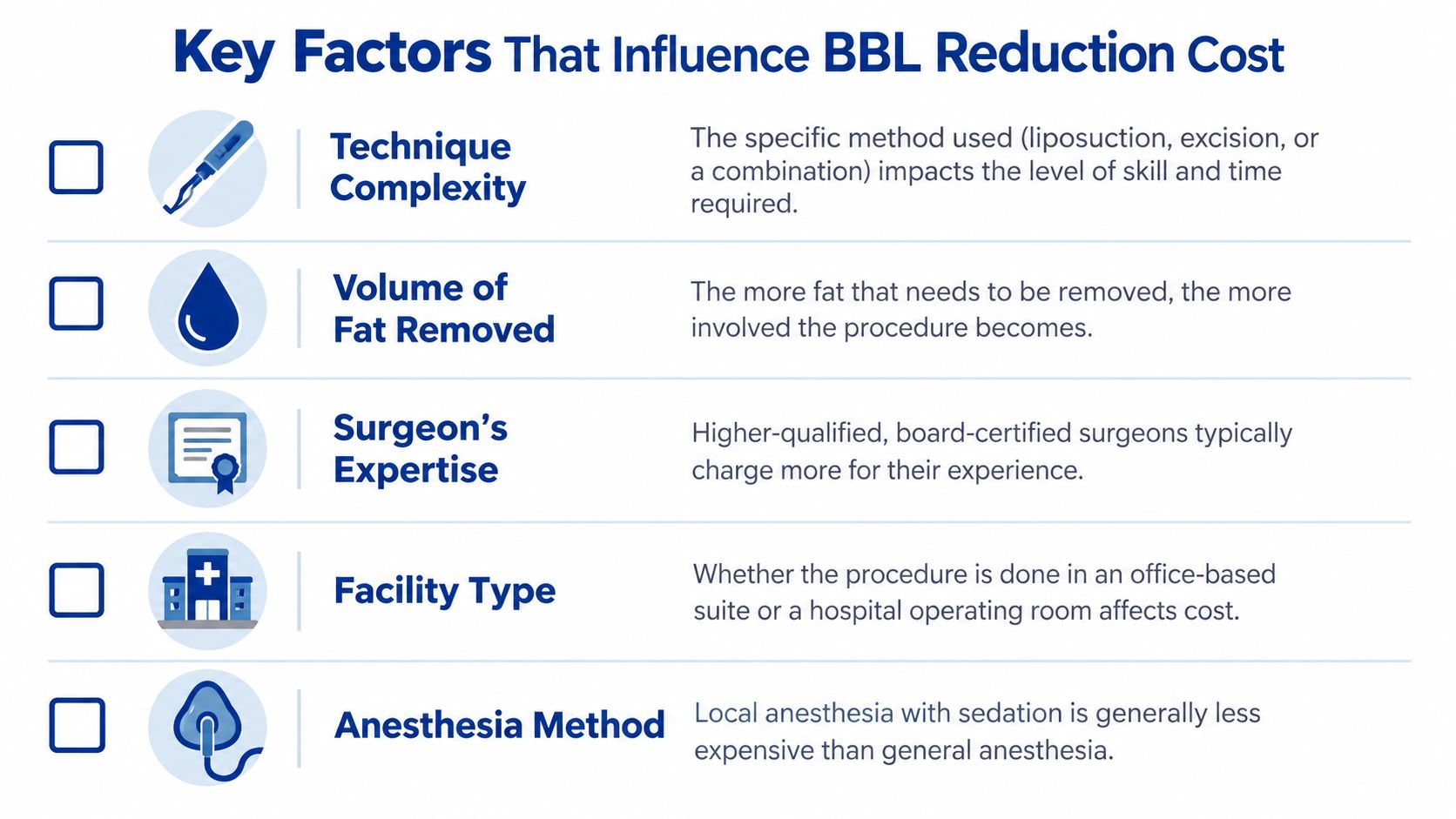
Two patients can ask for the same thing, “make my BBL smaller,” and receive very different recommendations. One may need limited buttock refinement. Another may need multi-zone contour correction after extensive prior surgery. Their BBL reduction cost will reflect different levels of planning, operating time, anesthesia, facility use, and follow-up.
Technique and tissue volume
The method matters. Targeted liposuction, excision, or a combination may be considered depending on fat distribution, skin quality, and the shape of the previous result. The more involved the technique, the more surgical judgment and operative time the plan may require.
The volume and location of fat also affect scope. Removing a modest area is different from reshaping the buttocks along with the waist, flanks, and thighs. Each additional zone can add marking, positioning, contour assessment, compression planning, and follow-up needs.
Revision expertise and facility setting
Revision surgery calls for experience with altered anatomy. A surgeon who regularly evaluates prior fat transfer and liposuction results may identify problems that aren't visible in a photograph, such as tethering, uneven thickness, or a transition that needs treatment beyond the buttocks.
Facility choice also changes the care pathway. An office-based suite may support local anesthesia with sedation for an appropriate case, while a hospital operating room may be selected when the procedure is more extensive or requires general anesthesia and a larger surgical team.
Anesthesia and geographic factors
Anesthesia isn't only a line item. It influences preparation, monitoring, recovery, transportation, and how much support may be needed afterward. Local anesthesia with oral sedation can be considered for selected awake procedures, while general anesthesia creates a different workflow and recovery experience.
Geography affects professional and facility fees as well. Even within the same broad market, a quote can vary according to the surgeon's experience, the setting, the number of zones, and whether the plan includes skin tightening or other contour work.
Ask these questions before comparing quotes:
- What is included: Does the plan cover the surgeon, facility, anesthesia, garments, routine visits, and aftercare?
- What is being treated: Is the recommendation limited to the buttocks, or does it include the waist, flanks, hips, or thighs?
- What happens if the plan changes: How are additional care, staged surgery, or refinement handled?
- How is safety managed: Who provides anesthesia, how are you monitored, and what happens if you need a higher level of care?
The awake surgery cost guide provides additional context for understanding how anesthesia and facility choices shape an individualized surgical plan.
Comparing Awake Office Based Revision and OR Based Revision
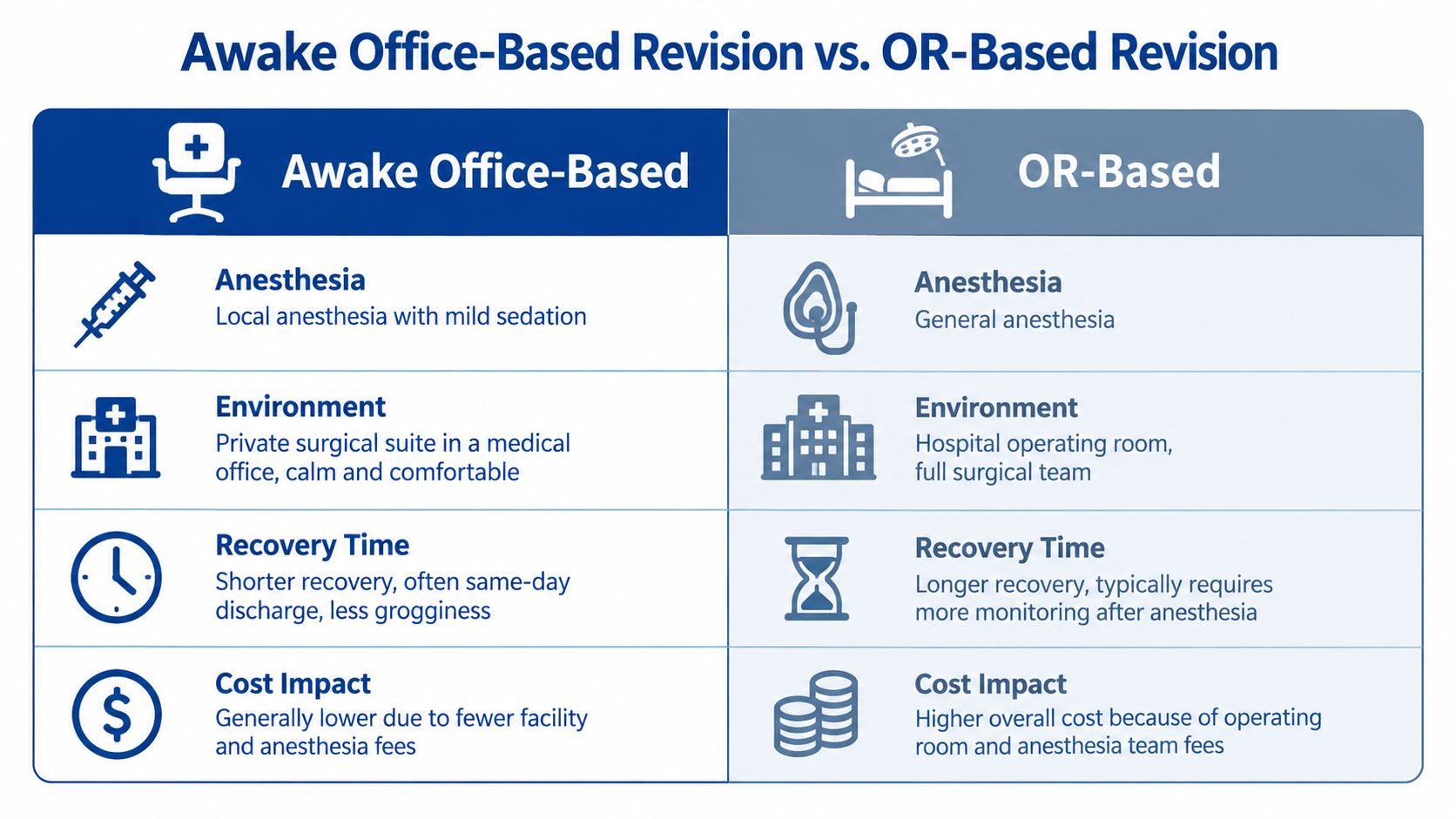
The main difference between these pathways is how anesthesia, monitoring, and the surgical environment are organized. In an awake office-based revision, the patient remains conscious while local anesthesia numbs the treatment area and a sedative helps with relaxation. In an OR-based revision, general anesthesia makes the patient unconscious and requires a different level of airway and postoperative monitoring.
What awake care can feel like
The awake BBL reduction approach may appeal to patients who want to avoid general anesthesia when their anatomy and procedure qualify. The American Society of Plastic Surgeons describes awake surgery as keeping the patient conscious while the surgeon uses local anesthesia with a sedative, rather than general anesthesia. The American Board of Cosmetic Surgery also explains that awake patients can breathe on their own without a ventilator and communicate with the surgeon during the procedure. The professional overview of awake plastic surgery offers further explanation.
Communication can be useful during contouring. A patient may be able to change position when directed, answer questions, and participate in a calm, controlled workflow. Some people also prefer avoiding the grogginess and airway management associated with general anesthesia.
Where OR-based care may fit
An operating room can be appropriate when the revision is extensive, involves multiple complex procedures, requires skin excision, or exceeds the safe limits of an office-based setting. General anesthesia may provide the immobility and controlled conditions needed for a longer or more involved operation.
The choice shouldn't be made from cost alone. A lower facility fee doesn't make an awake approach suitable if the treatment plan is too extensive, and general anesthesia isn't automatically better because it takes place in an operating room. The safest setting is the one that matches the procedure, the patient's health, and the surgeon's ability to monitor and manage the case.
A practical side-by-side view
| Consideration | Awake office-based revision | OR-based revision |
|---|---|---|
| Anesthesia | Local anesthesia with oral sedation may be used for selected cases | General anesthesia may be used for more extensive procedures |
| Communication | The patient may communicate with the surgical team | The patient is unconscious during the operation |
| Facility | A private medical-office surgical suite | A hospital or full operating-room environment |
| Recovery experience | Some patients may have less grogginess and a simpler discharge process | More postoperative monitoring may be needed after general anesthesia |
| Candidacy | Best suited to appropriately selected procedures | Considered when complexity or safety needs exceed office-based care |
Ideal Face & Body's PRECISION SCULPT laser liposculpting and Awake Butt Lift approaches are relevant to discussions about selected awake contouring cases. During consultation, the surgeon should explain whether those techniques fit your anatomy rather than presenting them as a universal solution.
Recovery Follow Up and What to Expect After BBL Reduction
Recovery reflects the entire contour plan, not just the buttocks. If the surgeon treats the waist, flanks, hips, or thighs at the same time, those areas can contribute to swelling, bruising, soreness, and limitations on movement.
The early healing period
Immediately after surgery, you'll receive instructions for compression garments and, when indicated, custom wrapping. These supports help manage swelling and protect the newly contoured areas while the tissues settle. You may need someone to drive you home and remain available during the first stage of recovery, depending on the anesthesia plan and your specific instructions.
Swelling can make the result look larger or less even than expected at first. Bruising may appear in both the treatment areas and nearby tissues as fluid shifts through the body. Those early changes don't represent the final contour, so follow-up examinations matter more than mirror checks during the first part of healing.
Activity and daily planning
Your surgeon will guide you on walking, sitting, sleeping positions, bathing, compression, and returning to work. Light movement is often part of recovery planning, but strenuous exercise, heavy lifting, and activities that increase pressure on treated areas may need to wait until you're cleared.
Prepare your home before surgery. Place essentials within easy reach, arrange comfortable clothing, organize meals, and plan help with errands or childcare. The practical goal is to reduce unnecessary movement so your body can focus on healing.
Follow-up and contour maturation
Follow-up visits allow the surgical team to assess swelling, skin retraction, incision healing, and symmetry. A revision result may become clearer gradually as inflammation decreases and the tissues adapt to their new shape.
Contact the practice promptly if you notice worsening pain, unusual drainage, fever, breathing problems, or a change that concerns you. Good aftercare isn't an optional extra. It protects the result and gives the surgeon an opportunity to address problems before they become harder to manage.
Risks Potential Additional Care and Financing Considerations
Revision contouring can improve proportion, but it can't guarantee perfect symmetry. Patients should understand the possibility of contour irregularities, prolonged swelling, numbness, changes in skin quality, infection, bleeding, anesthesia-related complications, or a need for additional refinement.
The risk profile depends on what has already been done and what the new plan requires. Prior surgery may leave scar tissue or uneven fat layers, making tissue removal less predictable. If skin doesn't retract as hoped, the surgeon may discuss a different contouring strategy or staged care rather than removing more fat aggressively.
Plan for the whole care journey
A consultation should clarify what happens beyond the procedure itself:
- Routine follow-up: Ask how visits are scheduled and which postoperative assessments are included.
- Garments and supplies: Confirm whether compression garments, wrapping materials, and dressing support are part of the plan.
- Unexpected concerns: Understand whom to contact and how urgent problems are handled.
- Refinement: Ask how the practice approaches a touch-up or secondary procedure if the contour continues to change.
- Staged treatment: Find out whether multiple areas should be treated together or separately for safety.
BBL reduction is generally considered cosmetic, so insurance usually doesn't cover it. Patients often explore payment plans or medical financing, but approval terms and repayment obligations vary. Read the agreement carefully and budget for transportation, time away from work, garments, medications, and possible follow-up needs, not only the quoted surgical fee.
Budgeting principle: The most useful quote is the one that explains the complete plan, not merely the number attached to the operating room.
How to Choose a Qualified Surgeon for BBL Reduction in Beverly Hills
Start with qualifications and revision-specific experience. Look for a double board-certified plastic surgeon who routinely evaluates BBL reduction, correction, and revision liposuction rather than focusing only on primary augmentation.
Ask to see before-and-after examples that resemble your concern. A gallery should include more than dramatic transformations. Look for patients with over-projection, asymmetry, irregular transitions, or multi-area contour changes. The surgeon should also explain what the photographs can and can't predict for your anatomy.
Questions worth asking
- Is awake care appropriate for me: Ask why local anesthesia with sedation is or isn't suitable for your plan.
- What areas need treatment: Clarify whether buttock reduction alone can meet your goal or whether surrounding contour correction is needed.
- Who performs each part: Confirm the surgeon's role, anesthesia provider, and postoperative support.
- How is safety handled: Ask about monitoring, emergency protocols, and when an OR setting would be recommended.
- What does follow-up include: Request a written outline of visits, garments, medications, and potential additional care.
Ideal Face & Body, led by Dr. Justin Yovino and Dr. Sarah Yovino, offers evaluation for selected BBL reduction and revision cases, including awake subcutaneous fat removal when the anatomy is appropriate. The practice uses proprietary PRECISION SCULPT and Awake Butt Lift approaches in an office setting in Beverly Hills' Golden Triangle, with virtual and out-of-town consultation options available.
Bring records from your prior BBL if you have them, along with a list of procedures, medications, health conditions, and specific concerns. Bring reference images only to communicate shape preferences, not to demand an identical result. BBL reduction cost is best understood after the surgeon defines the safest personalized plan, including the areas treated, anesthesia pathway, facility, recovery, and follow-up.
Ideal Face & Body evaluates BBL reduction and revision needs with a focus on proportion, individualized contour planning, and selected awake office-based options. Visit Ideal Face & Body to request a consultation and discuss the right pathway for your anatomy, goals, and complete recovery journey.