Have you ever looked at a SkinTyte before and after gallery and wondered whether the visible change came from the treatment, the camera, or several undisclosed procedures combined? That question matters because SkinTyte is designed to create gradual, modest tightening, not an instant surgical lift.
A useful comparison should show the same person, in the same position, under consistent lighting, after enough time has passed for collagen remodeling. SkinTyte uses near-infrared energy to heat the deeper skin without removing the surface, so the meaningful result usually develops over a three-to-six-month remodeling window, not on the day of treatment. Clinical research on broad-band infrared tightening supports this gradual pattern, with improvement building after repeated sessions rather than appearing as a dramatic single-visit transformation.
Table of Contents
- What Most SkinTyte Before and After Photos Actually Show
- How SkinTyte Works Beneath the Surface
- How to Judge Whether a Before and After Photo Is Real
- Who Makes a Good Candidate and Who Should Wait
- Realistic Timelines and What a Typical Case Looks Like
- How SkinTyte Compares to Morpheus8 and Other Options
- Recovery, Side Effects, and How Long Results Last
- Common Questions Patients Ask Before Booking
What Most SkinTyte Before and After Photos Actually Show
Most readers expect a side-by-side image promising a sharper jawline, smoother neck, or firmer abdomen after one appointment. The photograph may show a real difference, but it can also imply more than the treatment alone proves. A responsible gallery should make the treatment timeline, number of sessions, camera setup, and any additional procedures clear.
Read the image as evidence
A meaningful comparison begins with a documented baseline. The patient should be photographed before treatment and again after the planned series, with the same camera, lighting, expression, head position, and viewing angle. The after image should also be labeled by its timing relative to the final session.
That timing matters. SkinTyte delivers near-infrared heat into the dermis, where collagen first contracts and then remodels over time. Early photographs can capture temporary redness, swelling, or a short-lived feeling of tightness instead of the durable structural change a patient wants.
Practical rule: An after photo taken immediately after treatment cannot answer whether collagen remodeling worked.
Marketing galleries often leave out details that change how a viewer interprets the result. A patient may have completed several sessions, lost weight, changed skincare, received injectables, or undergone another energy-based treatment. Without that context, a subtle improvement can look like a dramatic lift.
What a credible gallery should reveal
Look for these details before treating a photo as proof:
- Treatment count: Confirm whether the image represents one appointment or a full series.
- Elapsed time: Check how long the patient waited before the after photo.
- Standardization: Compare lighting, makeup, expression, neck position, and camera distance.
- Treatment boundaries: Ask whether the area shown received any additional procedure.
- Expected scale of change: Decide whether the visible result looks like modest tightening or an exaggerated surgical-style lift.
A well-made gallery can help you understand what SkinTyte may do for someone with similar skin quality and laxity. It can't guarantee that your face, neck, or body will respond in exactly the same way.
How SkinTyte Works Beneath the Surface
What creates a believable SkinTyte before-and-after result beneath the skin? SkinTyte is a near-infrared, non-ablative skin-tightening treatment. Its light falls within the 800–1400 nanometer range, directing heat toward the dermis while leaving the outer epidermis largely intact. The proposed process includes controlled heating, collagen denaturation, and later collagen remodeling, as described in the clinical literature on infrared thermal remodeling.
Older collagen behaves somewhat like a stretched elastic band that has lost its snap. Heat does not peel away the surface or instantly install new support. It changes conditions within the dermis, encouraging some contraction first and gradual reorganization of collagen afterward.
Why the surface can look normal
The handpiece is intended to warm deeper tissue while limiting excessive epidermal injury. That helps explain why visible recovery is often less pronounced than after an ablative procedure or deep peel. A normal-looking surface does not mean the deeper tissue received no treatment.
Technique still matters. The clinician adjusts contact, movement, energy delivery, and treatment response. A comfortable session cannot confirm that nothing happened, and warmth by itself cannot prove that the intended tissue temperature was reached.
Why a series often matters
Collagen remodeling develops gradually. One pass may provide stimulation, but a series can create a more cumulative treatment effect. A clinical study of broad-band infrared therapy used repeated sessions at monthly intervals and reported gradual changes in facial wrinkles and laxity. The study found 21% of patients had marked improvement in crow's-feet wrinkles, 30% had moderate improvement, and 28% had slight improvement. Cheek laxity showed 31% marked, 31% moderate, and 28% slight improvement, while 76% reported satisfied-to-very-satisfied outcomes (open clinical study of broad-band infrared therapy).
Those findings describe one study and should not be treated as a guarantee for every SkinTyte patient. They do establish a useful way to read a gallery: judge the result after the completed series and the remodeling window, not from an immediate post-treatment image. Readers comparing forms of device-based stimulation can consult this complete EMS facial guide. For a different heating approach, Ideal Face & Body explains radiofrequency skin rejuvenation.
How to Judge Whether a Before and After Photo Is Real
A convincing photo set isn't necessarily a reliable photo set. Your job is to determine whether the images isolate the treatment or combine it with changes that weren't disclosed.
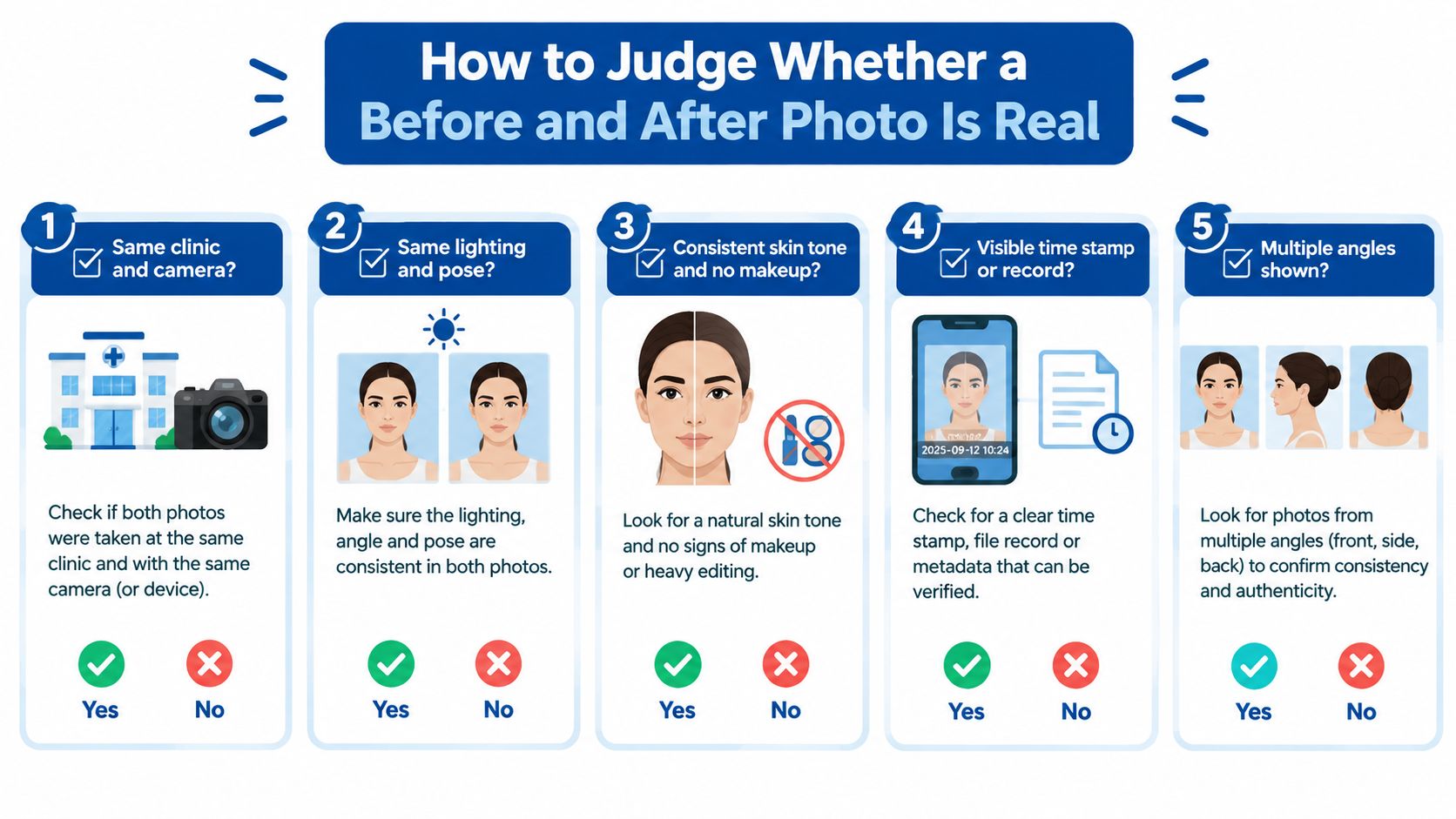
Start with the basics. Ask whether both images came from the same clinic, with the same camera, lighting, background, and distance. A brighter light can soften shadows, while a different lens can alter facial proportions. A lifted chin or tilted head can make the jawline appear tighter without changing the skin.
Five questions to ask
- Was the pose identical? The patient should face the same direction, hold the neck naturally, and use a comparable expression. A smiling before image and a relaxed after image aren't equivalent.
- Was the after photo taken at the right time? Ideally, the clinic should document the interval after the final session and explain why that timing represents a meaningful result.
- Were outside variables recorded? Weight change, skincare changes, exercise, injectables, and other procedures can all affect appearance.
- How many sessions were completed? One treatment and a complete series answer different questions.
- Are multiple angles available? Front, oblique, and side views help reveal whether the change is consistent or exists only from one flattering angle.
The patient should also ask whether the images were filtered or retouched. A guide such as this AI Image Detector manipulation guide can help readers understand common signs of image alteration, although a consultation should still include direct questions about the clinic's photography process.
Heavy makeup, altered lighting, a different head position, or an undisclosed combination treatment should lower your confidence in the comparison.
The photo should match the patient's starting degree of laxity. Mild looseness may respond with a visible but restrained improvement. Advanced sagging won't suddenly resemble a surgical lift because the after image was taken from a more favorable angle.
Who Makes a Good Candidate and Who Should Wait
Candidacy depends less on age alone than on the amount and type of laxity. SkinTyte is most useful when the skin has begun to look less firm but still retains enough elasticity to respond to gradual collagen remodeling.
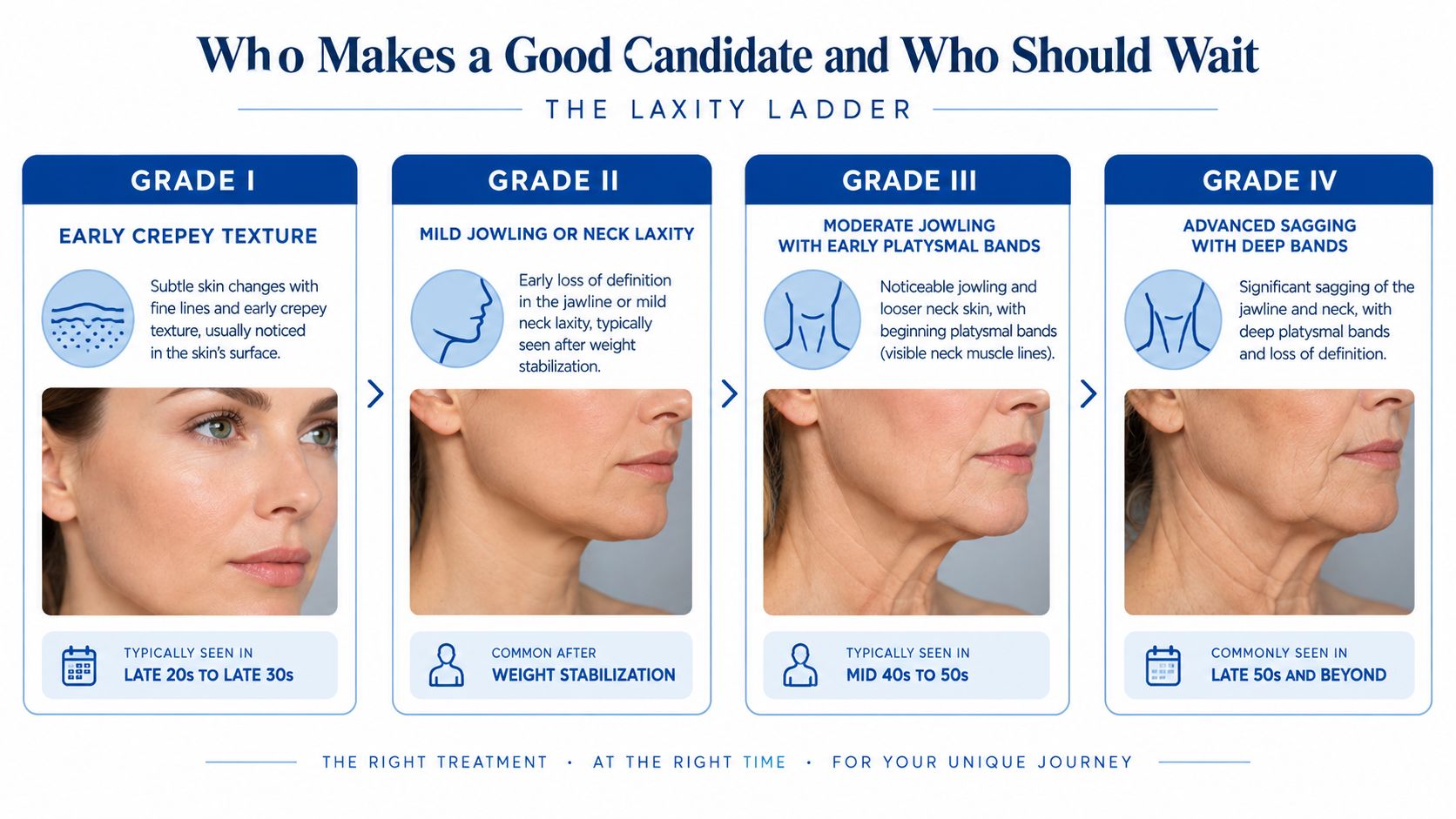
Use a simple laxity ladder
- Grade I: Early crepey texture and mild loss of firmness. The face may look slightly tired, but there isn't substantial descent.
- Grade II: Mild jowling or neck laxity, especially after weight has stabilized. This is often a reasonable range for noninvasive tightening.
- Grade III: Moderate descent, visible neck bands, or more established jowling. A deeper treatment or surgery may provide a more satisfying change.
- Grade IV: Advanced sagging and pronounced tissue descent. A surgical consultation is usually more appropriate than relying on a surface-level tightening device.
The strongest SkinTyte before and after changes usually occur in the earlier grades because the device is tightening existing skin rather than removing excess tissue. A patient seeking the lift shown in a facelift gallery will probably feel disappointed if the treatment plan promises only energy-based tightening.
A clinical checklist
A suitable candidate generally has stable weight, realistic expectations, and enough patience to complete a series and wait for delayed remodeling. The treatment zone should not have active acne, eczema, open wounds, uncontrolled rosacea, suspicious lesions, or active skin cancer.
A provider should pause or postpone treatment for pregnancy, breastfeeding, recent isotretinoin use, implanted defibrillators, or medical conditions that impair healing, including uncontrolled diabetes. The clinician also needs a complete medication and medical history before deciding whether treatment is appropriate.
Sun protection matters after every light-based treatment. Patients who won't protect the treated area from ultraviolet exposure may compromise skin quality and make the result harder to evaluate.
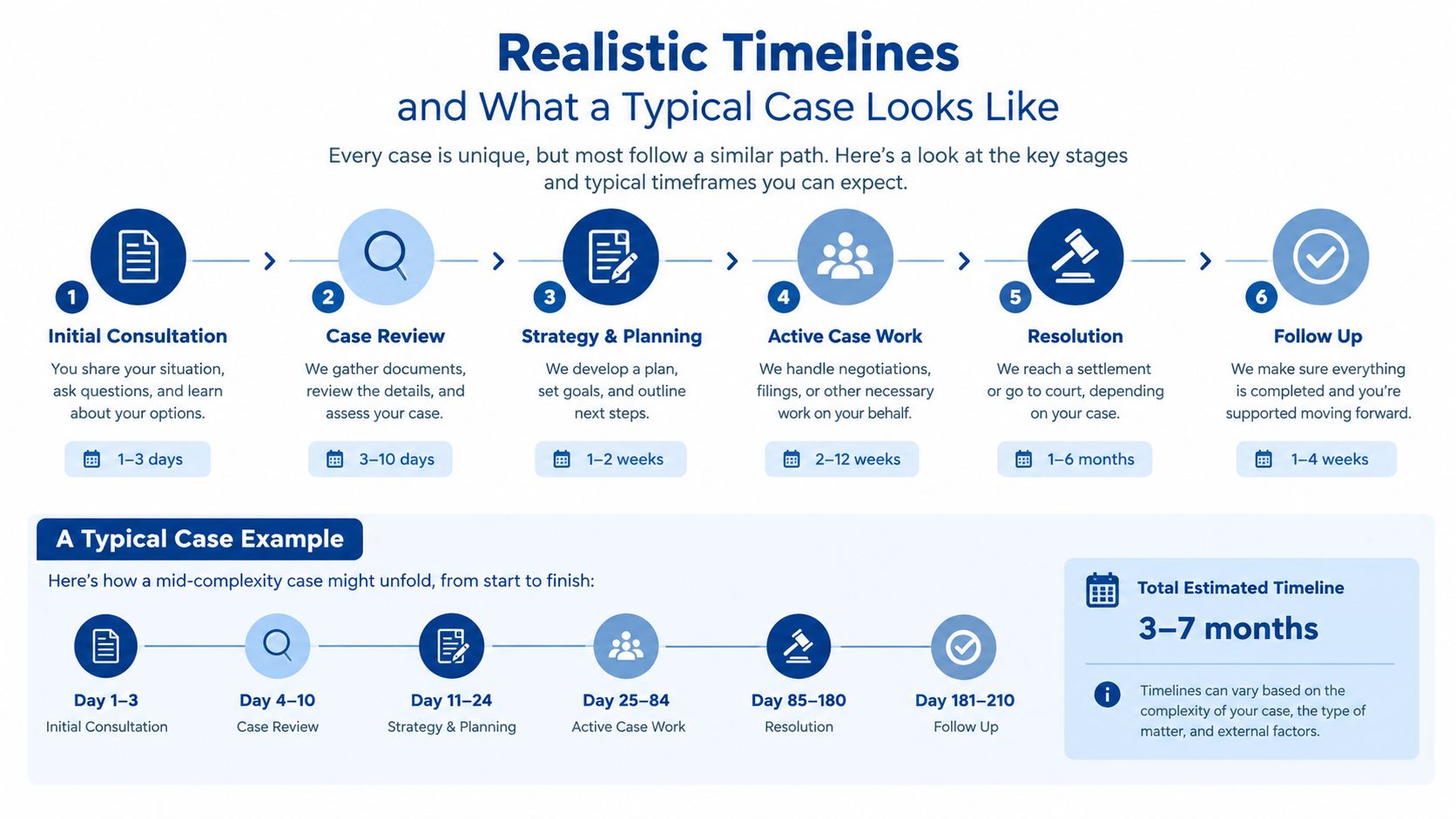
Realistic Timelines and What a Typical Case Looks Like
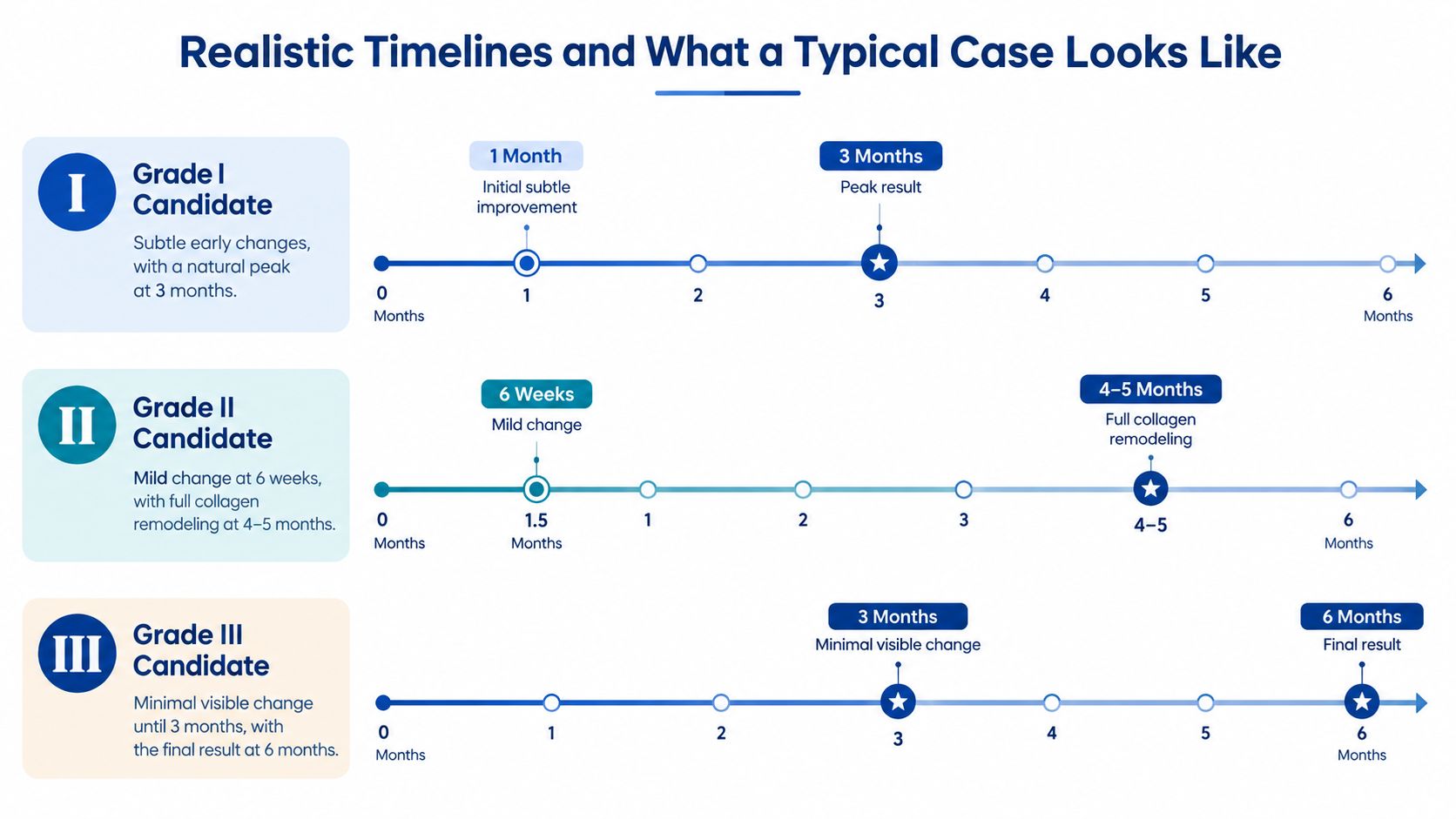
The most common expectation error is judging the result too early. SkinTyte may create an initial sensation of firmness, but the more meaningful change depends on collagen reorganization over the following months.
Consider three representative planning examples, not guaranteed outcomes. A younger patient with early cheek laxity may notice little more than a subtle change at first, then see clearer definition as the remodeling period progresses. A patient with mild neck laxity may need repeated sessions before the photographs show a convincing difference. Someone with substantial abdominal looseness after weight loss may notice better skin quality without receiving the degree of contour change associated with body surgery.
What the calendar can look like
During the first hours, the skin may look flushed and feel warm. The next several weeks can be visually quiet, which doesn't necessarily mean the treatment failed. Collagen changes are occurring below the surface and aren't always obvious in the mirror.
By the later remodeling window, the jawline, cheek, neck, or treated body area may look somewhat firmer. The change is often easier to see in standardized photographs than in daily life because a camera allows direct comparison of the same angle.
| Stage | What patients may notice | What the clinician evaluates |
|---|---|---|
| Immediately after treatment | Warmth, mild flush, temporary tightness | Skin response and comfort |
| Early healing period | Little visible change or subtle firmness | Resolution of redness and irritation |
| Remodeling period | Gradual improvement in laxity and texture | Comparison with standardized baseline images |
| Final assessment | The most useful before and after comparison | Whether the result meets the original goal |
Treatment planning varies by area and skin condition. A clinician may recommend several sessions spaced apart rather than presenting one appointment as a complete lift. For readers comparing gradual tightening approaches, Ideal Face & Body also discusses Venus Legacy treatments.
The key question isn't whether the result looks dramatic at two weeks. It's whether the final comparison was taken after an appropriate remodeling interval and whether the improvement matches the starting laxity.
How SkinTyte Compares to Morpheus8 and Other Options
Choosing a tightening treatment starts with the problem you want to change. SkinTyte focuses on broad-area near-infrared heating and modest tightening. Other options reach different tissue depths, create different degrees of surface injury, or address volume and excess skin more directly.
| Treatment | Depth reached | Typical downtime | Best-fit patient |
|---|---|---|---|
| SkinTyte | Dermal heating without intentional surface ablation | Minimal visible recovery | Mild laxity and patients prioritizing comfort and convenience |
| Fractional radiofrequency microneedling | Deeper dermis, with controlled needle-based energy delivery | Visible redness and recovery that vary by settings | Patients with laxity plus texture, pores, or acne-scar concerns |
| Microfocused ultrasound | Deeper structural tissue planes | Usually limited surface recovery, with discomfort varying by treatment | Patients seeking lift-focused remodeling of deeper support |
| Surgical lift | Excess skin and deeper facial or neck structures | Substantially longer recovery | Advanced laxity, jowling, or neck descent requiring tissue repositioning |
SkinTyte is a reasonable starting point when laxity is early and downtime needs to be minimal. Fractional radiofrequency microneedling may make more sense when texture and laxity need treatment together. Readers researching that category can browse Morpheus8 providers, then ask each clinic how it manages settings, skin tone, recovery, and combination treatments.
Microfocused ultrasound can be more lift-oriented because it targets deeper tissue. Surgery remains the most direct option when excess skin or significant descent drives the concern. No energy device should be presented as an equivalent substitute for a surgical lift in a patient with advanced sagging.
A practical decision rule is simple:
- Mild laxity and minimal downtime: Consider SkinTyte.
- Texture plus laxity: Discuss fractional radiofrequency microneedling.
- Deeper descent: Ask about ultrasound or surgery.
- Loose skin or major contour change: Seek a surgical assessment.
Combination plans can be useful when the patient wants both better skin quality and stronger contour definition. The treatment plan should identify which procedure addresses which problem rather than attributing every visible improvement to SkinTyte. Ideal Face & Body offers non-surgical skin treatments alongside surgical facial and body-contouring consultations, including Morpheus 8 skin tightening.
Recovery, Side Effects, and How Long Results Last
SkinTyte is often described as having little or no downtime, but that doesn't mean the skin needs no care. Immediately after treatment, patients commonly notice warmth, mild flushing, temporary swelling, or a tight sensation. These effects generally reflect the controlled thermal response and usually settle without interrupting normal activity.
Makeup may often be applied the same day if the provider approves it. Gentle cleansing, sun protection, and avoiding unnecessary heat or irritation help keep the treated area comfortable while the skin settles.
Expected versus concerning symptoms
Expected effects tend to be mild and short-lived:
- Redness: A temporary vascular response to heat.
- Warmth: Residual sensation from the treatment's thermal energy.
- Mild swelling: A short-term inflammatory response.
- Tightness: Early contraction or temporary tissue response.
Contact the treating provider if you develop blistering, persistent pain, significant pigment change, or symptoms that worsen instead of improving. These aren't symptoms to diagnose through an online gallery or general article.
The visible result develops later. Some initial contraction may appear during the early weeks, but the most meaningful assessment belongs in the three-to-six-month remodeling window, when newly organized collagen has had time to mature. Durability varies with age, skin quality, sun exposure, weight changes, and the maintenance plan recommended by the clinician.
A maintenance schedule should be individualized rather than copied from a gallery. If the clinic promises permanent tightening from a short series, ask how it defines maintenance, how it photographs follow-up results, and what happens as natural aging continues.
Common Questions Patients Ask Before Booking
How should I evaluate a clinic's gallery?
Ask to see unedited photographs taken in the same room, with consistent lighting, identical poses, and matched angles. Confirm the number of sessions, the date of the final treatment, and the interval before the after photograph.
You can also ask whether the patient changed weight, skincare, exercise, or injectables during the comparison period. A trustworthy provider should be able to explain what the images show and what they don't prove.
What result should I expect?
SkinTyte provides gradual firming, not a facelift equivalent. Patients with mild to moderate laxity tend to have the clearest opportunity for a visible change because the skin still has enough elasticity to respond.
Advanced jowling, substantial neck banding, or significant volume loss may require a different strategy. Depending on the underlying problem, that could involve deeper energy-based remodeling, injectables, body contouring, or surgery. SkinTyte won't remove a large amount of excess skin or restore lost volume by itself.
What does a session feel like?
Most patients describe warmth, sometimes with brief snapping sensations, rather than sharp pain. Numbing may not be necessary, but comfort depends on the treatment area, settings, and individual sensitivity.
The appointment length varies by area and treatment plan. A provider should explain the expected duration, the number of passes, and whether the area will be treated alone or combined with another procedure.
Can SkinTyte be combined with other treatments?
It may be combined with procedures that address a different concern, but sequencing matters. Adding resurfacing, microneedling, injectable work, or body contouring without allowing the skin to recover can make the result harder to interpret and may increase irritation.
Ask which treatment is responsible for which expected improvement. If a gallery shows better tone, reduced laxity, and altered contour, the provider should identify whether those changes came from SkinTyte, another treatment, or the combination.
A consultation is also the right time to discuss skin tone, medical history, active conditions, sun exposure, and whether your desired result is realistic for a noninvasive approach. The strongest plan isn't the one with the most procedures. It's the one that matches the treatment's actual reach to the problem you want changed.
Ideal Face & Body offers consultations for non-surgical skin tightening, energy-based treatments, and surgical options when laxity is more advanced. Visit Ideal Face & Body to discuss your goals, review before and after documentation, and determine whether SkinTyte or another approach fits your skin and timeline.