Most advice on awake BBL reduction is too slick. It treats a revision problem like a convenience procedure. That's backwards.
If you want a buttock that's smaller, less projected, more even, or closer to your natural frame, you're not shopping for a shortcut. You're shopping for judgment. Awake only describes the anesthesia plan. It does not mean easy. It does not mean every patient is safer in that setting. It does not mean one session is always the right answer.
Patients who regret a prior BBL usually come in with the same hope: “Can you just lipo it down while I'm awake and be done?” Sometimes, yes. Often, not in the way social media implies. Reduction is correction. Correction requires restraint, planning, and a surgeon who knows when less surgery today creates a better shape later.
Table of Contents
- Why Awake BBL Reduction Is a Revision Procedure, Not a Marketing Term
- How Awake BBL Reduction Actually Works in an Office Setting
- Who Is a Real Candidate for Awake BBL Reduction
- What Happens During an Awake BBL Reduction
- Alternatives Worth Comparing Before You Commit
- Choosing a Surgeon With Real Revision Experience
- Recovery, Aftercare, and Realistic Before and After Timelines
- Honest Answers to the Questions Awake Patients Actually Ask
Why Awake BBL Reduction Is a Revision Procedure, Not a Marketing Term
A primary buttock enhancement and an awake BBL reduction are not mirror images of each other. They are different operations with different problems to solve.
Primary enhancement is about adding shape and projection. Reduction is about undoing excess, rebalancing asymmetry, and protecting contour while working through tissue that may no longer behave normally. Prior liposuction can leave irregular scar planes. Prior fat transfer can survive unevenly. Weight changes can stretch skin in ways liposuction alone won't fix. That makes revision harder than the phrase “awake reduction” suggests.
Awake describes anesthesia, not complexity
The historical reason office-based contouring under local anesthesia became possible is real. Modern awake body contouring sits on the same foundation as tumescent liposuction. A major milestone came in 1985, when Jeffrey Klein introduced the tumescent technique for safe liposuction in awake patients under local anesthesia. The broader history matters too. Modern liposuction is generally traced to the 1975 blunt-cannula work of Arpad and Fischer and the 1977 wet technique introduced by Yves-Gerard Illouz, which reduced bleeding and made higher-volume contouring more practical. In the liposuction literature, blood loss with tumescent and superwet methods has been estimated at about 1% of aspirate volume, which helps explain why awake, office-based contouring became feasible in selected patients (historical review of liposuction techniques).
That history supports the concept of awake surgery. It does not erase revision difficulty.
Practical rule: If someone markets awake BBL reduction as inherently simple, they're skipping the hardest part of the conversation.
What makes reduction different
Reduction cases usually involve one or more of these revision-specific issues:
- Overfilled projection that doesn't match the waist, hips, or thighs anymore.
- Asymmetry from uneven graft survival.
- Contour distortion from old liposuction passes, scar tissue, or a poorly blended transition zone.
- Skin laxity that becomes more obvious after fat is removed.
- Expectation mismatch where the patient wants a dramatic downsizing but the skin envelope won't support it cleanly in one pass.
That's why I treat awake BBL reduction as a correction procedure first. The anesthesia choice comes second.
If your concern is regret after a prior BBL, BBL reduction and correction should be evaluated with revision rules, not with the same checklist used for first-time body contouring. Candidacy, technique, and surgeon selection all change once the tissue has already been altered.
How Awake BBL Reduction Actually Works in an Office Setting
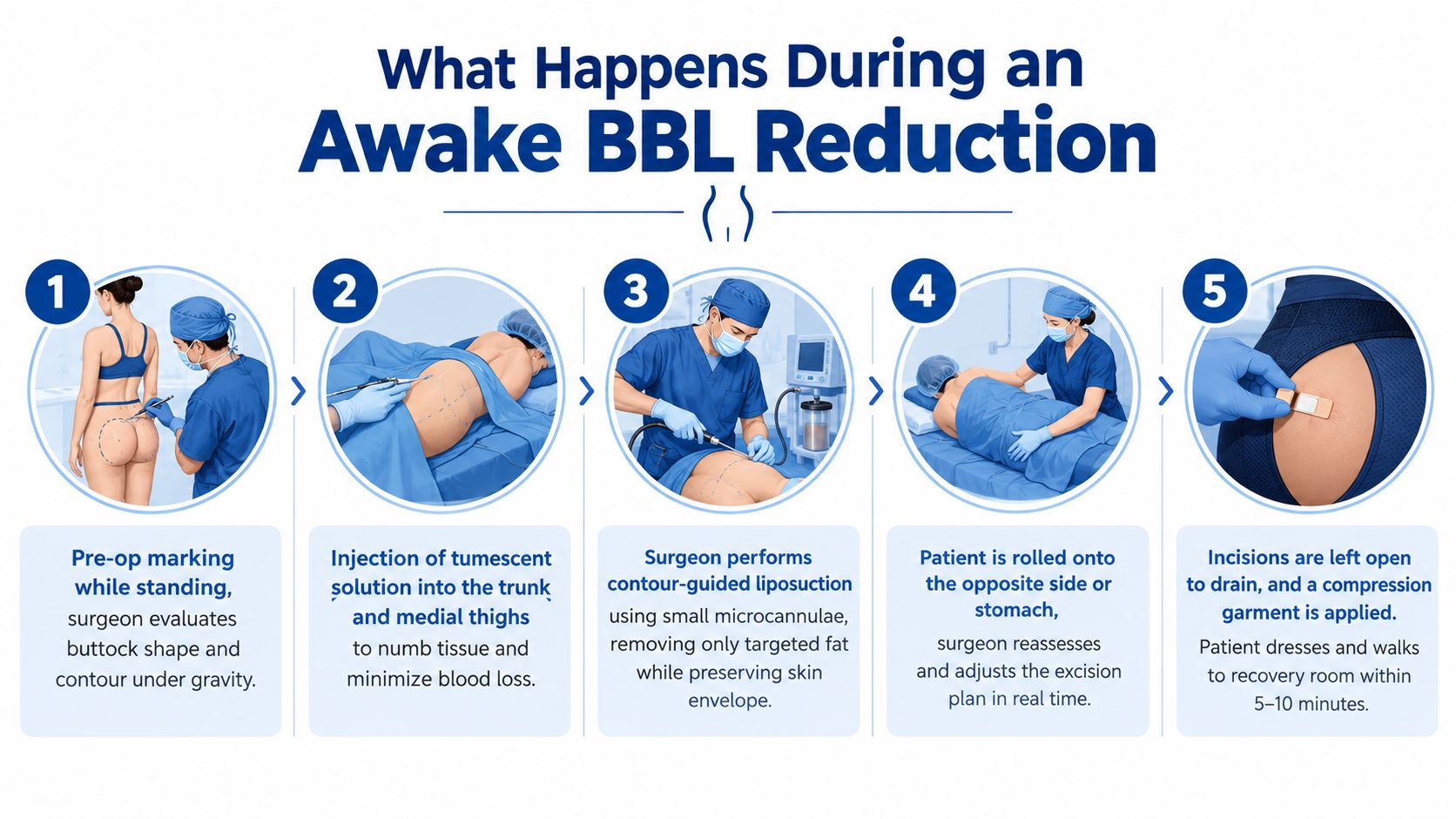
In the right patient, awake BBL reduction is usually an office-based contouring procedure under local anesthesia, sometimes with oral medication to reduce anxiety. You're responsive. You can change position. The surgeon can check shape under real conditions instead of relying only on a motionless patient under general anesthesia.
That's the upside. The trade-off is obvious. You're present for the experience, so the case has to be selected with discipline.
What the patient usually feels
Most patients don't describe sharp operative pain once the area is fully numbed. They describe pressure, pushing, vibration, and pulling. The most uncomfortable part is often the numbing phase, not the fat removal itself.
Awake surgery in other reduction settings helps explain why this model works. One published wide-awake breast reduction report used a 60 mL tumescent infiltration mix composed of 30 mL of 1% lidocaine with epinephrine, plus 25 mL Ringer's solution and 5 mL bicarbonate. The point isn't to copy a recipe across body areas. The point is that local anesthetic dosing, vasoconstriction, and buffering are what allow tissue excision without general anesthesia or airway management (wide-awake breast reduction report).
Why the office setting can work well
The awake office workflow has built-in advantages when the case is appropriate:
- Real-time contour checks because the patient can be repositioned during surgery.
- Monitored vitals without the recovery fog that comes with general anesthesia.
- Limited, targeted fat removal instead of overly aggressive suction just because access is easy.
- Immediate feedback if pressure points, anxiety, or positioning need adjustment.
The best awake cases are not the biggest cases. They're the best-selected cases.
A systematic review of awake breast surgery found that awake techniques shortened hospital stays, reduced costs, lowered surgical stress, maintained surgical results, and improved postoperative pain control compared with general anesthesia. That review also identified nerve blocks as the safest and most effective awake anesthetic option among the techniques studied (systematic review of awake breast surgery). Buttock revision is a different procedure, but the workflow logic carries over. Less anesthesia burden can be a real advantage when the operation itself is also kept within awake limits.
For patients comparing approaches, awake liposuction and fat transfer is the broader category. Awake BBL reduction is the narrower, more selective revision version of that idea.
Who Is a Real Candidate for Awake BBL Reduction
Good candidates are not just people who dislike their BBL. They're people whose anatomy and goals still match what an awake reduction can safely accomplish.
The strongest candidate usually wants refinement, not demolition. That means localized excess in the buttocks or surrounding frame, decent skin recoil, stable weight, and realistic expectations about shape. If the goal is “I want this to look smaller, cleaner, and more balanced,” that may fit. If the goal is “I want this dramatically reduced no matter what my skin does,” awake reduction may be the wrong tool.
Signs the anatomy fits the procedure
A useful candidacy discussion usually centers on three questions.
First, where is the excess? If the problem is mostly subcutaneous fullness, contour-guided liposuction may address it. If the fullness reflects deeper structural issues from prior augmentation, the plan becomes more complicated.
Second, how does the skin behave? Tight skin tolerates reduction better. Loose skin often punishes aggressive liposuction by revealing waviness, sagging, or a deflated look.
Third, how altered is the tissue already? Prior liposuction scarring, contour grooves, and irregular fat survival all raise the difficulty.
When I'd push back
These are the patients I consider poor awake candidates:
- Large-volume changers who want a major reduction in one sitting.
- Patients with major skin laxity who likely need excision, not just fat removal.
- Anyone with uncontrolled medical issues that make office-based surgery less appropriate.
- Patients seeking perfection from a revision case with obvious biological limits.
- People using “awake” as a workaround because they've been told they aren't a candidate for the surgery they need.
Recent buttock revision data supports the idea that local anesthesia is now common in some practices, but not universal and not automatic. A study summary cited 123 patients who underwent BBL revision or buttock reduction between 2018 and 2023, and 77 of 123 procedures, or 63%, were completed under local anesthesia with oral sedation. The same summary also cites older mortality framing used in this discussion, including liposuction under general anesthesia at between 1:5,000 and 1:5,225 and awake tumescent anesthesia as having a theoretical mortality risk of about 1:500,000 (discussion of awake anesthesia in buttock revision).
Those numbers are often used to justify local anesthesia. Fine. But they still don't answer candidacy by themselves. Safety starts with saying no to the wrong anatomy, the wrong expectations, and the wrong scale of revision.
What Happens During an Awake BBL Reduction
The procedure makes more sense when you think of it as a sequence of contour checks rather than a single uninterrupted suction event. The surgeon isn't trying to empty the buttock. The surgeon is trying to change the silhouette while preserving smooth transitions.
The early part of the case
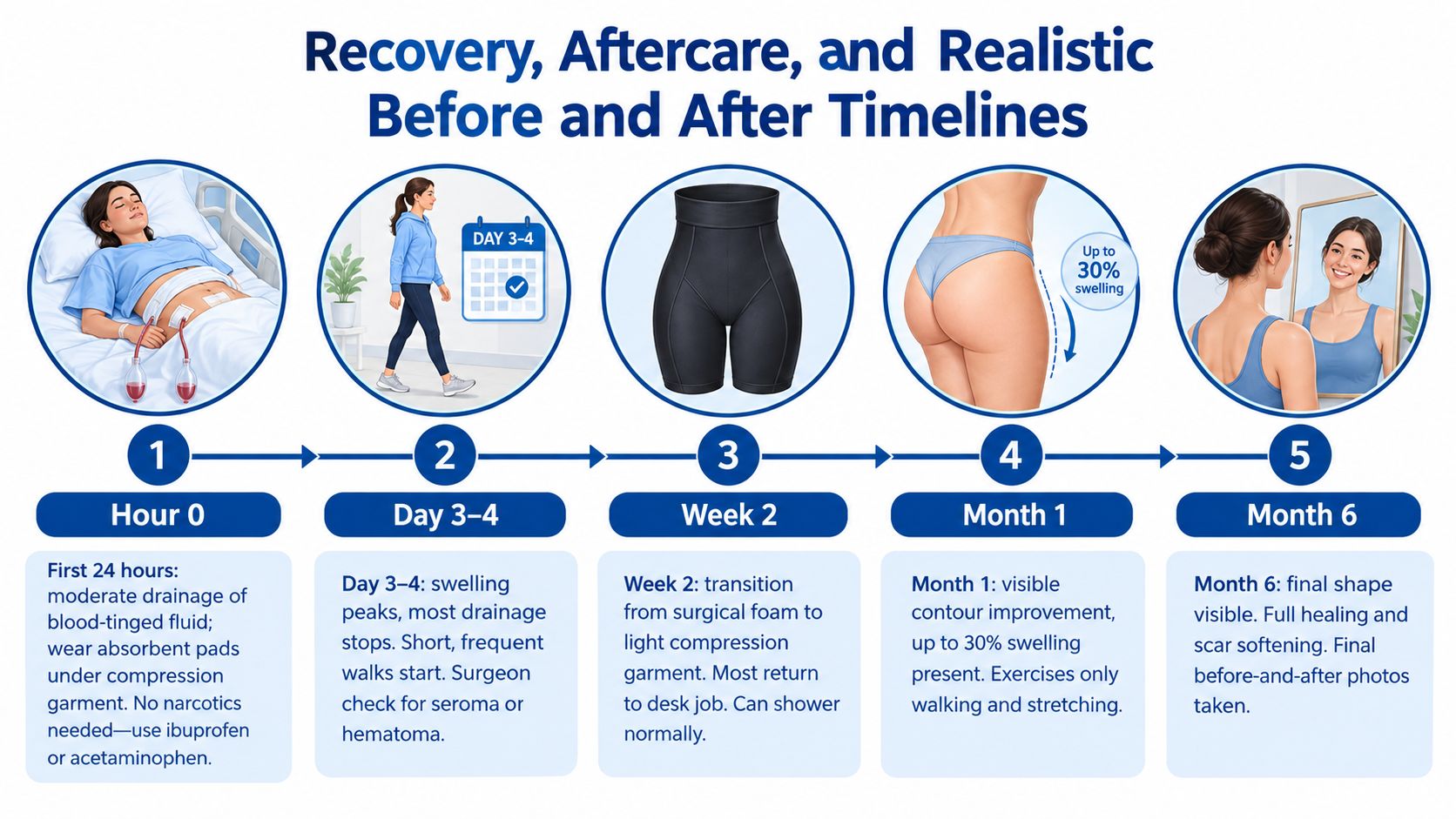
The process starts with marking while standing. That matters because gravity tells the truth. Projection, lower-pole fullness, lateral spillover, and asymmetry all look different when you're upright than when you're lying flat.
After that comes the numbing phase. Tumescent solution is placed into the treatment area, and the tissue becomes firm and swollen for a while. Patients typically feel pressure and fullness more than sharp pain. There's a pause while the anesthesia and vasoconstriction do their work.
The contouring phase
Fat is then removed through small access points with slim cannulas. The important part is not the cannula. It's the pattern of removal.
Reduction cases usually require selective debulking, edge feathering, and constant reassessment of nearby zones like the hips, sacral area, and upper posterior thighs. Uniform suction is a mistake in revision surgery. The buttock has to fit the frame around it.
Sometimes the smartest first session is intentionally incomplete. Staging becomes attractive when the skin envelope looks tight but vulnerable, when asymmetry needs conservative correction, or when removing too much in one sitting would create a flat or irregular result that's harder to fix later.
If a surgeon promises a dramatic reversal in one awake session without discussing staging, I'd question the plan.
The end of the case
Before the case is finished, symmetry checks matter. In awake revision work, those checks may include re-positioning and direct visual reassessment rather than blind faith that both sides were treated identically.
That's a real advantage of the awake setting. The patient is not a passive object under a sheet. The patient is part of a contouring process that can be checked in real time.
Alternatives Worth Comparing Before You Commit
Most patients ask the wrong question first. They ask, “Can I do this awake?” The better question is, “What exactly am I trying to fix?”
That shift changes everything. If the issue is residual volume, one path makes sense. If it's distorted shape, another path is better. If skin quality is the true problem, awake reduction alone may make the buttock look worse.
Match the treatment to the problem
| Problem to solve | Best alternative | When awake reduction is wrong tool |
|---|---|---|
| Diffuse excess volume with otherwise good skin | Revision liposuction | When the reduction goal is too aggressive for one awake session |
| Volume reduction with skin that may not recoil evenly | Staged fat removal | When pushing for a one-stage result would risk contour collapse |
| Projection imbalance rather than true excess | Fat redistribution or shape correction | When removing volume would flatten the buttock without restoring proportion |
| Distortion tied to prior implants or another augmentation method | Implant removal or exchange when indicated | When the implant, not fat alone, is driving the deformity |
| Significant laxity or hanging tissue | Skin-excision procedure, sometimes combined with contouring | When liposuction alone would worsen sagging |
| Scar-related contour deformity | Formal revision strategy based on scar planes | When simple suction would deepen grooves or asymmetry |
The common mistake
Patients and some practices treat a revision like a primary lipo case. That's the error.
A primary-procedure mindset says, “There's too much fullness. Remove fat.” A revision mindset asks, “Which part is too full, which part is unsupported, what will the skin do next, and what happens if we take more than the envelope can handle?” Those are not the same conversation.
One underserved issue in this space is whether awake BBL reduction is a distinct patient need or just a label pasted onto generic liposuction pages. Independent coverage remains thin. A 2025 study reported 123 patients undergoing BBL revision or buttock reduction between 2018 and 2023, and a 2026 industry report said demand for BBL reversal is growing and the category is becoming more recognized as a revision procedure (industry report on growing BBL reversal demand). I agree with the broader point. The trend worth paying attention to isn't just more enhancement. It's more correction.
If your surgeon can't clearly explain why your problem needs reduction, staging, reshaping, skin excision, or a different revision plan altogether, keep looking.
Choosing a Surgeon With Real Revision Experience
For awake BBL reduction, revision experience matters more than raw cosmetic volume. A surgeon can do a lot of primary body contouring and still have weak judgment in reduction work.
That's because revision surgery isn't about speed or routine. It's about reading altered tissue correctly, knowing when to stage, and resisting the temptation to over-treat asymmetry in one sitting.
What credentials actually matter
I'd focus on a short list:
- Double board certification in plastic surgery related disciplines. That tells you more than social media content ever will.
- Hospital privileges for body contouring procedures. Even if the surgery is office-based, privileges show outside review of training and judgment.
- A real revision caseload. Not just a before-and-after gallery full of primary enhancements.
- Comfort saying no to an awake approach when the case is too extensive.
At Ideal Face & Body, Dr. Justin Yovino and Dr. Sarah Yovino are part of a practice built around awake, office-based procedures under local anesthesia, including revision-focused body contouring. That doesn't mean every patient belongs in an awake plan. It means the setting is familiar when the case fits it.

Red flags I wouldn't ignore
A few warning signs show up repeatedly:
- Only primary BBL photos with no clear revision examples.
- Discount-style marketing that frames awake surgery as a bargain instead of a selection issue.
- No discussion of staging when the buttocks are obviously overfilled or the skin looks borderline.
- Vague answers about asymmetry planning, contour irregularities, or after-hours concerns.
- Defensiveness when you ask how often they perform awake reductions specifically.
A review of underserved questions around awake buttock reduction points out the unresolved issue: generic awake liposuction content often doesn't explain how pain, pressure, positioning, and contour accuracy change when the goal is reduction after a prior BBL. That same discussion notes a 2026 trend summary listing 27,059 BBL procedures, down 5% year over year, while revision demand is rising (discussion of awake BBL reduction and shifting revision demand).
Five questions worth asking in consultation
- How many awake BBL reductions do you perform in a typical year?
- What portion of your contouring practice is revision, not primary enhancement?
- If I'm asymmetric at three months, what's your plan?
- Do you rely on a staged approach when the skin envelope looks limited?
- Who answers after-hours concerns if swelling or contour changes worry me?
A candid “you're not the right awake candidate” is worth more than an easy yes.
Recovery, Aftercare, and Realistic Before and After Timelines
Recovery after awake BBL reduction is usually more manageable than patients fear, but it's still real surgery. You may avoid the fog of general anesthesia, but you do not avoid swelling, drainage, compression, and patience.
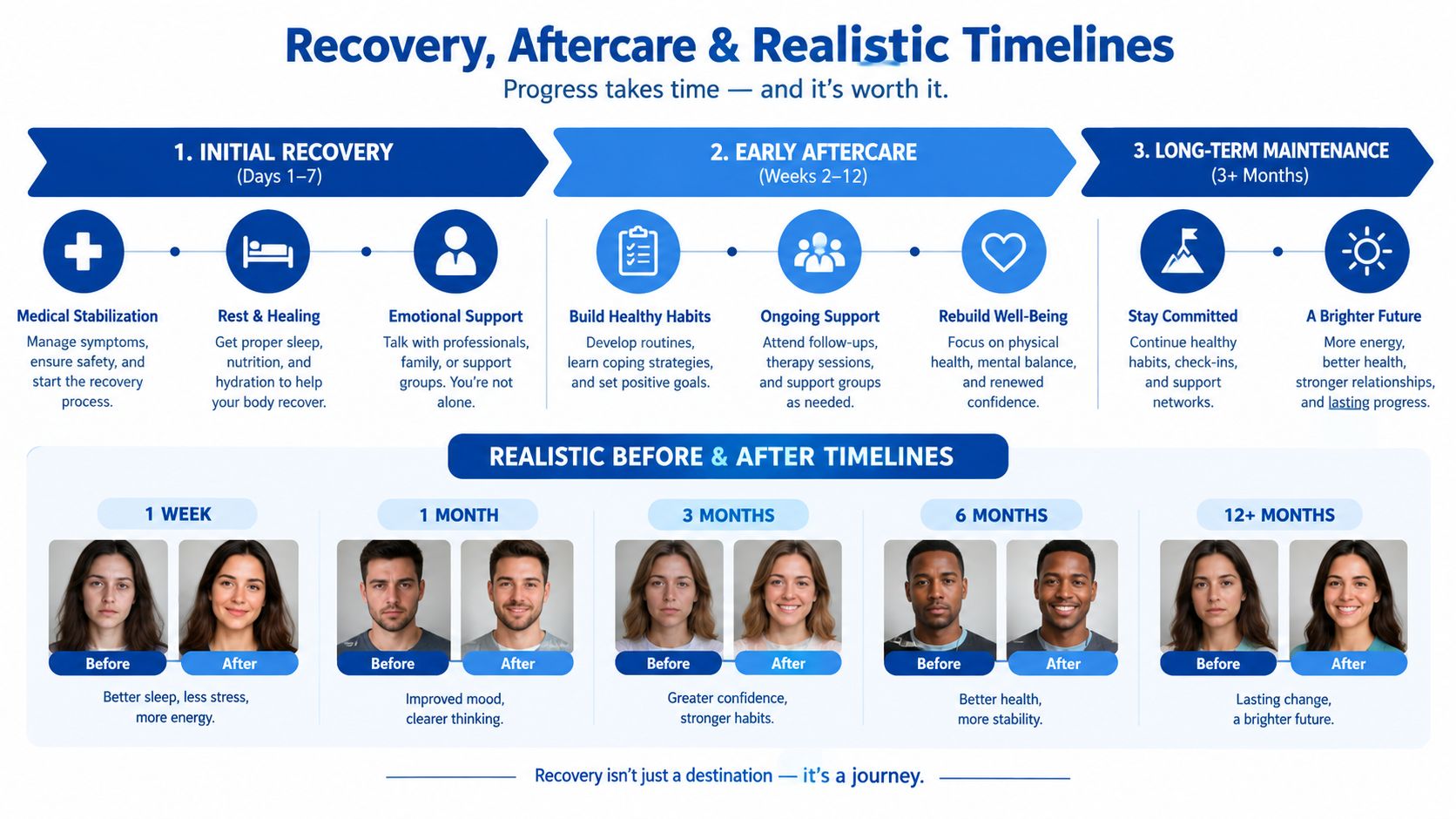
The first day often feels messy more than dramatic. Small incisions can drain blood-tinged fluid. The treated area feels sore, tight, and heavy. Most patients move carefully, not dramatically, and they usually tolerate that better than they expected.
The first few weeks
A simple way to understand it:
First 72 hours
Drainage gradually tapers. Swelling builds. Compression matters. Walking is light and frequent, not athletic.Week one
Bruising and firmness are common. The contour doesn't look final because retained fluid and tissue stiffness distort everything.Weeks two to three
Many patients are more mobile and more comfortable at desk work. This is also when they start overanalyzing asymmetry that often improves with time.Weeks four to six
Early shape changes become easier to read. Lower-body exercise may return gradually depending on the extent of treatment and the surgeon's plan.
When results actually make sense
Revision swelling can be deceptive. Early reduction may look uneven, under-corrected, or oddly flat in one area and still full in another. That doesn't automatically mean the contour is wrong. It means healing is not linear.
Awake surgery research outside buttock revision helps explain why recovery can feel lighter from an anesthesia standpoint. In a 2021 prospective observational study of awake breast surgery using thoracic paravertebral block, 50 patients were enrolled, 49 completed surgery awake, only 1 required conversion to general anesthesia, and none needed intraoperative or postoperative opioids (prospective study of awake breast surgery). Buttock reduction is different, but the pattern is familiar. When anesthesia burden is lower and the case is properly selected, recovery can be more straightforward.
For a broader sense of how fat-transfer patients are counseled through healing, buttock recovery after fat transfer gives useful context, even though reduction follows its own timeline and contour goals.
Same-day reasons to call
Call the office the same day if swelling suddenly becomes one-sided and tense, if pain sharply escalates instead of gradually easing, if drainage becomes alarming rather than expected, or if you develop a concern that feels out of proportion to what you were told to expect. Good aftercare isn't optional in revision work. It's part of the procedure.
Honest Answers to the Questions Awake Patients Actually Ask
The most honest question is usually the one patients delay the longest: “Am I picking awake because it fits me, or because it sounds less scary?” That's the right question.
If you're nervous about being conscious, that's normal. Patients usually worry they'll feel everything, hear every sound, panic halfway through, or move at the wrong moment. In reality, the experience is more controlled than people imagine, but only if the procedure is scaled correctly. A small-to-moderate revision in a calm patient is one thing. A long, emotionally loaded, extensive correction is another.
The unspoken concerns
Will I feel the cannula?
You may feel motion, pressure, tugging, and vibration. That's not the same as sharp pain. The awake part is sensory, not usually agonizing, when the numbing has been done properly and the case is a good fit.
What if I panic?
That possibility should be discussed before surgery, not during it. The answer isn't bravado. The answer is planning. Anxiety tolerance matters in awake surgery.
Will I look crooked at week three?
Possibly. Early asymmetry is common in revision healing because swelling is rarely balanced side to side. What matters is whether the shape is gradually settling or becoming more distorted.
Early unevenness is common. Progressive deformity is not.
Practical questions patients ask late in the consult
A companion is often part of the day even when the surgery is office-based, because feeling alert enough to stand up isn't the same as being ready to handle the entire rest of the day alone.
Driving, sitting, exercise, and intimacy all come down to soreness, drainage, swelling, and the exact scope of correction. These are not one-line answers. They should be designed for the areas treated and whether the surgery was deliberately staged.
A 2022 prospective study on awake breast conservative surgery defined awake surgery strictly as procedures done with local or regional anesthesia without mechanical ventilation, including peripheral nerve blocks, erector spinae blocks, and central neuraxial blocks. The study used that approach in part to help shorten surgical waiting lists during and after the COVID-19 emergency (prospective study defining awake surgery). That definition matters because it reinforces what awake really means. It's an anesthesia framework, not a promise that every body-contouring revision belongs in it.
The bottom line is simple. Awake BBL reduction can be a smart correction strategy. It is not the automatic modern choice, and it is not the brave choice. It's the right choice only when your anatomy, your goals, and your tolerance for an awake experience all line up.
If you're considering awake BBL reduction, Ideal Face & Body offers office-based evaluation for BBL reduction, correction, and revision under local anesthesia, with treatment planning centered on contour goals and candidacy rather than marketing labels. If you want a direct opinion about whether your case belongs in an awake setting, visit Ideal Face & Body.