
You may be staring at your chest in the mirror and thinking the same thing many patients think before they ever learn the name for it: the breasts don't just look small or uneven. The shape feels narrow, the lower part seems tight, the areolas may look puffy, and bras never sit quite right.
That pattern often points to tubular breasts, also called tuberous breasts. And if you're trying to understand how to fix tubular breasts, the most important thing to know is this: the answer usually isn't one single move. It's a shape problem first, not just a volume problem.
A calm, anatomy-first plan matters. At a practice like Ideal Face & Body in Beverly Hills, CA, Dr. Justin Yovino and Dr. Sarah Yovino focus on awake, office-based care under local anesthesia when appropriate, which gives patients a practical setting for discussing reshaping, lift options, and fat-transfer-based planning without treating every breast concern like a routine enlargement.
Table of Contents
- Understanding Tubular Breasts and Why Correction Is Individualized
- How Tubular Features Are Recognized and Classified
- Core Surgical Principles That Release and Reshape Tissue
- Choosing Your Volume and Lift Pathway With Durability in Mind
- What to Expect From Preparation Through Recovery and Results
- Planning Your Next Steps and Avoiding Common Pitfalls
Understanding Tubular Breasts and Why Correction Is Individualized
A patient might say, “My breasts look pointy, the nipples seem enlarged, and one side looks completely different from the other.” That description is common. What she's noticing is usually not just size. It's the way the breast developed.

Tubular breasts often have a constricted base, which means the breast footprint on the chest wall is tighter than expected. Instead of expanding smoothly during development, the lower part of the breast may stay short or underfilled. The skin envelope can also be tight. In some patients, breast tissue pushes forward into the areola, creating the familiar puffy areola look.
Why the shape feels so different
Patients researching this condition are trying to describe a few repeating features:
- A narrow breast base that makes the breast look pinched
- Lower-pole deficiency, meaning the bottom part of the breast looks short or empty
- Skin shortage in the lower breast, which limits roundness
- Areolar herniation, where tissue bulges into the areola
- Asymmetry, often with one side more affected than the other
These features don't always appear in the same combination. That's why correction has to be individualized.
A broad review noted that tuberous breast deformity was first formally described in 1976, and that authors have since proposed as many as 7 classification systems. That same review analyzed 38 studies including 897 patients, found an overall complication rate of 20%, and noted that true population incidence remains unknown. It also stated that breast asymmetry is seen in up to 88% of women seeking breast augmentation and/or reduction, which helps explain why recognizing this deformity matters in cosmetic breast surgery practice (systematic review on classification, incidence limits, and complications).
Practical rule: Tubular breasts aren't defined by cup size. They're defined by how the breast base, lower pole, skin, and areola formed.
Why “just make them bigger” misses the point
A fuller breast can still look tubular if the constricted base isn't released and the lower pole isn't reshaped. That's why consultation usually centers on shape, symmetry, tissue tightness, and skin behavior, not only on how much larger someone wants to be.
In plain terms, surgeons don't just ask, “How much volume do you want?” They ask questions like these:
- Where is the breast tightest
- How much lower-pole skin is available
- How different are the two sides
- Does the areola need reshaping
- Will one operation likely be enough, or is a staged plan more realistic
If you've been reading general breast augmentation content, it helps to separate routine enlargement from shape correction. This overview of who may be a candidate for breast augmentation shows why candidacy conversations often start broadly, but tubular breast planning has to go much deeper into anatomy.
How Tubular Features Are Recognized and Classified
A common consultation starts like this. A patient says, “My breasts are not just small. The bottom looks tight, the areola looks puffy, and one side seems shaped differently.” That description often points to a shape problem, not a volume problem.
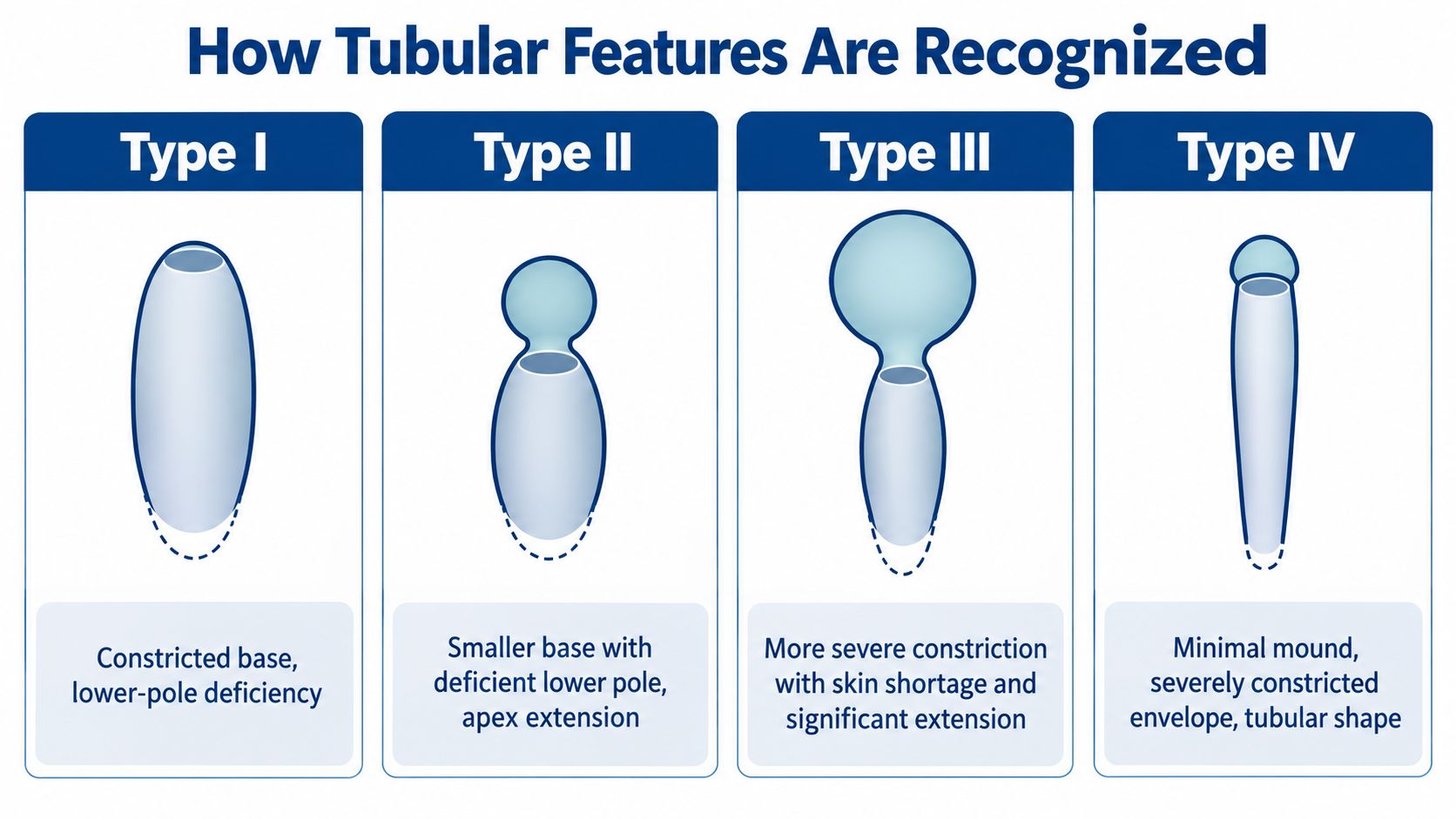
Surgeons recognize tubular features by looking at how the breast was built in three dimensions. The key question is not only how much breast tissue is present. The key question is where the tissue is restricted, where skin is lacking, and how much of the lower breast can expand.
That distinction matters because classification is not just labeling. It helps predict whether correction will hold up with one operation or whether a staged plan may produce a more stable shape. A tight lower pole that is not released enough can leave the breast looking pinched. A breast that is filled aggressively before the tissue is properly reshaped can look round on top but still tight at the bottom.
The visual clues surgeons look for
A surgeon usually looks for a pattern of findings that travel together:
- Base constriction. The breast footprint is narrow on the chest, almost like the base of the breast did not spread outward during development.
- Lower-pole hypoplasia. The lower part of the breast is short, tight, or underfilled, so the breast does not drape into a natural lower curve.
- Areolar enlargement or herniation. Tissue pushes forward through the areola, which can create a puffy or protruding appearance.
- Asymmetry. One side may be tighter, wider, larger, or lower than the other, which often means each breast needs a slightly different correction.
A helpful way to picture it is to compare the breast to a structure sitting on a base. If the base is narrow and the lower covering is tight, adding more contents does not reliably create a natural outline. It can increase pressure in the wrong place. That is why recognition focuses so heavily on the base, lower pole, skin envelope, and areola.
The four von Heimburg types
One commonly used system is the von Heimburg classification, which divides tuberous breast deformity into four types (review discussing von Heimburg types and Northwood index).
| Type | Plain-language meaning |
|---|---|
| Type I | Hypoplasia of the lower medial quadrant |
| Type II | Type I plus sufficient subareolar skin |
| Type III | Type I with insufficient subareolar skin |
| Type IV | Severe breast constriction with a minimal breast base |
The names sound technical, but the practical use is straightforward. Higher-severity patterns usually mean more lower-pole restriction, less available skin, and a greater need for careful release and internal reshaping.
Classification also helps avoid two common mistakes. One is under-release, where the tight ring of tissue is not opened enough and the lower pole stays short after surgery. The other is over-filling, where volume is used to force shape instead of building shape first and then choosing volume that the tissue can support.
The Northwood index
Some surgeons also use the Northwood index as an objective measurement. In plain language, it is one way to quantify how much the breast shape fits a tuberous pattern rather than relying on appearance alone.
Patients do not need to memorize measurement thresholds. What matters is why measurements are taken in the first place. They turn a vague concern, such as “the bottom looks off,” into a plan based on lower-pole length, base width, skin availability, and side-to-side differences.
For a consultation, these observations are useful to bring up:
- Does one breast look tighter or shorter at the bottom?
- Do the areolas look stretched, puffy, or more projected than expected?
- Does the breast project forward without rounding out below?
- Do the two sides seem built differently, not just different in size?
Those details help classify the deformity, but they also do something more important. They help set the strategy. Durable correction usually depends on matching the amount of release, reshaping, and volume to the anatomy that is there.
Core Surgical Principles That Release and Reshape Tissue
Most successful correction plans start with one idea: the tight shape has to be released before the breast can be properly reshaped. If that doesn't happen, added volume alone can exaggerate the deformity instead of correcting it.
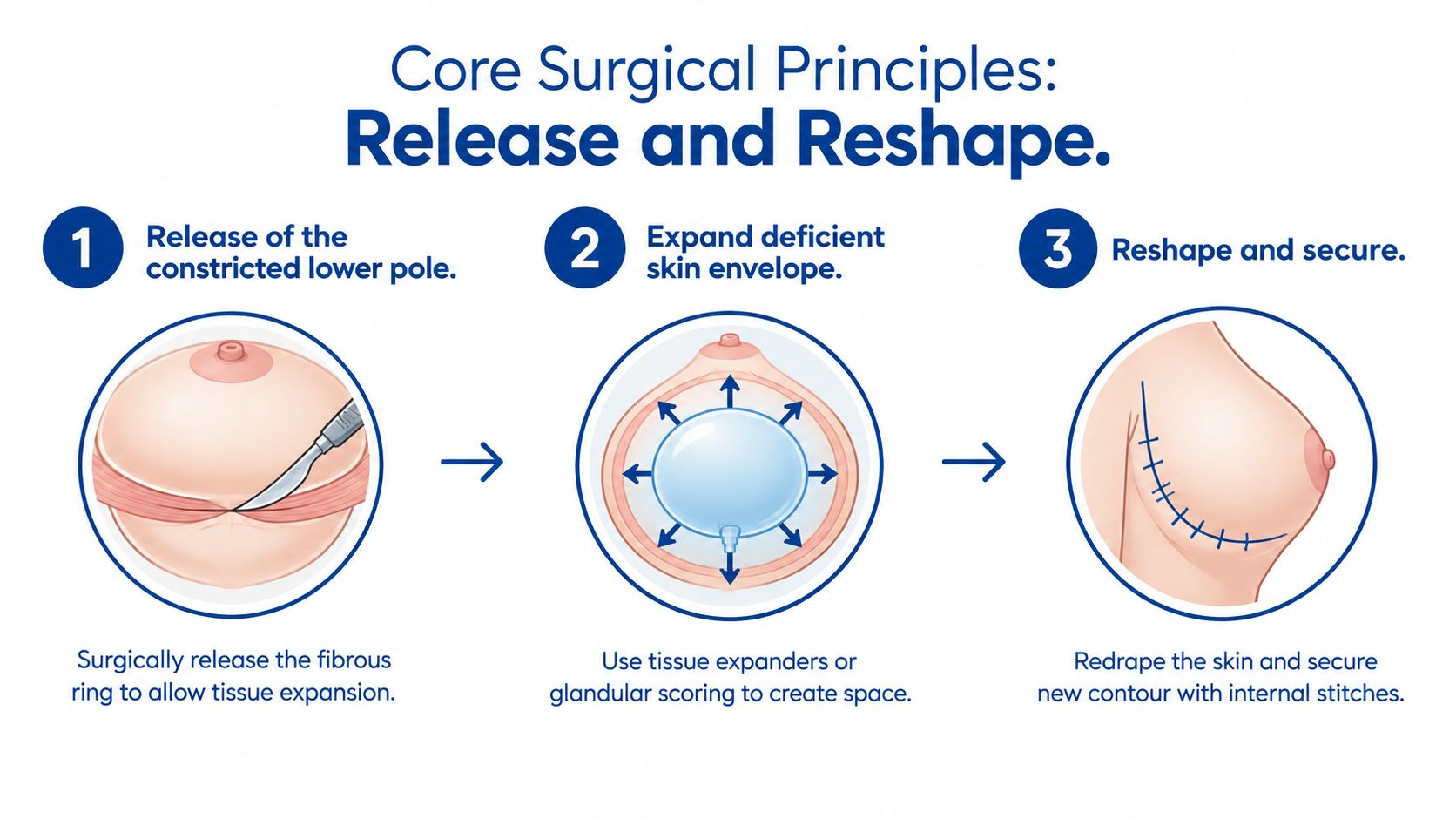
Release comes first
The lower pole is often restricted by a tight internal ring or band of tissue. Surgeons commonly address that with glandular release or scoring, which means carefully weakening the constriction so the lower breast can expand into a more natural curve.
Under-release is one of the easiest ways to get an incomplete result. If the tight lower pole isn't opened enough, the breast may still look pinched after surgery, even if volume has been added.
A 2023 systematic review of tuberous and tubular breast surgery found an overall complication rate of 20%, with 99% subjective patient satisfaction and a mean BREAST-Q satisfaction with clinical outcome of 86.7. The review supports a stepwise approach that typically combines glandular release or scoring, parenchymal reshaping, areolar reduction, and either implant-based volume restoration or autologous fat transfer depending on tissue deficiency and patient goals. It also highlights common pitfalls such as aesthetic dissatisfaction, contour irregularity, and the need for secondary refinement, especially because the lower pole is often constricted and asymmetrical (systematic review on stepwise correction and satisfaction).
Reshaping is not the same as filling
Once the breast is released, the next issue is where the existing tissue sits. Surgeons often reshape the breast tissue itself, sometimes called parenchymal reshaping, so volume that was concentrated high or centrally can help support the lower breast contour.
That may include:
- Redistributing glandular tissue so the lower pole fills out better
- Expanding the deficient base so the breast footprint looks less narrow
- Reducing or controlling the areola if herniation is part of the deformity
- Internal suturing to help maintain the new contour
This is the part patients often don't realize. Tubular breast correction is usually a reconstruction of shape mechanics, not just a size adjustment.
If the breast is tight below and puffy at the areola, the surgeon has to solve both problems. Filling one area while ignoring the other rarely creates a balanced result.
Why combination plans are standard
Surgical reviews consistently describe tuberous correction as a multistep process. Common elements include releasing the constricted lower pole, expanding the deficient base, and adding volume with fat grafting or implants. Some reviews explicitly state that fat grafting and implants are the two main volume options and are often combined for best results, because the anatomy can involve skin deficiency, areolar herniation, and lower-pole underdevelopment at the same time (review of combined correction mechanics).
At Ideal Face & Body, one practical pathway discussed for selected patients is awake breast reshaping with lift-based tissue rearrangement and fat-transfer planning under local anesthesia, rather than treating tubular anatomy as a one-size-fits-all enlargement problem.
Avoiding the two technical mistakes patients should understand
Patients don't need to know operative details, but they should understand the two planning errors that often drive disappointment.
Under-release
The breast stays constricted at the bottom. The shape remains narrow or develops a persistent indentation.Over-filling
Too much volume is used to force a shape the tissues weren't fully prepared to accept. That can create contour irregularity, heaviness, or an unnatural lower-pole look.
If you like reading broader perioperative education, some patients also find surgery health insights helpful for understanding recovery habits, tissue healing, and how procedure planning affects long-term outcomes.
Choosing Your Volume and Lift Pathway With Durability in Mind
This is usually the question underneath every consultation: what's most likely to look natural and avoid repeat surgery, while still correcting the shape?
That's the right question. For tubular breasts, the decision often isn't “Which operation fixes it?” It's which pathway matches your priorities around durability, natural feel, visible lift, and willingness to stage treatment.
The trade-off most patients care about
Some approaches create more immediate change in one operation. Others take more than one session but may offer a softer contour and lower long-term revision burden.
Long-term literature supports that distinction. A 2024 follow-up study reported that within 5 years, 46% of implant-based patients required reoperation versus 21% in the lipofilling group, and all major complications occurred in the implant group. Earlier long-term review data similarly found reoperation in 62.3% of implant-based breasts versus 28.6% of autologous cases, while a 7-year retrospective algorithm reported that autologous reconstruction averaged 2.9 procedures to reach the target result versus 1.3 procedures for alloplastic augmentation. The practical benchmark is that implants may achieve faster one-stage volume correction, but autologous or staged fat-grafting pathways tend to trade more procedures upfront for lower late revision burden and a more natural contour (long-term comparison of implant-based and autologous pathways).
That durability-versus-staging framework is often more useful than arguing over a single “best” operation.
Volume and Lift Pathways Compared for Tubular Breast Correction
| Pathway | Best For | Staging and Durability Notes |
|---|---|---|
| Lift and reshaping without added volume | Patients whose main problem is constriction, areolar shape, or breast position rather than wanting larger breasts | Depends heavily on existing tissue. Strong shape correction may be possible, but limited native volume means fullness gains are modest. |
| Autologous fat transfer with reshaping | Patients who want a more natural feel and want to avoid prosthetic material | Often staged because graft take is partial and tissue capacity is limited. The literature describes lower long-term reoperation burden than implant-based pathways, but more sessions may be needed upfront. |
| Lift plus fat transfer | Patients who need both skin/tissue reshaping and selective volume restoration | Useful when the breast needs release and contour support in specific zones, especially the lower pole. Healing and final contour often evolve gradually. |
| More heavily volume-driven correction | Patients prioritizing a faster visible size change | Historically can provide quicker one-stage fullness, but long-term studies report higher reoperation burden than autologous strategies. |
What fat transfer can and can't do
A 2025 narrative review found 66 papers, with 23 meeting inclusion criteria, and reported typical 6 to 12 month graft survival of 60% to 70%. It also noted that multiple sessions are often needed because of partial fat resorption and limited tissue capacity. A 2022 comparative study found that after two fat-grafting procedures, 77% of patients achieved excellent results, and satisfaction and naturalness were higher than with mastopexy plus silicone implants, though the implant group produced more immediate visible change after one procedure (review of fat grafting trends and comparative outcomes).
That's why fat transfer appeals to many tubular breast patients. It can soften a pinched contour and avoid prosthetic material. But it usually requires patience.
A separate review comparing correction strategies also found that after two fat-grafting procedures, 77% of patients had excellent results at 1 year. In the same comparison, one mastopexy-plus-implant group had 73% excellent results, while the fat-grafting group reported higher naturalness and satisfaction, with a statistically significant difference favoring fat grafting (comparison of fat grafting and mastopexy-plus-implant outcomes).
How to think about your own decision
If you're trying to decide how to fix tubular breasts, these questions usually clarify the path:
- Do you care most about avoiding prosthetic material?
- Do you want the softest, most natural feel possible?
- Would you rather accept staged treatment to reduce later revision burden?
- Is visible lift more important than added volume?
- Are you comfortable with shape improvement that settles gradually rather than instantly?
Patients considering fat transfer often want a realistic sense of how results hold over time. This discussion of what to expect from breast fat transfer and how lasting it may be is useful because it frames durability in the same practical way tubular breast correction should be framed.
What to Expect From Preparation Through Recovery and Results
Once the plan is clear, most patients want to know what daily life around the procedure looks like. That's a good shift in focus. Better preparation usually leads to a smoother recovery and better decision-making.
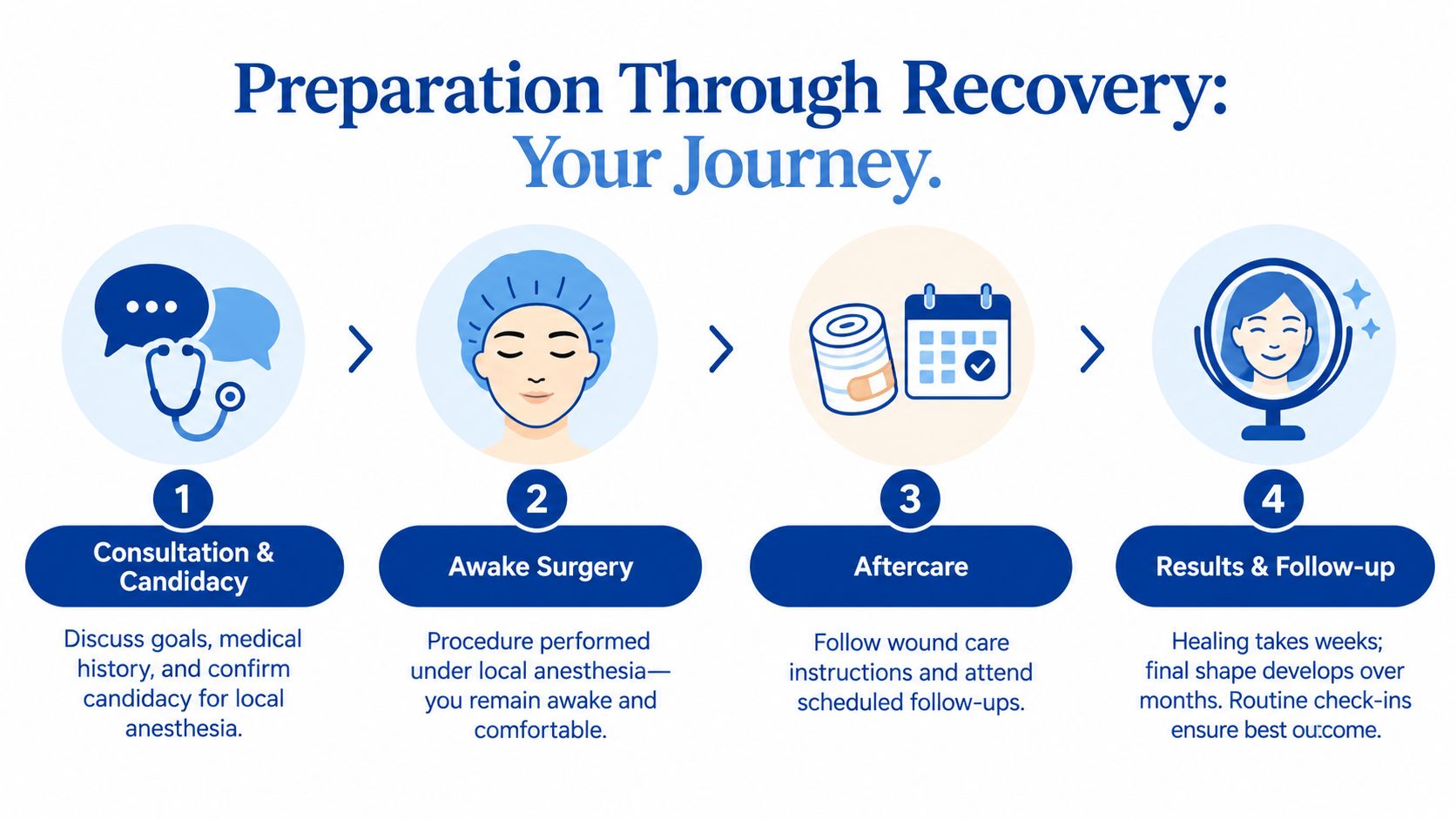
Before surgery
The consultation is where the anatomy is translated into a surgical map. The surgeon evaluates breast base width, lower-pole tightness, areolar position, skin quality, and asymmetry. Just as important, the patient and surgeon define the endpoint. Is the priority better roundness, smaller areolas, more balance, more lift, or more upper fullness?
At a practice focused on awake procedures, candidacy for local-anesthesia surgery is also part of planning. Not every patient or every correction pattern is handled the same way, so selection matters.
A practical preparation checklist usually includes:
- Medication review so the surgical team knows what may affect bleeding or healing
- Recovery planning for support garments, rides, time away from strenuous activity, and home setup
- Goal alignment so “natural,” “lifted,” or “fuller” mean the same thing to both patient and surgeon
- Photo review to identify asymmetries that patients may not have noticed from every angle
The day of surgery and early recovery
Awake surgery under local anesthesia can be a good fit for selected breast reshaping procedures, especially for patients who prefer an office-based setting and want to avoid general anesthesia when appropriate. During the early recovery phase, swelling, tightness, and shape irregularity aren't unusual. Freshly reshaped tissue almost never looks settled right away.
Early results can look uneven before they look refined. That doesn't automatically mean something is wrong. It often means healing is still in progress.
The key in the first phase is consistency. Follow incision care instructions, wear recommended support, protect the breasts from pressure, and keep follow-up visits.
What results typically require patience
Tubular breast correction often improves in layers. The immediate postoperative shape may already show a better lower-pole contour or a less puffy areola, but refinement takes time. Tissue relaxation, scar maturation, and settling all influence the final look.
Patients should be prepared for a few normal realities:
- Asymmetry may improve before it disappears
- Contour edges may soften gradually
- The lower pole may look firm before it rounds out
- A staged plan may still require later refinement
Longer-term series show why that conversation matters. A 2017 long-term outcomes study of 88 treated breasts reported that 57 underwent implant-based correction and 31 underwent autologous procedures. 41 breasts required secondary procedures, with reoperation needed in 62.3% of implant-based cases versus 28.6% of autologous cases. A later 12-year experience series of 208 patients and 414 breasts treated from 2005 to 2017 reported a global complication rate of 8.9%, including 1.4% capsular contracture, 1.5% postoperative malposition, 2% double-bubble deformity, 2% rippling, and 2% areola or nipple sensitivity disorders (long-term outcomes and complication patterns in tuberous breast correction).
Those numbers don't mean patients should expect a bad result. They mean refinement planning should be honest from the start.
If you want a more practical overview of healing milestones, support garments, and follow-up habits, this guide to recovery from breast lift and augmentation gives a useful framework, even though tubular correction has its own shape-specific details.
Planning Your Next Steps and Avoiding Common Pitfalls
A good consultation for tubular breasts should leave you with a clearer understanding of anatomy, not just a procedure name. If you walk away only knowing that the breasts will be “made fuller,” you probably still don't have the whole plan.
The most useful way to think about how to fix tubular breasts is to match the problem to the mechanics:
- A constricted base needs release
- A short lower pole needs reshaping
- A puffy areola may need reduction or control
- A skin shortage may limit what can be done in one stage
- A desire for natural softness may point toward staged autologous volume restoration
Common mistakes patients can avoid
Some disappointments begin before surgery ever starts. They come from choosing the wrong framework.
Expecting one maneuver to solve everything
Tubular correction usually isn't a single-technique operation.Focusing only on size
If shape mechanics are ignored, more volume can still leave an unnatural contour.Underestimating asymmetry
The right and left sides often need different adjustments.Assuming natural-looking correction is always one-and-done
Fat transfer can be an excellent option, but staged treatment is often part of the trade-off.
The best plan usually sounds more tailored than dramatic. It explains what must be released, what must be reshaped, and what may need time.
A short consultation checklist
Bring these questions with you when meeting Dr. Justin Yovino and Dr. Sarah Yovino in Beverly Hills, CA:
- What features make my breasts tubular rather than small or asymmetric?
- How much of my correction depends on release and reshaping versus volume?
- Would a lift-based plan address most of my issue, or do I need staged fat transfer for contour support?
- What signs suggest my case may need refinement later?
- Which result matters most in my anatomy: more roundness, better balance, less areolar prominence, or more fullness?
If you use that framework, the decision gets simpler. You're no longer chasing a label or a trendy method. You're choosing the pathway that best fits your tissue, your goals, and your tolerance for staging versus revision risk.
If you're exploring correction for tubular breasts, Ideal Face & Body offers awake, office-based breast reshaping, breast lift, reduction, and fat-transfer options under local anesthesia when appropriate. Dr. Justin Yovino and Dr. Sarah Yovino take an anatomy-first approach that fits this condition well, especially when shape, asymmetry, and natural contour matter more than a one-size-fits-all plan. To learn more or request a consultation, visit Ideal Face & Body.