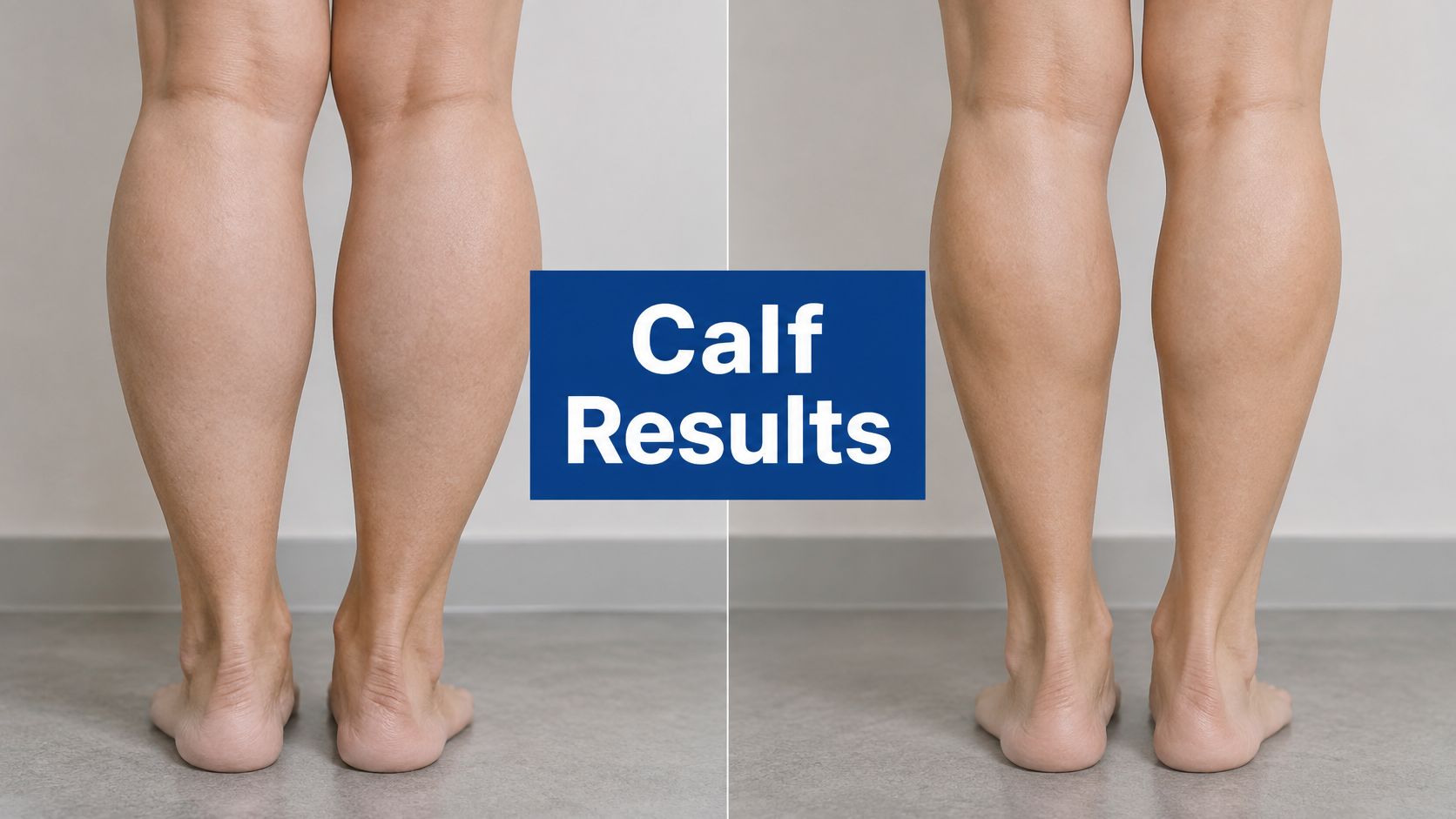
You've been scrolling through calf liposuction before and after photos, stopping at legs that look leaner through the ankle and more defined below the knee. Then you look at your own calves and wonder whether removing fat would create that shape, or whether your legs are built differently. That's the right question to bring to a consultation, because a photograph can show a result without explaining whether that result is possible for you.
Table of Contents
- Why Calf Before and After Photos Are Misleading
- What Makes the Calf Different From the Abdomen
- Real Calf Liposuction Before and After Cases
- How PRECISION SCULPT Awake Calf Liposuction Works
- Who Is a Good Candidate for Calf Liposuction
- Recovery Timeline and How to Read Stage Photos
- Why More Aggressive Fat Removal Is Not Better
- Questions to Ask Before Booking a Calf Consultation
Why Calf Before and After Photos Are Misleading
A polished gallery pairs a starting photograph with a healed result. What you don't see is the assessment that determined candidacy, the treatment boundaries, or the recovery between those images. Without that context, it's easy to mistake another patient's outcome for a prediction of your own.
Consider a photograph showing a more tapered lower leg. Was that change produced by calf treatment alone, or did the surgeon also contour the ankle and medial knee? Published lower-leg research includes combined treatment, so the visible difference can't automatically be credited to calf fat removal alone.
Questions that make a photograph useful
Ask for the details that allow a fair comparison:
- Postoperative timing: How many weeks or months had passed when the after photograph was taken?
- Treatment boundaries: Were the ankles or medial knees treated as well?
- Leg position: Was the patient relaxed, flexing, or shifting weight differently?
- Photography setup: Were lighting, camera distance, and viewing angle standardized?
A flexed calf and a relaxed calf aren't interchangeable reference points. Neither are a brightly lit front view and a side-lit image that emphasizes muscle definition. These differences don't necessarily make a gallery dishonest, but they make interpretation less reliable.
Practical rule: Use a gallery to understand what the surgeon changed, not to choose someone else's legs.
The most informative comparison combines photographs with consistent circumference measurements and an explanation of the starting anatomy. The broader guide to interpreting liposuction before-and-after results provides a useful framework for evaluating those records.
Bring photographs you like, but describe the feature that attracts you. A smoother ankle transition is a more useful discussion point than asking for an exact copy of another patient's silhouette.
What Makes the Calf Different From the Abdomen
Think of the lower leg as a layered structure. Bone and the gastrocnemius and soleus muscles establish the underlying shape. Subcutaneous fat covers that foundation, and skin forms the outer envelope.
Liposuction addresses the fat layer, not the foundation beneath it. That distinction explains why equally full-looking calves may respond very differently: one may contain a removable fat layer, while another owes most of its size to muscle or skeletal structure.
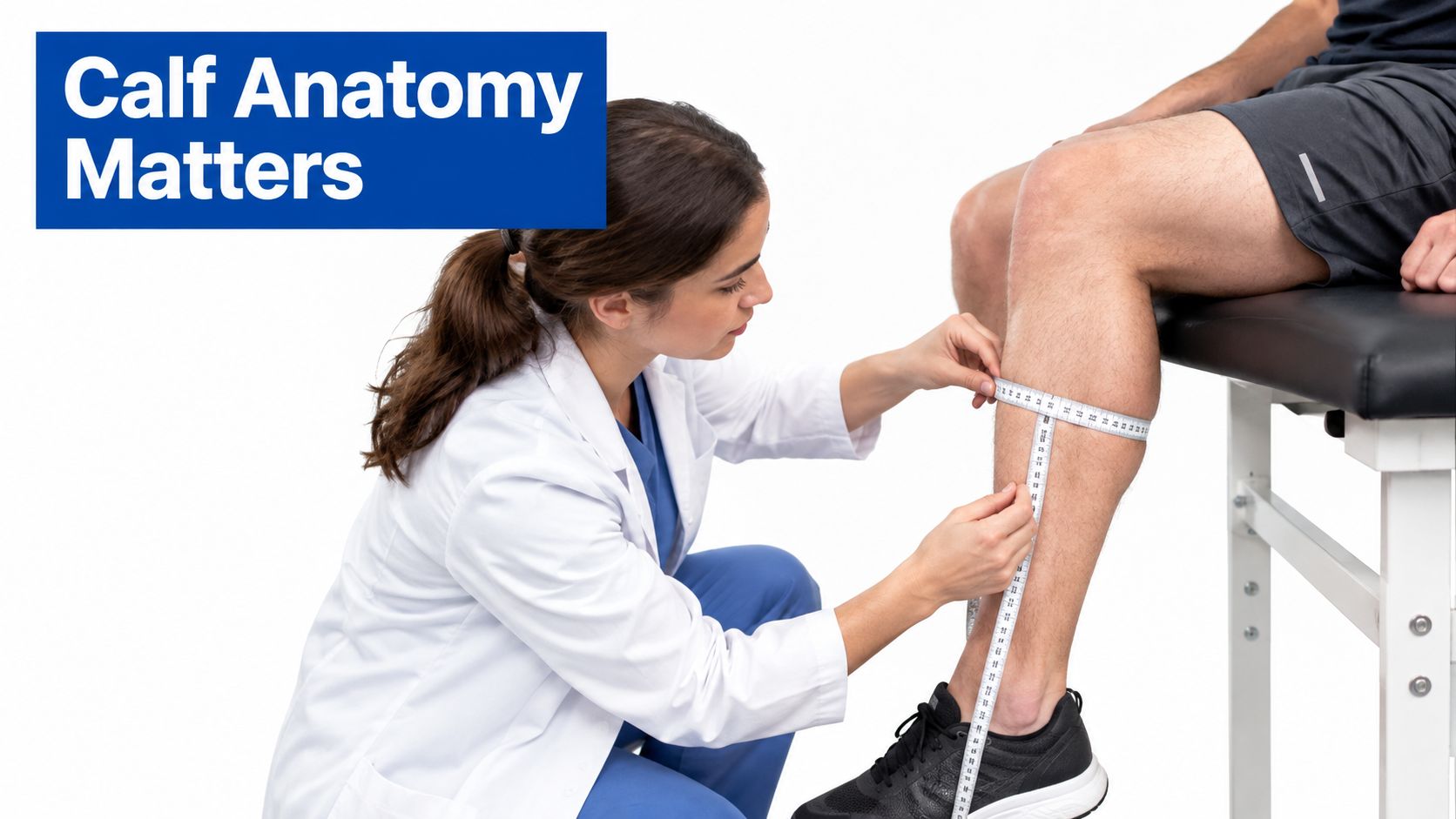
Why the available fat layer matters
The calf has less room for aggressive contouring than many trunk areas. The surgeon must preserve enough soft-tissue coverage to avoid exposing an uneven underlying contour.
Published planning benchmarks include pinch-test measurements of approximately 1.5–2.0 cm at the calf and 1.0–1.5 cm at the ankle, but these are reference points, not automatic clearance for surgery, as discussed in a report addressing lower-leg overcorrection and patient selection.
A meaningful examination therefore considers more than the thickest pinch:
- Distribution: Is the excess concentrated in particular zones, or is the entire leg broadly shaped?
- Underlying anatomy: How much of the visible prominence remains attributable to muscle and bone?
- Skin envelope: Will removing fat produce an appropriate contour within the existing skin?
- Soft-tissue reserve: Where must fat remain to maintain a smooth surface?
The surgeon should assess the leg as a connected shape rather than treating every visible prominence as something to remove. A fuller muscle belly can be normal anatomy, not an untreated pocket.
This is also why circumference alone is an incomplete target. A smaller measurement isn't automatically a better result if the surface becomes uneven. The useful question is whether the removable layer can be reduced while preserving a natural-looking covering over the underlying structures.
Real Calf Liposuction Before and After Cases
Published studies provide real outcome benchmarks, but they don't justify inventing an individual patient's transformation. The following patterns describe how to interpret treatment categories represented in lower-leg cohorts, not undocumented personal case histories.
Reading different treatment patterns
A fat-dominant calf: Look for refinement where examination identified subcutaneous fullness. A persuasive after image shows a smoother outline without suggesting that the underlying muscle was reduced. Without paired measurements, don't infer a particular circumference change.
Combined calf-and-ankle treatment: Evaluate the transition between those areas rather than focusing only on the widest calf point. The overall leg may appear more tapered because the surgeon addressed adjacent fat deposits.
Treatment including the medial knee: Look at the relationship between the knee and lower leg. That broader treatment field can change perceived proportions, so it shouldn't be compared directly with an isolated calf procedure.
Calf Liposuction Outcome Benchmarks From Published Studies
| Cohort | Patients | Avg Aspirate per Leg | Operative Time | Complication Rate | Follow-up |
|---|---|---|---|---|---|
| 2024 dry liposculpture series | 70 | Not reported separately; 1,395 ± 645 cc from both legs combined | Mean 98 minutes | Minor bruising in 21 patients, 30%; no major complications reported | Bruising resolved over several weeks; a mean follow-up interval isn't specified in these benchmarks |
| 2021–2025 combined-technique lower-leg series | 30 | 793 ± 418 mL | Mean 115 ± 33 minutes, including concurrent procedures | Three patients experienced complications | Mean 4.2 ± 4.3 months |
The volume units and treatment fields matter. A combined-leg aspirate must not be presented as a per-leg amount, and an operative time that includes concurrent procedures isn't an isolated calf-surgery estimate.
Aspirate also contains fat, fluid, and blood. It isn't interchangeable with a reduction in leg circumference, and the table doesn't establish a volume target for your procedure.
The combined-technique cohort reported hyperpigmentation, scar thickening, and a pressure injury complicated by cellulitis and prolonged edema. The absence of major complications in the dry-technique cohort doesn't establish that every method or patient carries the same risk.
These studies support the possibility of measurable contour change. They don't support a universal promise about how slim your calves will become.
How PRECISION SCULPT Awake Calf Liposuction Works
PRECISION SCULPT is an awake, laser-liposculpting approach performed in an office-based setting under local anesthesia. The practical distinction is that the treatment area is numbed while the patient remains awake, rather than routinely using general anesthesia.
That's an anesthesia and treatment-setting difference, not permission to treat more aggressively. The same anatomical limits apply whether a patient is awake or asleep.
From treatment mapping to controlled removal
Planning starts with identifying the fat that can reasonably be treated and the zones that need preservation. The proposed boundaries should be clear before treatment, including whether the ankle is part of the plan.
- Local anesthetic infiltration: Tumescent fluid is introduced into the subcutaneous treatment layer. The dilute anesthetic numbs the area, while epinephrine supports vasoconstriction.
- Laser-assisted treatment: The laser component distinguishes this approach from suction-assisted liposuction that doesn't use laser energy.
- Cannula contouring: Targeted removal follows the planned contour rather than a predetermined extraction volume.
- Aftercare planning: Compression, activity guidance, and follow-up remain part of the surgical process.
The PRECISION liposculpting overview explains the practice's approach. For an individual calf procedure, ask the surgeon to specify which instruments and treatment stages are proposed rather than assuming every branded treatment follows an identical sequence.
Awake doesn't mean recovery-free
Traditional liposuction isn't synonymous with hospital-based general anesthesia. Liposuction can use different anesthesia arrangements; the relevant comparison is the actual plan offered to you.
An awake procedure also shouldn't be presented as universally safer, painless, or free of downtime. Patient selection, monitoring, conservative technique, and access to postoperative assessment still matter.
For an office-based procedure in Beverly Hills' Golden Triangle, discuss practical arrangements before choosing a date. Confirm transportation requirements, where you'll recover, how concerns are handled after hours, and which follow-up visits require an in-person examination. A convenient location is useful only when the recovery plan is equally clear.
Who Is a Good Candidate for Calf Liposuction
A good candidate has a treatable anatomical problem and an acceptable medical risk profile. Wanting smaller calves is understandable, but it doesn't establish that fat removal is the appropriate solution.
The most useful consultation separates what creates the fullness from what the patient wants changed. When those match, the proposed benefit is easier to define. When they don't, declining surgery may be the sounder recommendation.
Favorable starting points
A reasonable candidacy discussion considers:
- Localized, pinchable fat: The surgeon can identify a subcutaneous layer that corresponds to the contour concern.
- Realistic goals: You'd accept refinement without expecting a different skeletal or muscular shape.
- Stable weight: The plan isn't being used as a substitute for an overall weight-management strategy.
- Recovery readiness: You can follow postoperative instructions and attend assessments rather than judging progress from photographs alone.
The pinch-test benchmarks discussed earlier are only part of that assessment. A measurement taken at a favorable spot doesn't establish that the entire calf can be treated similarly.
Reasons to investigate before proceeding
Published calf-specific discussion cautions against treatment in patients with chronic edema, severe varicosities, circulatory insufficiency, or previous thrombotic events, as outlined in the report on undesirable calf and ankle liposuction outcomes.
Persistent swelling needs an explanation, not an assumption that it represents cosmetic fat. The same applies when enlargement may reflect venous or lymphatic disease.
A responsible consultation can end with a recommendation not to operate.
That isn't a failure to offer a solution. It's recognition that a cosmetic procedure must address the actual source of the concern.
If the examination suggests muscle-dominant fullness, ask the surgeon to explain the limited change available from the fat layer. If fluid-related enlargement is suspected, the priority is appropriate medical evaluation rather than booking contouring on the strength of a gallery image.
Recovery Timeline and How to Read Stage Photos
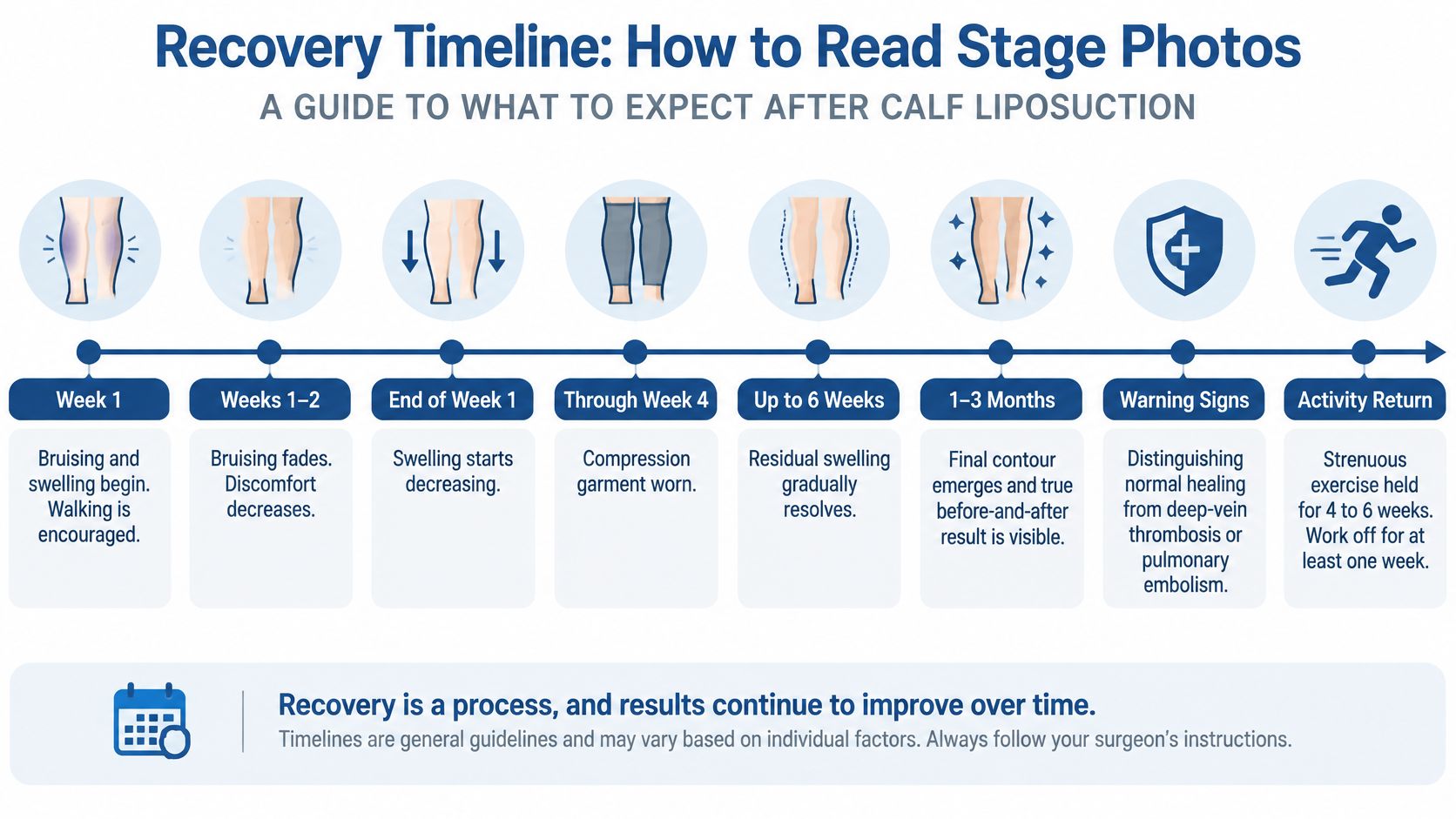
Recovery photographs are useful only when they're dated. An early image documents healing, while a later image helps assess the eventual contour. Neither should be interpreted without knowing what symptoms and swelling were present.
The general liposuction milestones below provide a planning framework, not a calf-specific deadline. Your surgeon's instructions take precedence when healing differs from that framework.
What the dated images can show
The American Society of Plastic Surgeons describes expected bruising, redness, discomfort, and swelling; swelling commonly starts decreasing by the end of the first week, residual swelling may persist for six weeks, compression may be recommended through approximately week four, and results may become apparent between one and three months, according to its liposuction recovery guidance.
Read those stages differently:
- Early recovery: Assess wound healing and the overall postoperative course, not whether the calf already matches the planned shape.
- While wearing compression: Ask whether differences between the legs reflect swelling or require examination.
- After substantial settling: Compare standardized views, surface quality, and measurements rather than relying on a single flattering angle.
General liposuction guidance describes bruising commonly resolving within one to two weeks and identifies calf pain or leg swelling as possible deep-vein thrombosis symptoms, while shortness of breath or tachycardia can indicate pulmonary embolism, in the clinical liposuction overview.
Function matters as much as photographs
Plan for at least one week away from work and potentially four to six weeks before strenuous exercise, based on ASPS guidance about liposuction recovery expectations. Discuss clinician-directed early walking separately from exercise clearance.
The awake liposuction recovery guide can help you prepare questions about activity, compression, and follow-up.
Don't diagnose a complication from a photograph. New or worsening calf pain or swelling warrants prompt medical assessment. Shortness of breath or a rapid heartbeat requires emergency evaluation, not waiting for a routine postoperative appointment.
Why More Aggressive Fat Removal Is Not Better
The largest extraction isn't the most successful calf procedure. When the available soft-tissue covering is limited, removing more can make the leg look less natural rather than more refined.
Published discussions of undesirable liposuction outcomes recognize grooves, dimpling, asymmetry, contour irregularity, and prolonged edema among the problems that require careful prevention and counseling. The review of unfavorable liposuction outcomes also explains the importance of conservative planning in this region.
What restraint accomplishes
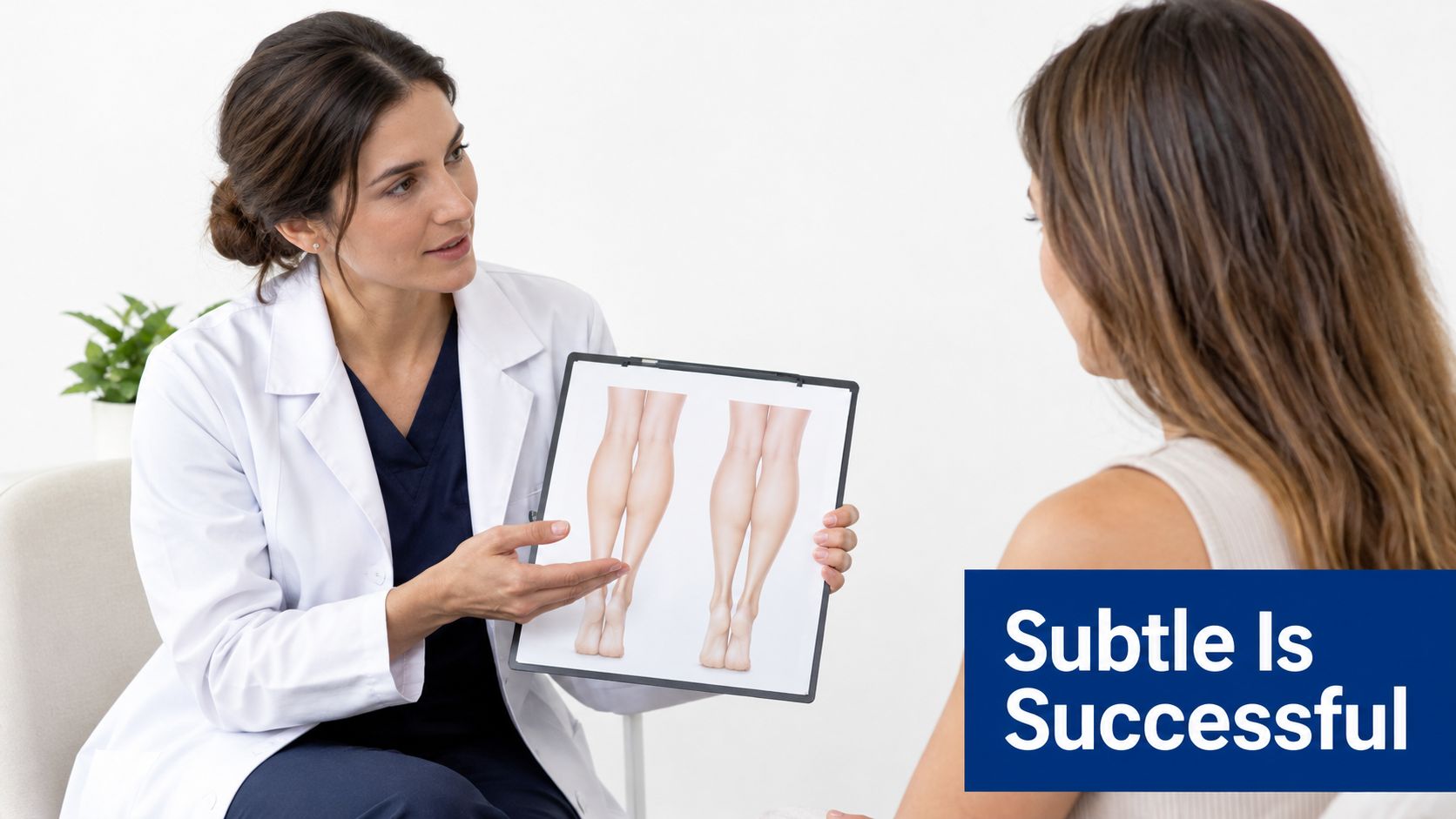
The overcorrection report discussed earlier described severe irregularity requiring staged autologous fat grafting. That's an important trade-off: a surgeon may intentionally leave some fullness to avoid creating a problem that is harder to correct.
Preservation isn't necessarily undertreatment. The remaining layer may be needed to maintain a smooth transition across areas with different underlying anatomy.
A better definition of success: A leg that looks balanced from several angles is more valuable than a dramatic reduction visible only in a carefully selected photograph.
When judging a healed result, prioritize:
- Bilateral balance: The legs should look coherent together, acknowledging any pre-existing differences.
- Surface continuity: Look for an even contour rather than isolated hollows.
- Ankle transition: Assess whether the calf flows naturally into the lower leg.
- Overall proportion: Consider the relationship to the knee and thigh rather than isolating the widest point.
These criteria may favor a modest change over a conspicuous one. A restrained result can still address the feature that bothered the patient without making the surgery itself obvious.
Ask the surgeon where they would deliberately avoid further removal. A clear answer demonstrates an anatomical stopping point. A promise to remove as much as possible doesn't explain how the remaining tissues will look.
Questions to Ask Before Booking a Calf Consultation
Arrive with a description of your concern, your medical history, and photographs that illustrate the contour feature you'd like to discuss. Mention persistent swelling, previous circulation problems, and any history of thrombosis before focusing on aesthetic preferences.
A virtual consultation can begin the conversation, but ask what still requires an in-person examination before a treatment recommendation is finalized.
Build a useful consultation agenda
- Anatomical assessment: What proportion of my fullness appears to be treatable fat, and what will remain unchanged?
- Zone-by-zone examination: Where were pinch measurements taken, and where is treatment inappropriate?
- Treatment scope: Does the proposed procedure include the ankle or medial knee?
- Expected change: Can you describe the likely contour improvement without promising an unsupported circumference reduction?
- Comparable records: Can I review standardized, dated photographs of patients with a similar starting anatomy?
- Technique details: Which parts of the awake laser-assisted approach are appropriate for my legs?
- Recovery arrangements: What compression, activity restrictions, and follow-up schedule will I receive?
- Escalation instructions: Who should I contact after hours, and which symptoms require emergency care?
The answers should leave you understanding both the intended improvement and the reasons to limit treatment. You shouldn't need to interpret a consent form or gallery alone to work out the main trade-offs.
For clarity about the practice's current service scope, breast implant placement, implant-based breast augmentation, and breast implant revision are no longer offered. Those procedures are separate from the calf-contouring discussion.
Ideal Face & Body offers awake, office-based PRECISION SCULPT laser liposculpting for calf and ankle contouring in Beverly Hills, CA. Visit Ideal Face & Body to arrange a consultation focused on your starting anatomy, comparable before-and-after results, and a realistic recovery plan.