Breast implants are not lifetime devices. The FDA labeling notes that as many as 20% of augmentation patients may need removal within 8-10 years. The breast implant removal procedure itself ranges from simple removal to removal with capsule treatment, with or without a lift or fat transfer.
Confusion starts inside that range. Patients hear explant, capsulectomy, and en bloc used as if they're interchangeable, and they hear symptom relief and breast appearance treated as one outcome. Neither holds up. A clear plan separates three questions: what happens to the implant, what happens to the capsule around it, and what happens to the breast after both are decided. Feeling better and looking the way you want are two conversations, not one promise.
Table of Contents
- Why Breast Implant Removal Is More Common Than You Think
- The Reasons Patients Choose Explant Surgery
- Simple Removal, Capsulectomy, and En Bloc Explained
- Awake Local Anesthesia Versus General Anesthesia
- Intraoperative Decisions on Pockets, Lifts, and Fat Transfer
- What Recovery Looks Like Week by Week
- Risks, Symptom Expectations, and What Removal Cannot Promise
- Planning Your Next Step in Beverly Hills
Why Breast Implant Removal Is More Common Than You Think
Many patients arrive thinking removal means something went unusually wrong. It doesn't always. The FDA labeling information stating breast implants are not lifetime devices frames removal as part of long-term management for some patients, with timing that varies by implant type, duration, complications, and individual factors.
U.S. procedural data supports that view. The American Society of Plastic Surgeons 2023 statistics reporting 41,271 breast implant removals described a 9% increase from the prior year, plus 2,342 removals among reconstructive patients counted separately. The same verified summary notes reoperation through three years in one study at 6.1% for primary augmentation and 25.8% for revision augmentation, which shows why surgical history matters.
A Family of Operations, Not One Operation
One patient needs a ruptured device removed. Another wants to be smaller and avoid future implant surgery. A third has pain, hardening, or systemic symptoms she wants evaluated. Those starting points don't lead to identical operations, even if all three patients use the word explant.
Think of your consultation as three linked decisions. First, does the implant come out, which is the core of every case. Second, does some, all, or none of the capsule come out with it. Third, does the breast need reshaping, volume from your own fat, both, or neither after the implant is gone.
Removal isn't a single promise. It's a set of choices, and each choice solves a different problem.
Keeping those questions separate prevents a common mistake. A patient can choose the right capsule plan and still be surprised by loose skin, or choose a lift and still have uncertainty about symptoms. When the implant, capsule, and breast are discussed separately, expectations become much more realistic.
The Reasons Patients Choose Explant Surgery
Your reason for removal shapes what your surgeon looks for before surgery. A deflated saline implant, a hard and painful breast, and a personal preference for a smaller shape may all end in explantation, but they don't require the same workup or the same operation.
Rupture is one concrete trigger. NHS guidance explains that a ruptured silicone implant can cause subtle changes in firmness or shape, while saline may deflate quickly, and you can review common breast implant rupture signs before your visit. The NHS overview of breast enlargement complications also lists capsular contracture, rotation, rippling, folds, altered nipple sensation, infection, bleeding, and blood clots as possible implant related issues.
What Each Reason Tends to Mean
Capsular contracture means the scar tissue around the implant tightens. It can distort shape and cause firmness or pain, so capsule treatment becomes a larger part of the conversation. Malposition and rotation are position problems, where the pocket and breast shape need assessment, not just device removal.
Infection or persistent pain changes timing and may require medical evaluation first. Systemic symptoms are a different category again, because removing the implant is a surgical step, not a diagnostic test for every symptom. Preference is also legitimate. Some patients want a smaller breast, no device to monitor, and no future implant replacement.
| Reason for Removal | What It Usually Means Surgically |
|---|---|
| Rupture or deflation | Confirm fill type and rupture status, remove the device, assess the capsule and any escaped material |
| Capsular contracture | Grade the contracture and decide whether release or capsule removal is needed |
| Pain, infection, or seroma | Evaluate the cause first, then plan removal and any capsule or fluid testing |
| Malposition, rippling, or folds | Assess the pocket and skin envelope along with removal |
| Systemic symptoms | Plan explantation with separate counseling on uncertain symptom outcomes |
| Preference for change | Focus on removal plus lift, fat transfer, or no added reshaping |
Naming your main reason helps your surgeon avoid overtreating one issue and undertreating another. It also clarifies which outcome matters most to you.
Simple Removal, Capsulectomy, and En Bloc Explained
Use a simple picture. The implant is the object. The capsule is your body's scar tissue envelope around that object, a bit like the lining that forms inside a pocket. The pocket is the space that envelope occupies in the breast. The breast implant removal procedure can address one layer or several.
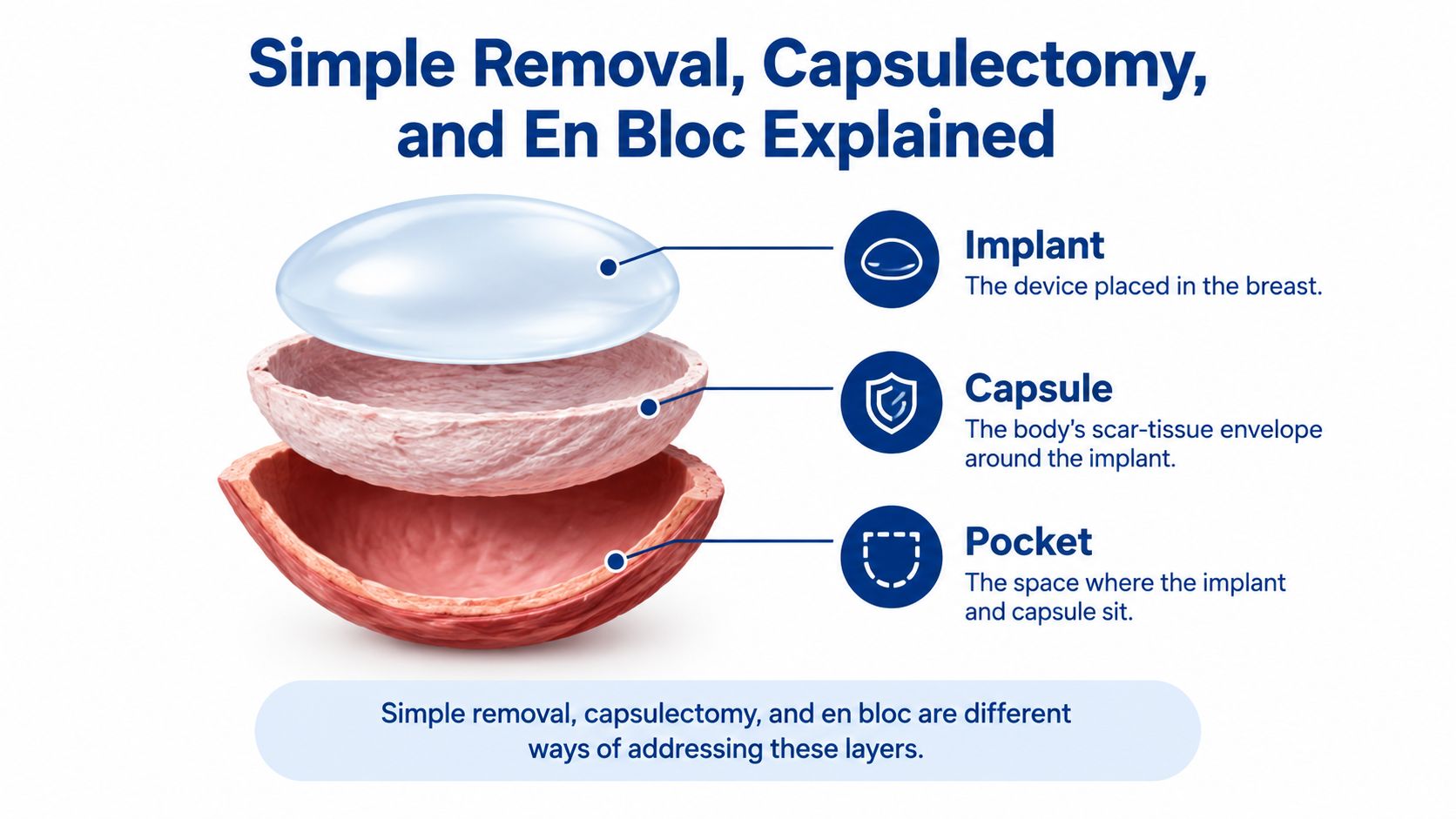
Four Ways to Handle the Capsule
- Explantation alone: The implant is removed and the capsule is left in place. This generally requires less dissection.
- Partial capsulectomy: Part of the capsule is removed or released, often the portion that's thickened, accessible, or distorting shape.
- Total capsulectomy: The surgeon removes the entire capsule, usually as a separate step from removing the implant.
- En bloc removal: The implant and intact capsule are removed together as one specimen, a technique reserved for selected oncologic cases.
The FDA discussion of breast implant risks and capsule removal notes that leaving the capsule generally requires less dissection and may reduce local risks such as bleeding, while capsule removal is more extensive and can increase operative morbidity. More surgery isn't automatically better surgery.
When Complete Capsule Removal Has a Stronger Case
Stronger indications include confirmed breast implant associated anaplastic large cell lymphoma, or BIA-ALCL, another capsular malignancy, significant calcification that interferes with imaging, and severe contracture when less invasive release won't work. For BIA-ALCL, treatment generally involves removing both the implant and the surrounding capsule, which is why oncologic specimen control matters there.
Practical rule: En bloc isn't a routine synonym for total capsulectomy. It's a specific way of keeping a specimen intact when malignancy requires it.
Patients sometimes request en bloc because they've seen the term online and assume it means the most thorough option. Thorough for cancer control and appropriate for a benign explant aren't the same standard. Your surgeon should explain what gain, if any, you get from extra dissection and what added risk comes with it.
Suspicious findings change the pathway entirely. A late fluid collection, mass, or abnormal capsule tissue needs imaging, possible aspiration, and pathologic evaluation rather than elective cosmetic removal alone. Documentation should cover fill type, surface texture, rupture status, contracture grade, capsule thickness or calcification, and any persistent pain before anyone commits to a plan.
Awake Local Anesthesia Versus General Anesthesia
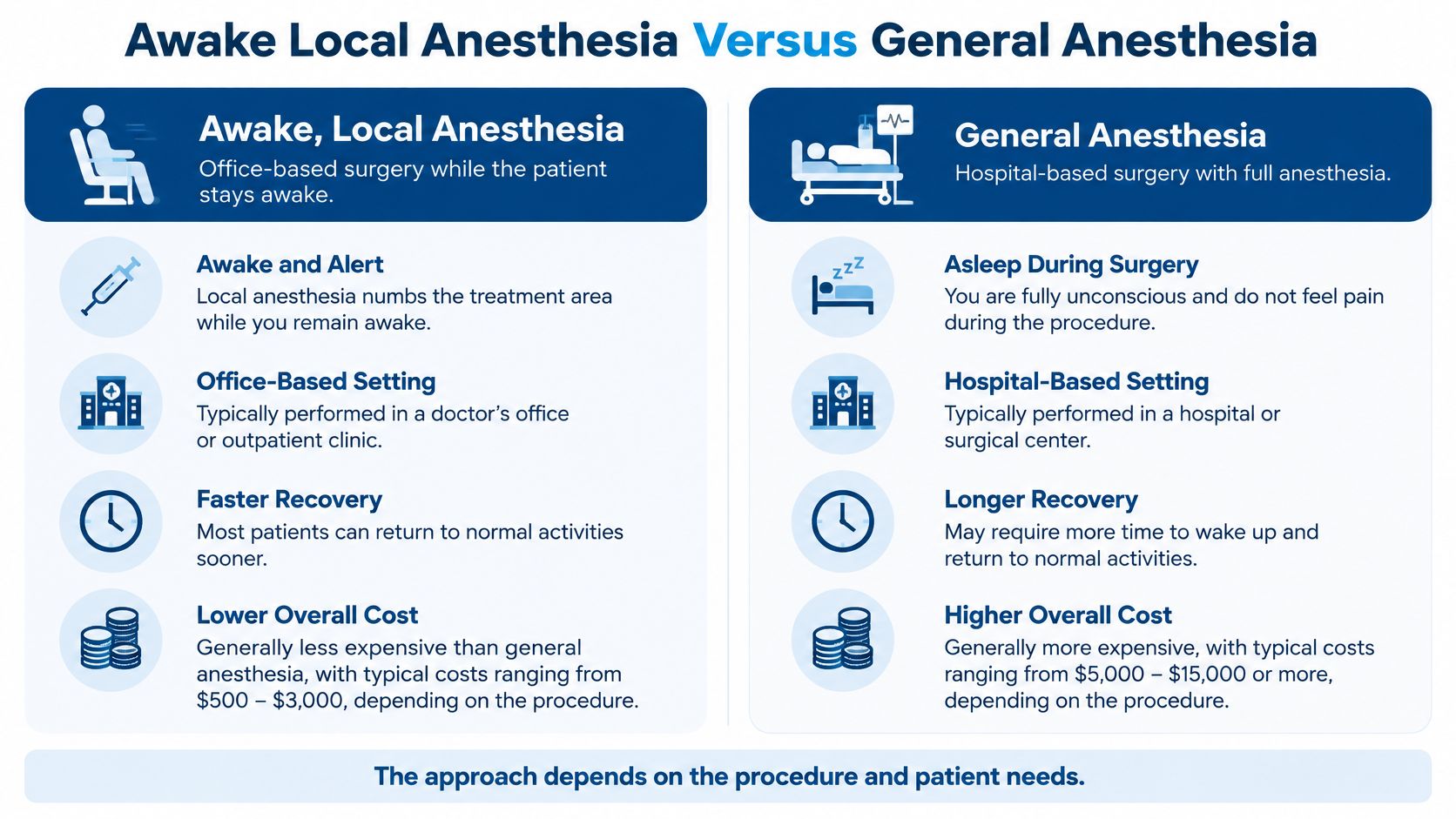
Removal doesn't automatically mean general anesthesia. Many explant procedures can be performed while you're awake under local anesthesia, sometimes with oral sedation, in an office based setting. Other cases, especially longer or more complex dissection, may be better suited to general anesthesia.
How the Two Settings Differ
With awake local anesthesia, numbing medicine is placed where surgery occurs and you remain conscious and breathing on your own. Many awake procedures avoid general anesthesia and IV lines, and recovery from the anesthesia itself is typically simpler because there's no general agent to clear. You'll still need someone to drive you home if sedation is used, and you'll still have surgical soreness.
With general anesthesia, you're fully asleep in a facility equipped for that level of care. That can suit patients who can't tolerate being awake, who need extensive capsule work, or whose combined procedures make a longer operation more practical. It also involves more anesthesia exposure and a groggier early recovery.
Ideal Face & Body in Beverly Hills, CA builds its surgical offering around awake, local anesthesia procedures, including explant with optional autologous fat transfer. That approach fits the practice model led by Dr. Justin Yovino with Dr. Sarah Yovino, and it's one reason candidacy is assessed case by case rather than assumed.
The capsule decision and anesthesia decision interact. Simple removal through an existing incision is a different undertaking than a total capsulectomy with a lift. Ask which parts of your proposed operation drive the anesthesia recommendation, because that answer tells you a lot about expected extent and recovery.
Intraoperative Decisions on Pockets, Lifts, and Fat Transfer
Once the implant comes out, three separate questions remain on the table, and each has its own answer. What happens to the empty pocket? What happens to stretched skin? Where does volume come from, if you want any? Keeping those questions apart prevents a common confusion, because a lift fixes the envelope, fat adds volume, and neither substitutes for the other.
Pocket management covers the first question. The pocket works like a vacant room where the implant lived. Your surgeon decides whether to close it, partially close it, or leave it alone, depending on whether tissue will settle into that old space or adhere naturally on its own. Closing it can support a smaller, higher contour. Pocket size, position, and how the capsule was handled all shape that call.
Skin Envelope and Volume Are Separate Problems
A mastopexy, or breast lift, removes excess skin and repositions the nipple. It adds no volume. Fat grafting adds volume using your own tissue, but it cannot tighten loose skin or raise a low nipple. Patients with both laxity and deflation may need both procedures, or a staged plan that sequences them.
Options such as the Awake Breast Lift address the envelope, while Raise Your Cup fat transfer addresses contour and modest volume. Reviewing how breast implant removal with fat transfer works shows how those pieces can fit together.
Fat transfer has limits worth hearing plainly. Retention varies, not every transferred cell survives, and one session cannot reliably replace large implant volume. Large implants plus a desire for substantial fullness without a new device may mean staged grafting, or accepting a smaller breast within a reduced skin envelope.
Notice that everything in this section belongs to the aesthetic side of the decision. How your body feels after removal is a separate conversation with its own evidence and its own uncertainty. This pathway covers removal without implant replacement, and if you later decide you want an implant again, that becomes a distinct reconstructive choice built on tissue quality, goals, and medical history. Good intraoperative judgment means matching technique to tissue and donor fat availability, then confirming balance before closure.
What Recovery Looks Like Week by Week
The breast you see in the first week isn't your final breast. Swelling, fluid shifts, and tissue settling change shape for months, and the two sides don't always change at the same pace.
Days 1-3 usually bring soreness, tightness, and swelling, with support garments or dressings as your surgeon directs. Short walks are commonly encouraged, while lifting and strenuous activity wait. Incision pain that's steadily improving differs from rapidly increasing pain, expanding swelling, fever, or drainage, which warrant a call.
Weeks 1-2 and the First Month
Bruising fades and early swelling starts to settle during the first two weeks. Shape can look uneven or flatter than expected, especially if no lift or fat transfer was performed. By the first month, many patients return to more normal routines as cleared, but firmness and contour irregularities can persist while tissue softens.
The FDA guidance on things to consider before getting breast implants warns that cosmetic changes after removal are common and may require revision surgery. After removal without replacement, the envelope doesn't immediately contract to pre implant dimensions.
Months 3-6 and What May Remain
Patients may notice ptosis, skin wrinkling, contour depression, dimpling, puckering, asymmetry, or visible chest wall concavity. Those changes reflect long term stretching, lost implant volume, glandular atrophy, scar capsule distortion, and sometimes rupture or silicone migration. Some improve as skin retracts. Others don't, which is why waiting for settling matters before judging the outcome.
A second stage isn't a failure. If loose skin, asymmetry, or a contour dent remains after healing, revision planning can address that specific issue with a lift, selective fat grafting, or scar and pocket adjustment. Planning that conversation at the three to six month point, when tissues have softened, leads to better decisions than reacting to week one appearance.
Risks, Symptom Expectations, and What Removal Cannot Promise
The hardest conversation concerns systemic symptoms. Many patients hope removal will resolve fatigue, joint pain, muscle pain, or brain fog, and some do report feeling better. Hope is understandable. A guarantee is not supported by the available data.
Keep three questions separate, because explant can answer them differently. The implant can be removed. The capsule, the scar envelope your body builds around the device, may be left alone, partly removed, or fully removed. The breast then has to settle around less volume, stretched skin, and whatever reshaping was or was not done.
The FDA page on medical device reports of systemic symptoms in women with breast implants is often quoted as a success rate, but it is not one: among 10,318 reports, 4,210 reported removal, only 785 supplied enough follow up information, 687 reported improvement, and 98 reported no improvement or worsening. Voluntary reports with missing follow up cannot establish a success rate or prove causation.
A Stronger, Still Nuanced Picture
Recent systematic reviews describe lower symptom burden in some explant groups, while still showing mixed patterns across patients, symptoms, and study methods. That supports a careful discussion, not an individual promise. Removal may improve symptoms for some patients. It may leave an unrelated autoimmune, thyroid, neurologic, or musculoskeletal condition untouched. It never replaces medical evaluation when symptoms persist.
Symptom outcome and breast appearance are two separate scorecards. You can improve on one, both, or neither, and your plan should prepare you for each possibility.
Surgical risk also needs honest framing. Published capsulectomy cohorts describe hematoma requiring evacuation, pneumothorax, deep vein thrombosis, and high satisfaction in selected respondents, but those results remain specific to their patients, techniques, and follow up. They should be read as examples of what has been measured, not as your personal odds.
More extensive capsule work generally means more dissection around the ribs, muscles, nerves, and breast tissue than simple removal. That is one reason en bloc or total capsulectomy should not be chosen as a default. Balance the theoretical benefit you expect against a real increase in surgical exposure, and keep medical follow up for persistent symptoms regardless of how clean the surgical result looks.
Planning Your Next Step in Beverly Hills
A useful consultation produces a written decision set, not just a date. Which implant is coming out, how the capsule will be handled, which anesthesia setting fits, and whether a lift, fat transfer, staged plan, or no reshaping makes sense should all be explicit.
Bring what documentation you can. Your surgeon should record implant fill type, surface texture, rupture status, contracture grade, capsule thickness or calcification, and any late seroma, mass, or persistent pain. FDA surveillance for silicone gel implants recommends an initial ultrasound or MRI at 5-6 years, followed by imaging every 2-3 years, with MRI when symptoms or an equivocal ultrasound raise rupture concern, as noted in the labeling cited earlier.
Documented indication matters beyond one practice. One NHS England clinical policy on breast prosthesis removal limits publicly funded removal to indications such as leakage or rupture, Baker grade III or IV contracture confirmed by a specialist, recurrent infection or seroma, and BIA-ALCL. Private elective care works differently, but the lesson holds. Clear findings support clear plans.
If you want background on how breast implant removal cost factors vary by procedure scope, expect the answer to vary with capsule work and any lift or fat transfer. Your practical next step is a consultation in Beverly Hills, CA to review implant history, imaging, tissue quality, and goals before surgery is scheduled.
If you're ready to separate the implant, capsule, and breast shape decisions with an awake, office based approach, schedule a consultation to review your imaging, implant history, and options for removal with an Awake Breast Lift or Raise Your Cup fat transfer. Visit Ideal Face & Body to request your appointment and start building a plan based on your tissue and goals, not a generic explant package.