You may be considering breast implant removal because of discomfort, capsular contracture, changing priorities, or a simple desire to return to your natural body before pregnancy. Yet when patients sit down to discuss explant surgery, they often spend less time asking about the operation than they do asking where the scar will be, whether it will widen, and whether the breast will look deflated afterward.
That concern is reasonable. Breast implant removal scars aren't judged at the operating table. They evolve with skin quality, implant size, the condition of the capsule, the time the implant has been in place, sun exposure, smoking history, and whether a lift is added. Some mature into a fine pale line. Others remain wider, darker, raised, or tethered. The most useful way to think about them is as a long-term healing timeline, not a single incision decision.
Table of Contents
- What Patients Actually Worry About Before Explant
- Common Incision Patterns and Where the Scars Sit
- Explant Alone Versus Explant With a Lift
- How Breast Implant Removal Scars Heal Over Time
- Scar Care That Actually Helps
- When Nonsurgical Care Is Not Enough
- When to Talk to a Specialist and What to Ask
What Patients Actually Worry About Before Explant
A typical consultation may include three very different patients. One has lived with vague breast discomfort for years and wants the implants removed but fears trading discomfort for a conspicuous scar. Another has capsular contracture, firmness, and distortion, yet worries that removing the implant will leave a hollow, loose envelope. A third wants the implants out before having children and is trying to understand whether a smaller scar now could mean another operation later.
Their histories differ, but their question is usually the same: “What will my breast implant removal scars look like when I'm finished healing?”
The honest answer depends on more than the length of the incision. A surgeon must evaluate the original access point, skin elasticity, implant dimensions, the pocket and capsule, breast droop, stretch marks, weight changes, and whether the nipple needs to move to a higher position. Reusing an old incision often limits new visible scarring, but it doesn't automatically correct loose skin or a breast that has stretched around a long-standing implant.
The scar question and the shape question are connected. A shorter incision may leave less visible scarring, but it may also leave more residual skin and droop.
Some scars fade into a thin, pale line by the later stages of maturation. Others become wide, raised, itchy, or darker, particularly after wound tension, delayed closure, infection, smoking, or an inherited tendency toward hypertrophic scarring. A 2023 review recorded breast scar irregularity in 4 patients, or 6.2% of the treated group, with later minor revision or steroid treatment required in those cases. The same review reported a mean follow-up of 6.5 months, with follow-up ranging from 1 to 36 months, underscoring why an early photograph can't serve as a final verdict (review of breast reshaping after implant removal).
Patients also sometimes look for a single answer about what the procedure will involve, including questions addressed in this guide to breast implant removal considerations. The practical goal isn't to promise an invisible scar. It's to identify which scar pattern fits the breast you want afterward and to plan care for the months when the tissue is still changing.
Common Incision Patterns and Where the Scars Sit
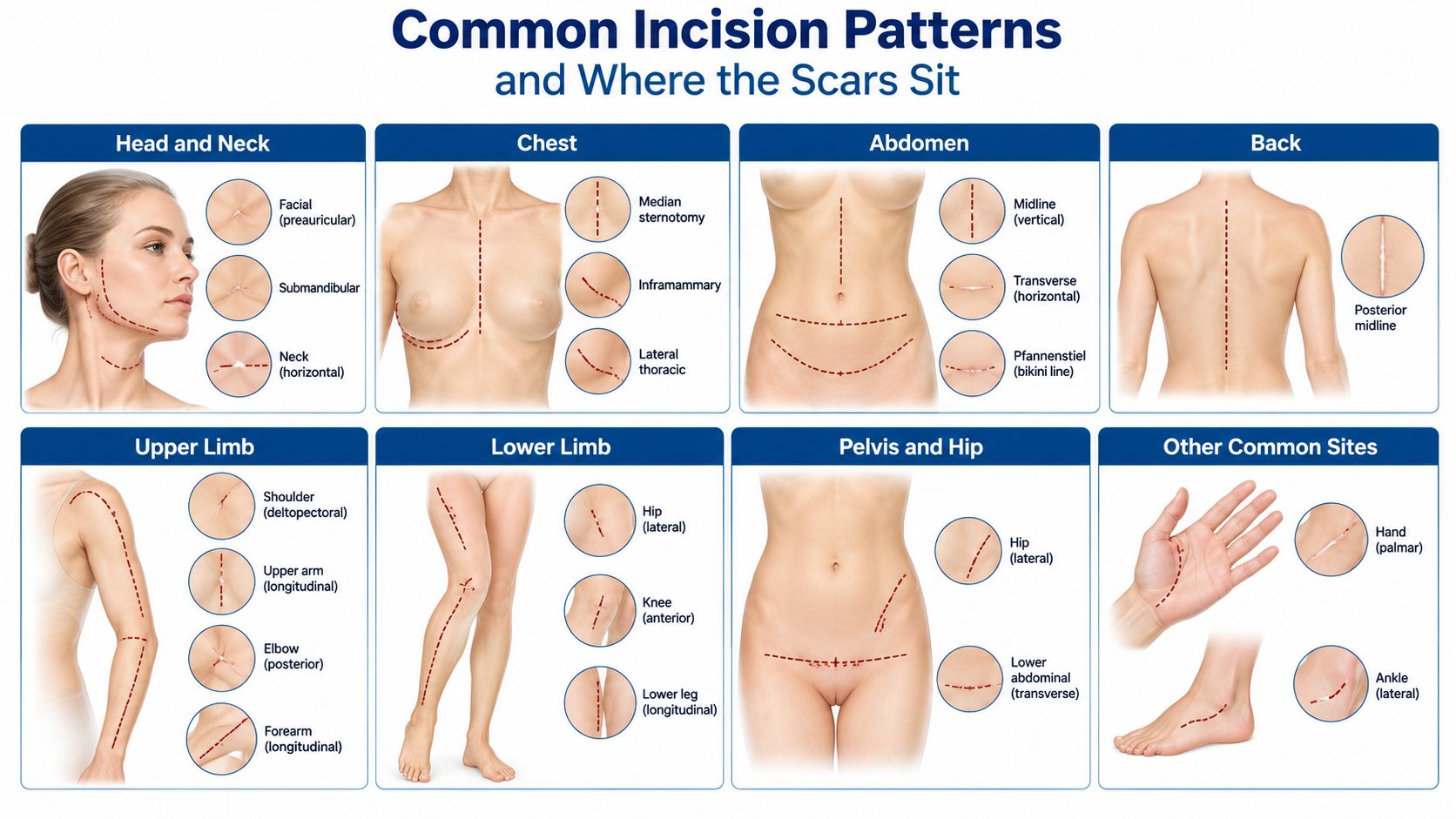
Most implant removals reuse the original augmentation incision. The Aesthetic Society explains that surgeons will almost always use the original implant incisions when replacing or removing implants, commonly an inframammary fold scar beneath the breast or a periareolar scar along the lower edge of the areola (incisions and scars used in breast surgery).
The inframammary fold approach
The inframammary incision sits in the natural crease where the lower breast meets the chest. It remains the workhorse approach for explant because it usually gives the surgeon direct access to the implant, pocket, and capsule while placing the scar beneath the breast rather than on the visible front surface.
In a 2021 cohort of 248 patients undergoing implant removal and capsulectomy, the prior surgical access was inframammary in 173 cases, or 70%, followed by mastopexy incisions in 57 cases, or 23%, periareolar incisions in 3 cases, or 1.2%, and previous mastectomy incisions in 15 cases, or 6% (2021 outcomes study). The figures describe prior access patterns, but they also explain why many patients already have a low-breast crease scar available for reuse.
The periareolar incision
A periareolar incision follows the border between the darker areolar skin and surrounding breast skin. It may be considered when the original implant entered through that route, when capsule work requires access from the front, or when a limited lift is part of the plan. Its visibility depends heavily on the contrast between the areola and breast skin, pigment behavior, and how much tension the closure carries.
The transaxillary route
A transaxillary incision sits in the armpit crease. It avoids a new breast-front scar, but it is less commonly selected for removal because the approach can limit direct control of the capsule and implant pocket. Comparative scar data from breast implantation surgery found similar long-term appearance between inframammary fold and axillary scars by 12 months, while axillary scars scored worse earlier for vascularity and height on the Vancouver Scar Scale (comparative breast incision scar data).
The mastopexy pattern
When removal is combined with a lift, the scar may follow a lollipop pattern, with a vertical line from the areola toward the fold, or an anchor, also called an inverted-T, with an added horizontal line in the crease. The old scar isn't always reusable if it sits too high, is too short for the required exposure, has poor tissue quality, or would place the new breast shape under excessive tension.
Skin tone, previous tanning, stretch marks, weight changes, and the direction of existing scars all influence the safest design. The smallest scar isn't automatically the best incision if it leaves dog-ears, loose skin, or an unsettled lower pole.
Explant Alone Versus Explant With a Lift
The central decision is simple to describe but difficult to make: remove the implant through the shortest practical access, or add a mastopexy to reshape the breast envelope. Explant alone usually means a shorter scar at the previous incision. It also leaves the surgeon with limited control over skin that has stretched around the implant.
A lift adds visible vertical or anchor components. In return, it can remove redundant skin, raise the nipple, tighten the lower breast, and improve the relationship between the breast tissue and chest wall. The trade-off is not merely cosmetic. A larger scar pattern may create a more balanced breast shape and reduce the chance that a patient feels under-corrected after the implant is gone.
In the 2021 clinical series, 53 patients, or 21%, underwent mastopexy at the time of implant removal (implant removal and capsulectomy outcomes). That doesn't mean every patient needs a lift. It shows that reshaping is a meaningful part of explant planning rather than an unusual add-on.
The practical comparison
| Factor | Explant Only | Explant With Mastopexy |
|---|---|---|
| Scar pattern | Usually the existing fold or periareolar incision | Lollipop or anchor pattern, depending on skin excess and droop |
| Shape control | Limited correction of loose skin and nipple position | Greater control over nipple height, skin envelope, and lower-pole contour |
| Recovery | Often less extensive because no lift pattern is added | More involved because multiple incision limbs must heal |
| Long-term trade-off | Shorter scar, with a greater possibility of residual laxity | More visible scar, with a better opportunity to restore shape |
| Later revision | May leave a patient seeking a lift after tissues settle | May reduce shape-related dissatisfaction, though scars still require maturation |
Patients with smaller implants, good skin elasticity, stable weight, and no smoking history may do well with removal alone. Patients with large or long-standing implants, postpartum volume loss, pronounced nipple descent, or substantial skin redundancy are more likely to look under-corrected without a lift.
A lift doesn't erase the effects of implant removal, and explant alone doesn't guarantee a natural-looking breast. The right choice depends on which compromise you can live with. A detailed discussion of implant removal with a lift should include photographs, scar direction, nipple position, and the possibility that the breast will continue to settle after surgery.
How Breast Implant Removal Scars Heal Over Time
A patient may leave surgery with a closed incision and still be far from the final scar. I tell patients to judge the process in phases because scars often look more alarming during active remodeling than they do once collagen has reorganized.
The early weeks
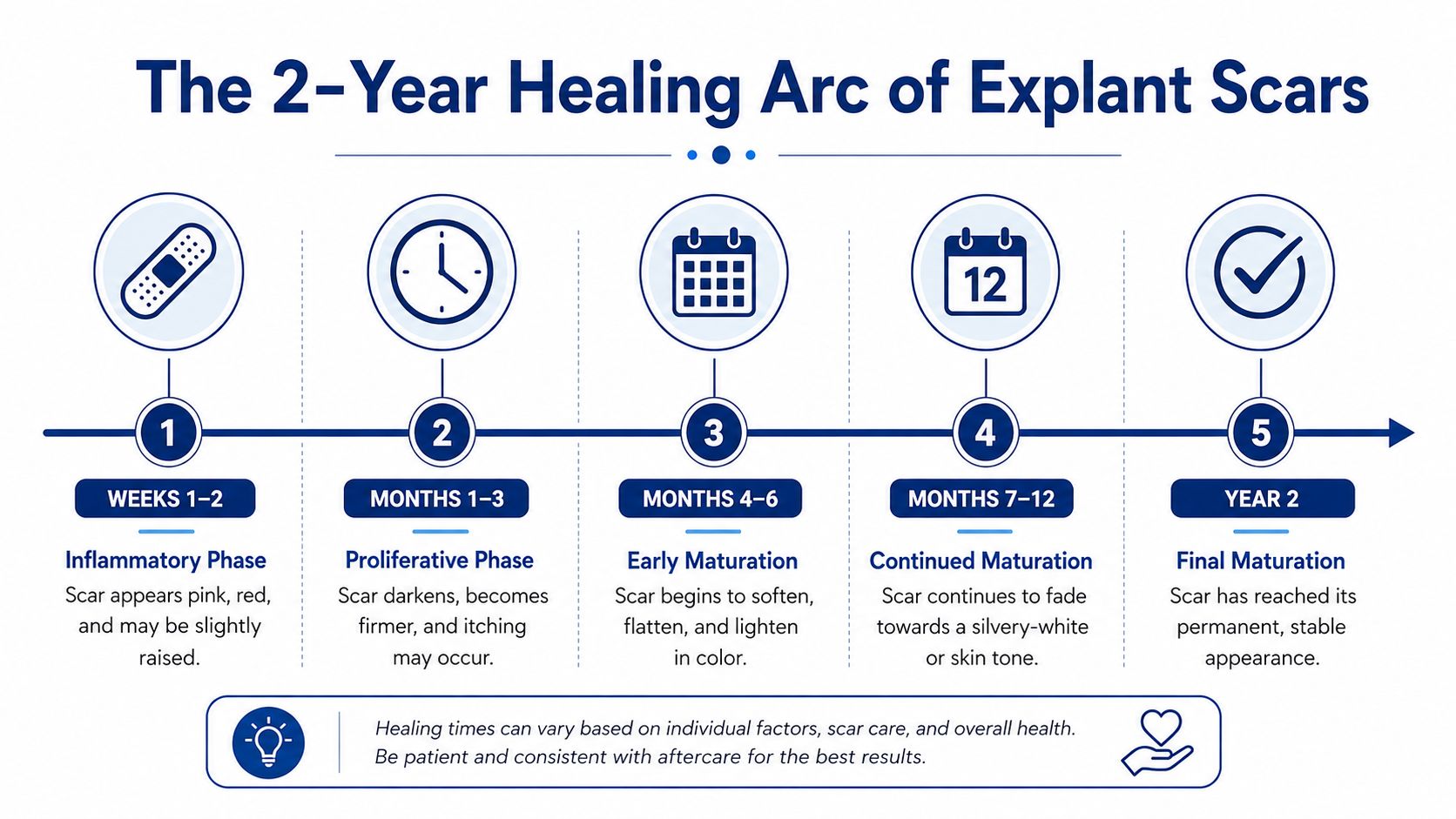
During weeks 1 to 2, the incision is closed but usually pink, red, slightly raised, and tender. Swelling can make the scar look uneven, especially beneath a breast that has just lost implant volume. Small amounts of itching or pulling are common as the skin edges begin to bond, but increasing drainage, spreading redness, or wound separation needs prompt medical review.
By weeks 3 to 6, the line often begins to flatten while its color shifts from stronger red toward pink. A dissolving suture may work its way toward the surface, creating a small irritated spot. Limited separation can heal with local care, but the treating surgeon should decide whether the wound needs additional protection.
The months that test patience
Between months 3 and 9, active scar remodeling can make the line feel firm, itchy, or temporarily more noticeable. A hypertrophic flare may develop during this interval, particularly where tension concentrates at a fold or at the meeting point of a vertical and horizontal lift scar. That appearance isn't necessarily permanent, but it deserves early assessment rather than months of self-treatment.
From months 9 to 18, collagen gradually reorganizes, pigmentation blends, and the scar often becomes softer and less obvious. An isolated inframammary line may mature sooner than an inverted-T mastopexy scar, and the horizontal limb commonly flattens more slowly than a vertical limb because of tension and movement across the fold.
The longer horizon
At 18 to 24 months, many scars have reached a stable appearance, although individual healing varies. Adjacent breast-scar research shows that scar quality generally improves as months pass, and later follow-up has found that much vascularity improvement can occur over 2 to 5 years, rather than only during the first year (breast scar quality and long-term follow-up).
A scar that looks disappointing at six weeks is a healing event, not a final result. The care and tension management used during the following months still matter.
Scar Care That Actually Helps
Scar treatment works best when it begins with wound protection, not aggressive products. Once the incision is fully closed and your surgeon approves, silicone sheeting or silicone gel is the most practical first-line option. Consistent wear, often for 12 or more hours daily, is commonly recommended in scar-care protocols, but the exact start date should follow the closure and dressing instructions provided by your surgical team.
Sun protection is equally important. Use broad-spectrum SPF 30 or higher on exposed scars once the wound has closed and your surgeon permits it, and cover the area when possible during the first year. Ultraviolet exposure can make a healing scar remain darker for longer and may leave pigmentation that doesn't blend easily.
The first tier of care
- Silicone: Apply sheets or gel only to an intact, closed incision. Stop if the skin becomes macerated, blistered, or persistently irritated.
- Sun protection: Use broad-spectrum SPF 30 or higher and avoid deliberate tanning over the scar during early maturation.
- Gentle massage: Around week 3, if the incision is sealed and your surgeon agrees, light massage can help soften adhesions and reduce a tethered sensation. It shouldn't be painful or forceful.
- Support: A well-fitted postoperative bra can reduce movement and tension, which becomes especially important after mastopexy because several incision limbs are healing at once.
Patients sometimes ask about broader principles of preventing abnormal scar formation after skin injury. A practical resource on how to heal burns without scarring can help explain why early wound protection and sun avoidance matter, although a surgical incision still requires individualized postoperative instructions.
Options with less certain benefit
Onion extract gels, vitamin E, and over-the-counter silicone patches may be reasonable for selected patients, but marketing claims often exceed the evidence. Vitamin E can irritate some skin, and applying too much of any product can keep the incision damp and inflamed. Guidance on scar-healing treatments should be filtered through the actual condition of the wound, not the product label.
When a scar needs medical treatment
A raised or hypertrophic scar may respond to intralesional corticosteroid treatment, commonly triamcinolone, often considered around weeks 6 to 12 when persistent thickening becomes clear. Pulsed dye or fractional laser treatment may help ongoing redness or texture concerns from around month 3 onward, while 5-fluorouracil injections can be considered for resistant hypertrophic bands by an experienced clinician.
Aggressive scrubbing, early exfoliation, and repeated friction don't improve a fresh incision. They can disrupt the surface and prolong inflammation. Mederma-type gels and excessive topical vitamin E also shouldn't replace silicone, sun protection, or evaluation of a scar that is becoming raised or painful.
When Nonsurgical Care Is Not Enough
Topical care can soften and flatten a scar, but it can't remove a true contour deformity or release a scar that has tethered the breast to the chest wall. In the 2021 explant series, scar revision was performed in 12 patients, or 4.8%, showing that visible scar refinement is a measurable part of planning rather than an exotic exception (explant and capsulectomy outcomes).
The exact need for revision varies with the operation, skin behavior, smoking, radiation history, wound complications, and whether an inverted-T lift was performed. A patient shouldn't interpret a published rate as a personal prediction. It is better used as a reminder that scar refinement belongs in the original consultation.
Matching the problem to the response
| Scar Problem | First-Line, Months 0-6 | Second-Line, After 12 Months |
|---|---|---|
| Widened or persistently red line | Silicone, sun protection, tension reduction, clinical review | Elliptical excision and controlled re-closure if fully mature |
| Raised hypertrophic band | Silicone and clinician-directed steroid treatment | Scar revision, sometimes combined with additional medical therapy |
| Tethered horizontal anchor scar | Massage after closure, silicone, assessment for adhesions | Release with scar revision, sometimes with fat grafting for depression |
| Widened vertical limb | Silicone and tension management | Elliptical revision once the tissue has matured |
| Dog-ears at lateral incision ends | Observation while swelling settles | Direct excision and re-closure when persistent |
| Step-off where vertical meets horizontal | Scar care and observation during settling | Revision of the junction, with contour correction if needed |
Z-plasty or W-plasty may help a contracted vertical component by changing the direction of tension. Fat grafting can improve a depressed or tethered scar when volume deficiency contributes to the contour problem. A formal revision is generally considered only after the original scar has matured, often at 12 months or later, unless a complication requires earlier intervention.
Revision doesn't make a scar disappear. It exchanges an unfavorable scar for a new scar designed with better orientation, less tension, and improved edge alignment.
The efficient path isn't always another laser session. A scar that remains thick despite months of silicone and steroid treatment, or a scar that creates a visible step-off, may respond more predictably to a carefully planned surgical correction.
When to Talk to a Specialist and What to Ask
A scar consultation should function as a working session, not a quick inspection. Bring implant records, previous operative reports, photographs of the scar at different healing stages, and a written priority list. Your priorities may include a flat breast, acceptance of a lift, minimal scar length, preservation of nipple sensation, or correction of asymmetry.
Seek earlier evaluation if the scar is actively widening after month three, remains distinctly thick beyond six months, changes color in a way that raises concern for vascular compromise, separates along the incision, or develops recurrent drainage. Increasing redness, warmth, worsening pain, foul drainage, fever, sudden swelling, or shortness of breath also requires prompt medical attention rather than routine scar observation.
Questions worth asking
- Incision choice: Which existing incision can be reused, and why would a new pattern be safer or more effective?
- Capsule management: Would total or partial capsulectomy change the incision, and how would an en bloc approach affect access? In total capsulectomy, the implant is removed first and the capsule is removed in pieces. In an en bloc approach, the implant and capsule are removed together through an incision under the breast (explanation of capsulectomy approaches).
- Shape versus scar: What breast contour is realistic with explant alone, and what would a lift add?
- Revision experience: What is your documented scar-revision rate for comparable procedures?
- Final assessment: How long do you ask patients to wait before judging the scar as mature?
The surgeon should document baseline photographs, explain which changes are expected, and establish re-evaluation checkpoints. That approach turns scar care into a monitored process rather than open-ended waiting.
Ideal Face & Body no longer offers breast implant placement, implant-based breast augmentation, or breast implant revision procedures. The practice offers consultation and surgical planning for implant removal and related breast reshaping, with Dr. Justin Yovino and Dr. Sarah Yovino helping patients evaluate scar placement, lift options, and realistic healing expectations. Visit Ideal Face & Body to discuss your breast implant removal scars and create a plan based on both the breast shape you want and the scar you can accept.