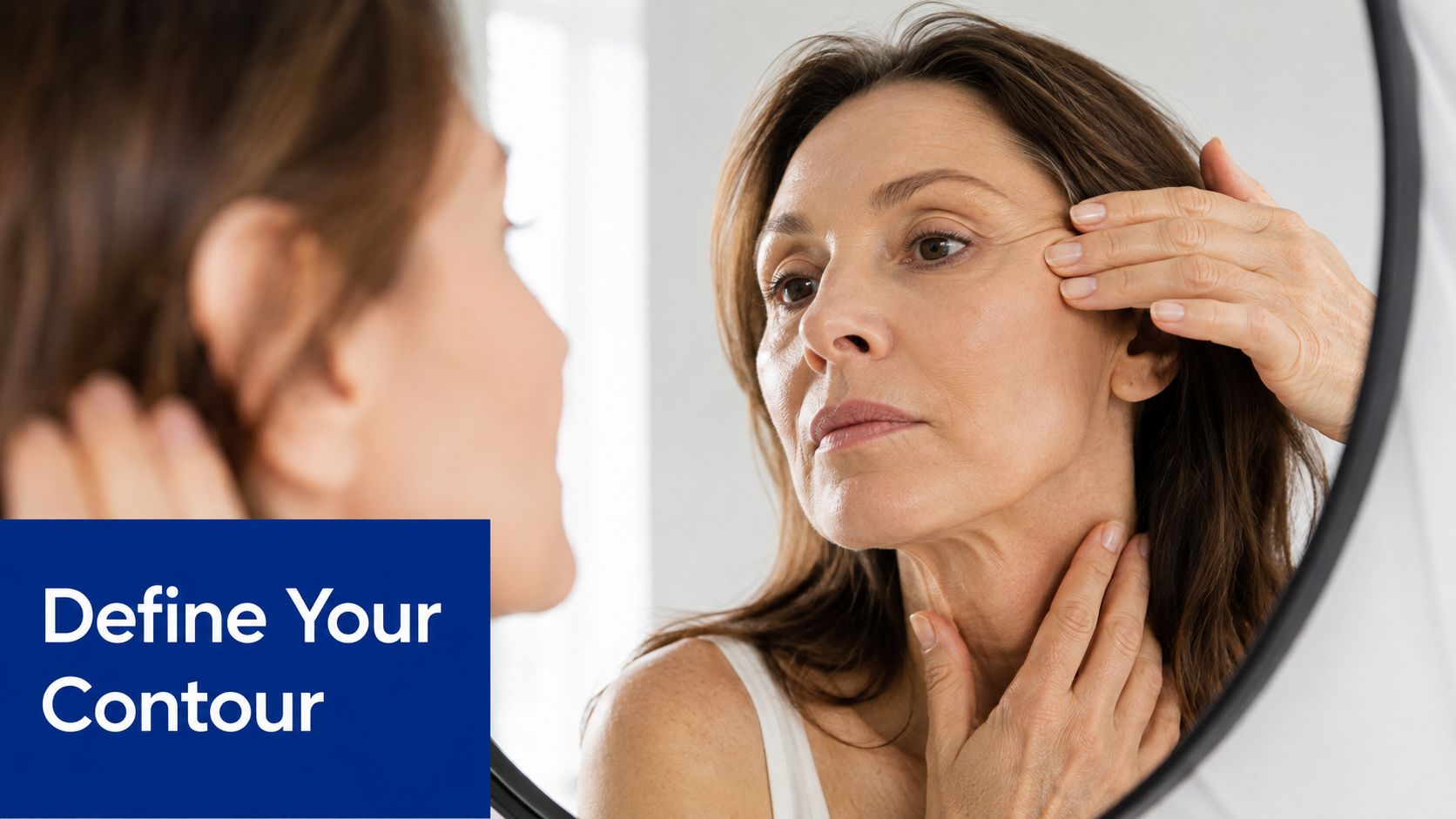
You notice it in an ordinary mirror moment. Pull the skin of your cheek gently backward, and the jawline seems to return. Release it, and the jowl drops back into place while the upper neck looks looser. That change can feel confusing because the problem appears to be “extra skin,” yet the visible contour often reflects movement in several deeper layers.
A jowl and neck lift treats that structural relationship. It can reposition descended tissue along the lower face, support the neck muscles, refine excess fat when appropriate, and remove only the skin that remains after the deeper contour has been improved. The right operation isn't selected by a catchy technique name. It's selected after examining where your jowl begins, how your platysma behaves, whether deeper structures add fullness, and how much skin elasticity remains.
The procedure has become part of mainstream facial rejuvenation in the United States. The American Society of Plastic Surgeons' national procedure statistics tracked 79,058 facelifts and 22,445 neck lifts among men in 2024, with male neck-lift volume showing 12% growth from the prior year. Those figures don't tell you which operation you need, but they do show that jawline and neck rejuvenation is a substantial part of modern facial surgery.
Table of Contents
- What a Jowl and Neck Lift Actually Treats
- The Anatomy Behind Jawline and Neck Aging
- Comparing Surgical Approaches From Mini to Deep Plane
- The Awake Local Anesthesia Option Explained
- Recovery Timeline and Realistic Downtime
- When a Lift Is Not the Whole Answer
- Risks and Complications Worth Understanding
- Non-Surgical Alternatives and How They Compare
What a Jowl and Neck Lift Actually Treats
The mirror test is useful because it reveals the difference between the lower face and the neck. A patient may pull the cheek backward and see the jowl soften, then notice that the neck still has bands or loose skin. Another patient may have a relatively smooth jawline but a heavy, lax neck. These are connected concerns, but they aren't identical anatomical problems.
A jowl forms along the lower cheek and jawline. Detailed anatomical research places the jowl in the subcutaneous layer over the posterior part of the mandibular ligament, rather than inside the neck itself, as described in this anatomical study of jowl formation and facial ligaments. Neck laxity, by contrast, may involve the platysma muscle, neck fat compartments, and loose skin below the jaw. Because the problems meet at the corner of the jaw, treating both can produce a more continuous contour than treating only the surface where the patient sees the change.
What the operation changes
A combined lift may reposition descended cheek and jowl tissue along the jaw, tighten or reposition the underlying neck muscle, contour selected fat, and redrape the skin. The exact sequence varies. Some patients need limited work around the jowl and upper neck, while others need deeper facial and neck support.
The procedure can:
- Sharpen the jawline by correcting descended lower-face tissue.
- Reduce visible neck banding when separated or lax platysma contributes to the appearance.
- Improve hanging upper-neck tissue and the transition from the cheek to the neck.
- Refine selected fat deposits when fat, rather than loose skin alone, contributes to fullness.
It won't cause weight loss, lift the brows, or remodel the chin itself. A weak or recessed chin can influence the appearance of the neck-jaw angle, but that is a separate structural question requiring its own evaluation.
Patients commonly seek this operation in their mid-40s through 60s, although chronological age isn't the deciding factor. Skin quality, tissue descent, anatomy, health, and expectations matter more. For non-surgical support between consultations or after treatment, readers may also find this guide to Skin Perfection jawline support useful, while recognizing that skincare can't reposition descended deep tissue. A focused overview of candidacy is available in when to consider a neck lift in Beverly Hills.
The Anatomy Behind Jawline and Neck Aging
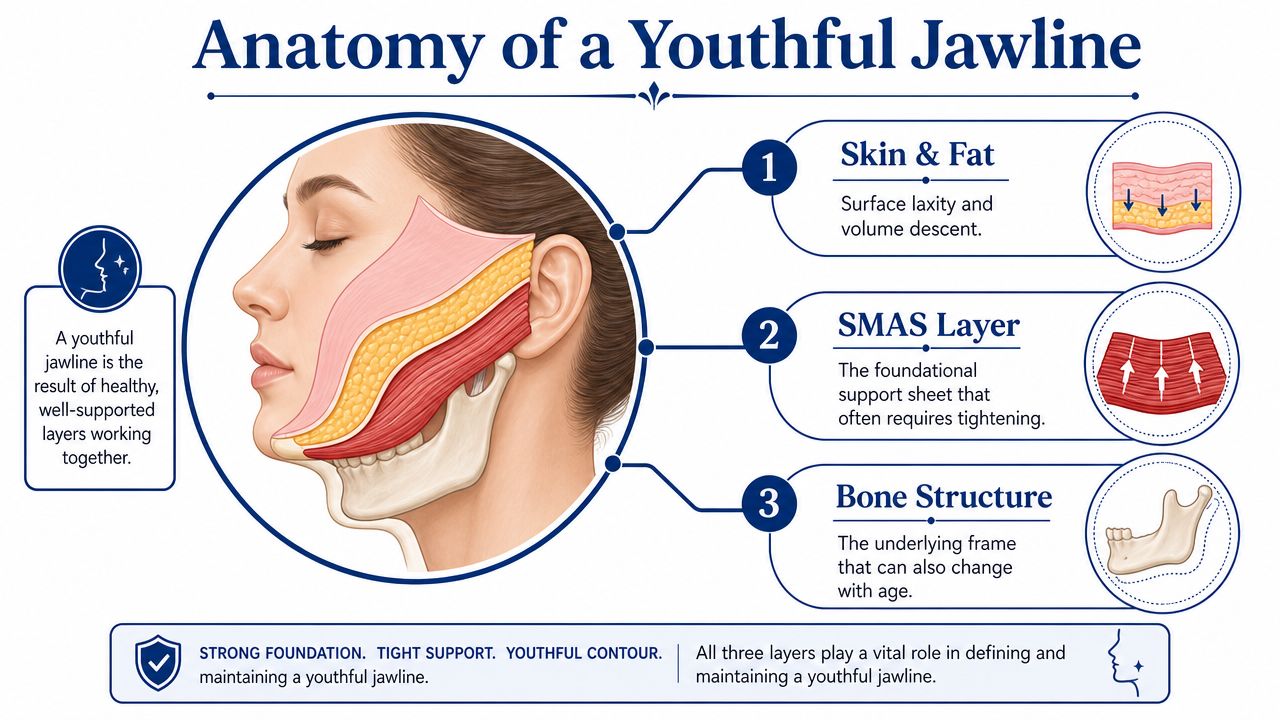
Think of the lower face as a layered mattress rather than a single sheet of skin. Each layer has a different job, and aging can affect all of them at the same time. Tightening only the top layer may temporarily pull the surface, but it doesn't necessarily restore the support underneath.
The SMAS and the jowl
The SMAS, or superficial musculoaponeurotic system, is a fibrous support layer beneath the skin. It behaves like the padding beneath a fitted sheet. If the padding slides downward, pulling the sheet tighter doesn't fully return the mattress to its original shape. A lift that addresses deeper support can reposition the tissue that has descended, allowing the skin to lie over the new contour with less tension.
The cheek's soft tissue can move forward and downward, creating a jowl over the mandibular ligament. That explains why surface tightening alone may leave the jawline rounded. The surgeon must decide whether the lower-face support layer, retaining ligaments, skin, or several of these structures need attention.
The platysma and neck fat
The platysma consists of thin muscle sheets extending from the upper chest toward the jaw. With age, the two sides can separate or become more visible, producing vertical bands. A visible band isn't just a wrinkle in the skin, so a skin-focused treatment may not correct its underlying cause.
Neck fullness also has layers:
- Subcutaneous fat sits directly beneath the skin and may respond to carefully selected contouring.
- Subplatysmal fat lies beneath the platysma and may require direct access rather than superficial fat removal.
- Deep fat near the salivary glands sits still deeper and must be evaluated carefully because it involves important anatomy.
A detailed neck-lift anatomical review describes platysma plication, subplatysmal fat management, and the relationship between these maneuvers and a smoother jawline. The central lesson is straightforward: the visible jawline is shaped by skin, fat, muscle, connective tissue, and the underlying frame. A structural operation can outperform a skin-only operation when several layers have changed.
Comparing Surgical Approaches From Mini to Deep Plane
The smallest operation isn't automatically the safest choice, and the deepest operation isn't automatically the best. Each approach changes a different combination of tissues.
A mini neck lift usually suits someone with modest lower-face descent, early jowling, and limited upper-neck laxity. Incisions are smaller, and the operation may focus on the jowl, upper neck, or selected fat. It can be appropriate when the patient's anatomy doesn't require broad release or substantial muscle correction. It won't reliably reproduce the result of a full lift in someone with marked cheek descent, significant platysmal separation, or substantial excess skin.
A full neck lift with platysmaplasty adds more direct treatment of the central neck. A small incision under the chin may allow the surgeon to repair separated platysma edges, address subplatysmal fat, and refine the midline. The operation can improve banding and the neck-to-chin transition, but it may not fully correct a lower face that has descended into prominent jowls.
A deep-plane face and neck lift releases selected retaining ligaments and repositions cheek and jowl tissue as a unit. It may provide a more integrated correction when the patient has significant lower-face descent together with neck laxity. The technique demands careful anatomical judgment because deeper dissection brings meaningful benefits and distinct risks.
| Surgical Approach Comparison | Tissues Addressed | Best For | Incisions |
|---|---|---|---|
| Mini neck lift | Limited skin, jowl tissue, selected superficial fat | Early or modest descent and good skin quality | Smaller incisions, planned around the ear or under the chin |
| Full neck lift with platysmaplasty | Platysma, central neck, selected subplatysmal fat, excess skin | Neck bands, central laxity, and under-chin fullness | Often includes an incision under the chin and incisions around or behind the ears |
| Deep-plane face and neck lift | SMAS, retaining ligaments, cheek and jowl tissue, platysma, and selected deeper structures | Significant lower-face descent combined with neck aging | More extensive, carefully concealed facial and neck incisions |
The lower-face lift approach for jowls may help you understand why jowls often need facial rather than purely neck-focused treatment. The most important decision, however, is the surgeon's interpretation of your anatomy, not the branded label attached to the procedure.
The Awake Local Anesthesia Option Explained
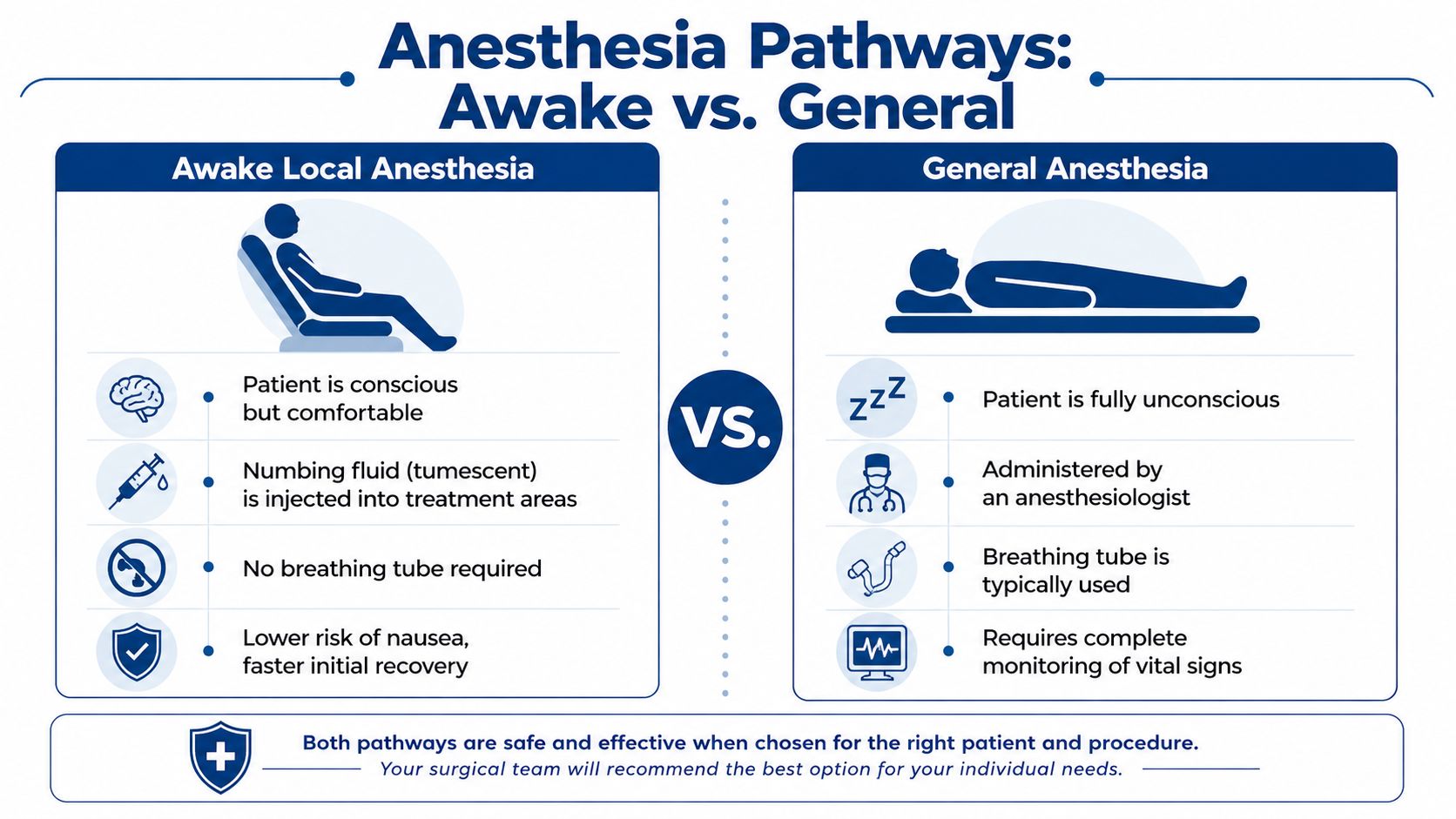
Awake surgery isn't a lesser version of surgery. In selected patients, local anesthetic with oral sedation can provide a credible alternative to general anesthesia for a jowl and neck lift. The surgeon numbs the treatment area with local infiltration, often using a tumescent solution, while sedation helps the patient remain calm and comfortable.
A 2026 cohort of deep-plane facelift and neck-lift patients treated with local anesthesia and oral sedation reported seroma in 3.52%, minor hematoma in 0.70%, and localized infection in 1.40%, with no hospitalizations or thromboembolic events in that cohort. The same report found no significant difference from published benchmark rates for general anesthesia or intravenous sedation, as documented in the comparative local-anesthesia cohort. These results support awake surgery as a legitimate option, not as proof that every patient or every operation should use it.
Who may fit the awake pathway
A patient may be a reasonable candidate when the planned procedure is limited or moderate, the patient is medically healthy, airway concerns aren't complex, and light sedation feels acceptable. An awake approach may be less suitable for a lengthy deep-plane dissection, multiple combined procedures, or someone whose anxiety would make the experience difficult.
Awake surgery still requires a properly equipped setting. The team monitors vital signs continuously, confirms that the local anesthetic dose is appropriate, and maintains a plan for responding to discomfort, bleeding, sedation changes, or an unexpected need for deeper anesthesia. Board-certified anesthesia oversight remains important even when a breathing tube isn't planned.
The surgeon also needs efficient, decisive technique. Awake procedures leave less room for prolonged uncertainty because the patient is participating in the experience. A consultation should cover not only whether local anesthesia is available, but whether the surgeon performs the specific operation regularly under that pathway. This awake neck-lift guide provides additional patient-focused context.
Recovery Timeline and Realistic Downtime
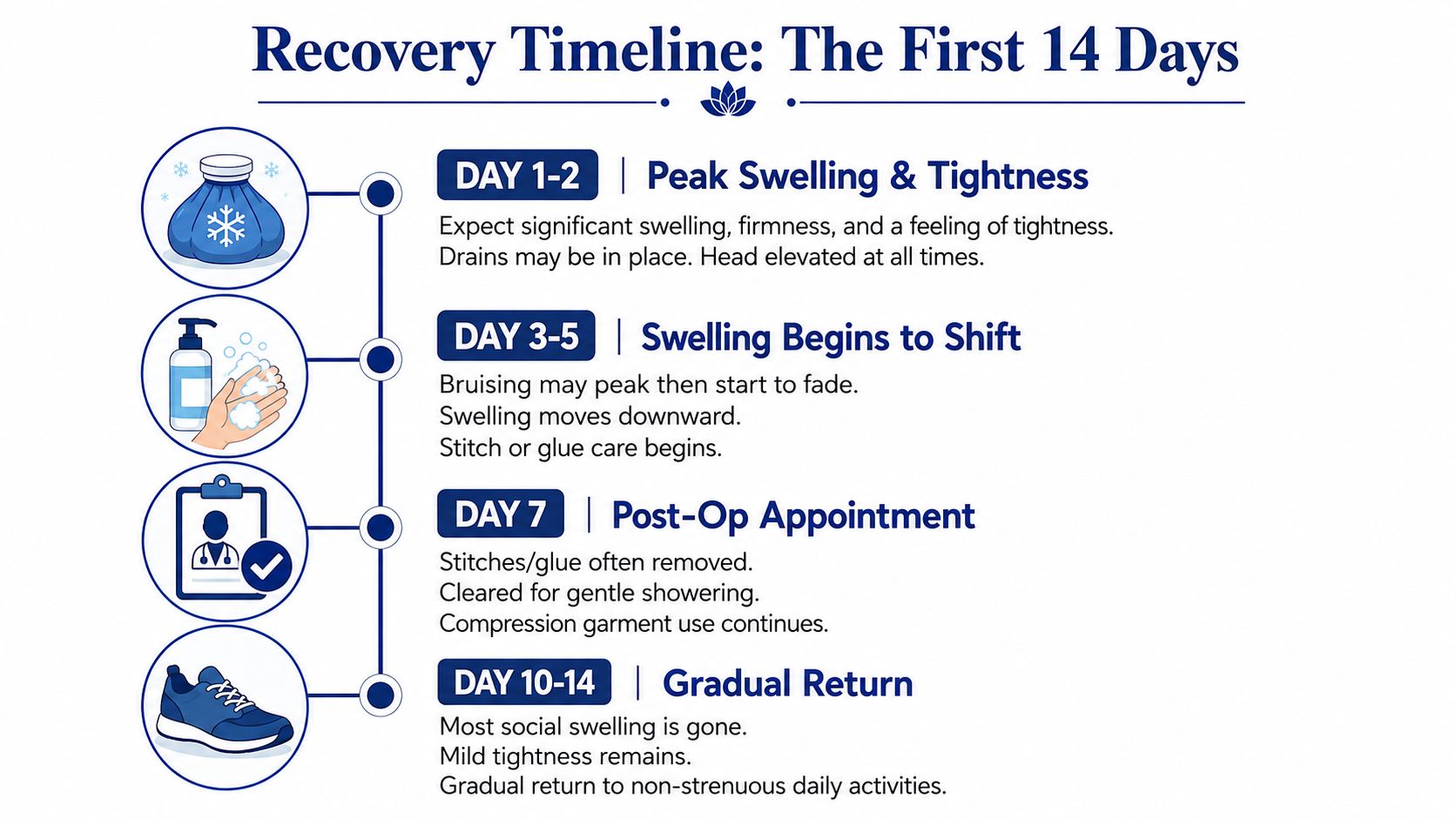
Recovery depends on the extent of dissection, your healing response, and whether facial procedures are combined. A sensible plan assumes that the first week requires help and that social confidence returns gradually rather than all at once.
The first two days
During the first 48 hours, expect swelling, tightness, bruising, and a feeling that the neck is firm or overcorrected. Small drains may be present, depending on the surgeon's technique and your fluid-collection risk. Keep your head raised, including while sleeping, and follow instructions about cool compresses without placing pressure directly on incisions.
Days three through five often bring peak bruising and a noticeable shift in swelling. Many patients begin moving away from prescription pain control during this period, but discomfort varies. A neck garment supports the tissues and helps control swelling when prescribed, but it doesn't replace careful surgical technique or follow-up.
Days five through fourteen
Sutures are often removed around day five to seven, depending on incision location and healing. Drains are removed according to output and examination, rather than a universal calendar. Gentle walking is usually encouraged, while heavy lifting, straining, strenuous cardio, steam rooms, saunas, and other heat exposure remain restricted for the period your surgeon specifies.
By approximately day ten to fourteen, many patients feel comfortable on video calls or at light social activities, sometimes with makeup coverage once the surgeon permits it. Mild tightness, numbness, and swelling can remain. The final contour continues to refine over three to six months as tissues settle, as described in the neck-lift complication and recovery review.
Before surgery, prepare easy meals, loose front-opening clothing, extra pillows, prescribed medications, and a responsible adult who can drive you home and remain available during the first night. Once incisions have closed and your surgeon approves it, silicone therapy and sun protection can support scar maturation.
When a Lift Is Not the Whole Answer
A heavy neck can persist even when skin laxity and platysma separation are modest. The fullness may sit beneath the muscle, where a surface lift cannot pull the tissue tighter. The treatment plan therefore starts with identifying the structure creating the contour, not treating every under-jaw concern as loose skin.
The submandibular glands may be enlarged or positioned low beneath the jaw, leaving a bulge after skin redraping. Subplatysmal fat lies below the platysma, so superficial liposuction may leave it untouched. Prominent muscle bulk in the anterior belly of the digastric muscle can also fill the area beneath the jaw.
During examination, a surgeon may assess these structures and discuss selected options, including partial gland reduction, subplatysmal fat resection, or digastric management. Each reaches anatomy close to nerves, ducts, vessels, and salivary structures. Deeper treatment can address a deeper cause, but it also adds technical demands and potential trade-offs.
A 2025 systematic review of deep-plane neck-lift techniques examined 8,648 patients. The submandibular gland was altered in 69.9% of studies, the digastric muscles in 58.6%, and subplatysmal fat in 48.6%. Only 12% of studies reported objective outcomes, so patient satisfaction appeared more often than measured anatomical change. The review also found a higher nerve-palsy range with deep-plane techniques than with traditional neck-lift approaches.
Consultation principle: A photograph shows the contour problem. A hands-on examination helps identify its cause.
A skin-focused lift or non-surgical tightening may produce limited change when fullness lies deeper. In other patients, the glands and muscles have a favorable position, making deeper intervention unnecessary. An online form or front-facing photograph cannot reliably distinguish these situations.
Risks and Complications Worth Understanding
A jowl and neck lift changes more than the skin envelope. It reshapes tissue around important nerves, blood vessels, muscles, and skin flaps, so the consent discussion should separate expected recovery from problems that may need urgent treatment.
Hematoma deserves particular attention because it can appear after an initially smooth operation. A review of facelift and neck-rejuvenation complications describes hematoma as the most commonly reported complication, with rates of approximately 0.2% to 8%. It often develops within 10 to 12 hours after surgery, and a large collection can threaten skin viability or the airway. Seroma, infection, delayed healing, contour irregularity, asymmetry, thickened scars, and temporary numbness are other possible outcomes.
A separate deep-neck surgical series involving 641 patients reported subcutaneous serous collection in 4.3%, marginal mandibular neuropraxia in 3.3%, hematoma in 2.96%, and parotid sialocele in 0.3% (deep neck surgery outcomes). Those figures apply to that technique and patient group. They do not predict an individual patient's risk.
| Complication Rates in Jowl and Neck Lift Surgery | Approximate Rate | Typical Outcome |
|---|---|---|
| Subcutaneous serous collection | 4.3% in a deep-neck series | Often monitored or treated with drainage |
| Marginal mandibular neuropraxia | 3.3% in a deep-neck series | Frequently temporary weakness |
| Hematoma | 2.96% in a deep-neck series, with broader facelift reports of 0.2% to 8% | May require urgent evaluation or surgery |
| Parotid sialocele | 0.3% in a deep-neck series | Uncommon, requiring focused management |
Smoking, untreated medical conditions, medication interactions, and inadequate aftercare can impair healing. Awake local anesthesia may avoid some risks associated with airway instrumentation, general anesthesia, and postoperative nausea, but it does not remove the risks of bleeding, infection, nerve symptoms, or an uneven contour. Contact the surgical team urgently for rapidly increasing swelling, severe pain, breathing difficulty, fever, spreading redness, or new facial weakness.
Non-Surgical Alternatives and How They Compare
Non-surgical care fits best when the anatomy is early, the concern is limited, or the patient isn't ready for surgery. It can improve skin quality, modest fullness, or selected muscle activity, but it can't reproduce the effect of repositioning descended jowl tissue or repairing a separated platysma.
Matching treatment to the problem
Hyaluronic acid fillers can restore selected volume and sometimes improve the visual transition around the jaw. They don't lift a descended cheek as a surgical operation does, and placement must respect facial anatomy.
Biostimulatory injectables, including collagen-stimulating categories, may improve the appearance of skin and soft-tissue support gradually. Results are subtle and depend on the underlying problem. They aren't a substitute for removing significant excess skin or repositioning deep tissue.
Neuromodulators can soften the appearance of platysmal bands when muscle activity contributes to the concern. They don't correct loose skin or permanently reposition the muscle.
Deoxycholic acid injections may suit a small, localized pocket of submental fat in someone with adequate skin elasticity. They aren't designed to correct marked laxity, prominent jowls, or deep structural fullness.
Radiofrequency microneedling and ultrasound-based tightening can improve mild laxity and skin texture. Patients should view the change as gradual and modest. Energy treatments may require multiple sessions, and their effects generally last for a limited period rather than permanently changing facial support.
Submental liposuction is most logical when excess superficial fat is the main concern and the skin can contract well. A 30-case series reported excellent postoperative neck contour in 86.6% of cases, while a newer adverse-event analysis identified 270 events and an event rate of 12.9% per procedure (submental liposuction data). Those findings reinforce that even familiar contouring procedures carry measurable risk.
A practical decision framework
Ask first, what is creating the blur? Mild skin laxity, a small fat pocket, and active platysmal bands lead to different treatment discussions than descended cheek tissue and loose neck skin. If the problem is structural and pronounced, delaying surgery for repeated surface treatments may produce incremental changes without correcting the central issue.
During consultations, ask:
- Training and certification: Is the surgeon board-certified in plastic surgery or facial plastic surgery?
- Relevant experience: How many jowl and neck lifts does the surgeon perform annually?
- Comparable anatomy: Can you review before-and-after photographs of patients with similar jowls, neck length, skin quality, and tissue fullness?
- Anesthesia planning: Will the operation use local anesthesia, sedation, or general anesthesia, and where will it occur?
- Facility safety: Is the surgical setting properly accredited and equipped for emergencies?
- After-hours care: Who answers if swelling, pain, bleeding, or weakness develops overnight?
- Revision policy: How does the practice handle persistent asymmetry or a result that needs refinement?
Be cautious when a practice relies on heavy discounting, skips an in-person examination, pressures you to add procedures, operates outside an appropriately accredited setting, or shows only filtered or stock photographs. A gallery should use consistent lighting, neutral backgrounds, similar angles, and clearly identified postoperative timing. Look for results after healing has progressed, not only immediately after surgery.
Ideal Face & Body describes awake, office-based facial procedures under local anesthesia, including facelift, neck lift, and mini neck lift options. Those offerings can be part of a consultation, but the operation and anesthesia plan should still be based on your anatomy, medical history, and tolerance for the surgical experience.
If you're noticing jowls, neck bands, or a blurred jawline, schedule a consultation with Ideal Face & Body to discuss whether an awake jowl and neck lift, a more limited contouring procedure, or non-surgical care fits your anatomy. Bring your questions, medication list, and realistic goals so the team can explain the tissues involved, recovery expectations, and safest path forward.