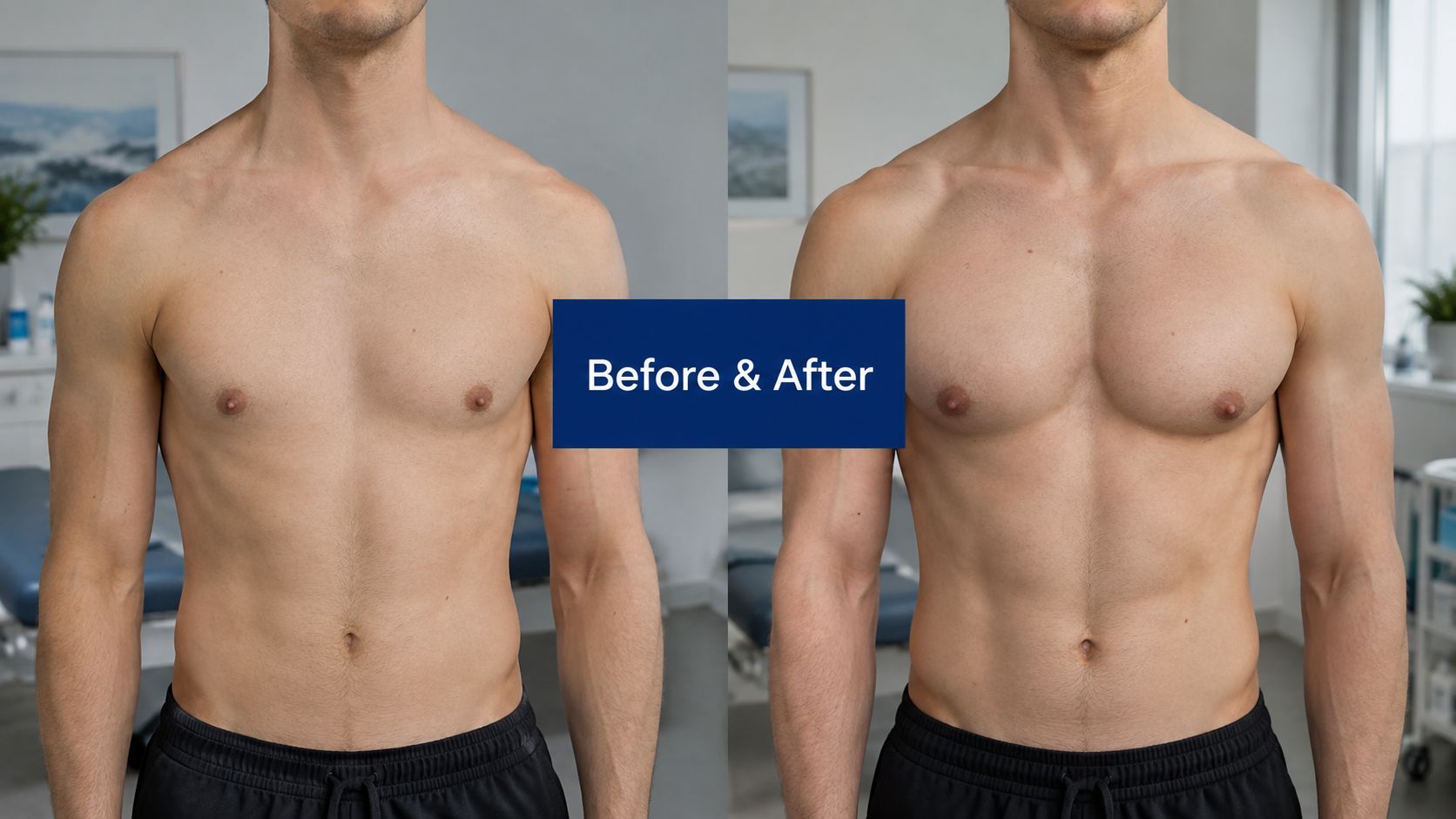
You've probably seen them: sharply defined male chests in polished galleries, with a flatter “before” image beside a fuller “after.” The photos can look convincing, yet they leave important questions unanswered. Will the chest move naturally during exercise? Will the implant show through on a lean body? How should you judge a result while swelling is still present?
Those questions matter more than a dramatic side-by-side image. Pectoral implants before-after results depend on anatomy, implant placement, soft-tissue coverage, muscle movement, and healing, not just the device's size. This guide explains what photographs can and can't reveal, who may benefit, which alternatives deserve consideration, and what to ask before choosing surgery. For a broader look at male procedure outcomes, you can also review this male plastic surgery before-and-after gallery.
Table of Contents
- Why Before and After Photos Only Tell Half the Story
- What Pectoral Implants Are and Where They Came From
- How to Read Pectoral Implants Before After Photos Realistically
- Who Is a Good Candidate and What Are the Alternatives
- The Surgical Technique From Consultation to Placement
- Recovery Timeline and Aftercare Week by Week
- Risks and Complications You Should Know About
- Choosing Your Surgeon and Questions to Ask at Consultation
Why Before and After Photos Only Tell Half the Story
A man scrolling through pectoral implant galleries late at night may notice the same pattern repeatedly. The “before” photo shows a relatively flat chest, and the “after” shows a more projected outline with stronger upper-chest definition. What he can't see is whether the patient is standing relaxed, flexing, lifting the arms, or rotating the shoulders. He also can't tell how the result feels during a workout or how the implant looks in ordinary lighting.
A still image freezes one moment. It doesn't show animation deformity, a change in contour that can occur when the pectoralis muscle contracts over or around an implant. It also can't reveal tightness, altered sensation, muscle spasms, or whether the patient needed additional treatment after healing.
The body around the implant changes the picture
A lean patient may have less soft tissue covering the implant. That can make edges or rippling more noticeable, even when the implant is well positioned. Someone with thicker coverage may have a smoother visual transition, but the same implant volume won't necessarily create the same contour on both bodies.
Photography can exaggerate those differences. Bright overhead lighting can deepen shadows beneath the chest, while side lighting can emphasize an upper border. Arm position changes the way the pectoralis muscle sits, and a flexed photograph can make a chest appear more projected than it does at rest.
Practical rule: Treat a gallery as evidence of what may be possible, not as a promise of what you'll receive.
What a useful gallery should answer
A trustworthy set of photos should make it easier to compare similar conditions. Look for consistent views, comparable posture, clear lighting, and enough time between surgery and the final images to allow swelling and implant settling to progress. Ask whether the photos include both relaxed and contracted positions.
The most useful consultation goes beyond image selection. It connects the photograph to your chest-wall shape, muscle development, tissue thickness, goals, and the placement plane chosen for your anatomy. Those details explain why two patients with similar “before” images can have different “after” contours.
What Pectoral Implants Are and Where They Came From
Pectoral implants are solid, anatomically shaped silicone devices placed in the chest to add projection and create the appearance of fuller pectoral muscles. Think of the implant as an architectural form fitted beneath an existing structure. It can establish shape and volume, but the final appearance still depends on the foundation around it, including the ribs, sternum, pectoralis muscle, skin, and soft-tissue coverage.
The device doesn't turn a flat chest into a trained muscle by itself. Instead, it changes the outer contour. A surgeon must select an implant that follows the patient's chest width and existing muscle borders rather than choosing the largest available size.
The reconstructive beginning
The history helps explain why modern pectoral augmentation focuses on contour and positioning. Pectoral implants were first developed in 1988 for male patients with pectus excavatum, a chest-wall deformity involving a sunken sternum. Surgeons used custom cohesive silicone gel implants shaped from paper-mache casts of the deformity. This was reconstructive surgery, intended to restore a more balanced chest wall rather than create an elective bodybuilding effect. The development history is described in the American Society of Plastic Surgeons' overview of cosmetic procedures for men.
By the early 1990s, surgeons began adapting the technique for cosmetic chest augmentation in men. Early placement through a pre-sternal incision carried a high risk of implant exposure because the implant had minimal tissue coverage. The approach later shifted toward a trans-axillary subpectoral method, with the incision placed near the armpit and the implant positioned beneath the pectoralis muscle.
Why the procedure remains specialized
Pectoral augmentation is recognized internationally, but it has stayed a niche procedure within male cosmetic surgery. Historical industry data reported 32 pectoral implant operations in 1994, compared with 37,343 liposuction procedures and more than 197,000 hair-restoration procedures in that same year, as summarized by Mel Magazine's historical review of pectoral implants. A later industry summary reported 206 pectoral implant surgeries in the prior year, and after a 43% increase between 2011 and 2012, the total reached 317 cases. U.S. plastic-surgery data later reported 987 male pectoral implants in 2017.
Those figures don't determine whether surgery is right for you. They do show why experience with male chest anatomy matters. A surgeon who understands the procedure's reconstructive roots and its evolution can evaluate positioning as a contour problem, not just a volume problem.
How to Read Pectoral Implants Before After Photos Realistically
Start with the image conditions before judging the result. A before-and-after photograph can look impressive because of lighting, posture, muscle contraction, or a change in body composition. Your first task is to determine whether the images allow a fair comparison.
Use this visual checklist
- Check the pose: Compare relaxed with relaxed and flexed with flexed. A raised arm or rotated shoulder can change the apparent chest outline.
- Look at lighting: Consistent front lighting makes shadows and borders easier to interpret. Dramatically different lighting can create a false impression of added definition.
- Assess the frame: A lean build may reveal implant edges more readily than a chest with thicker soft-tissue coverage.
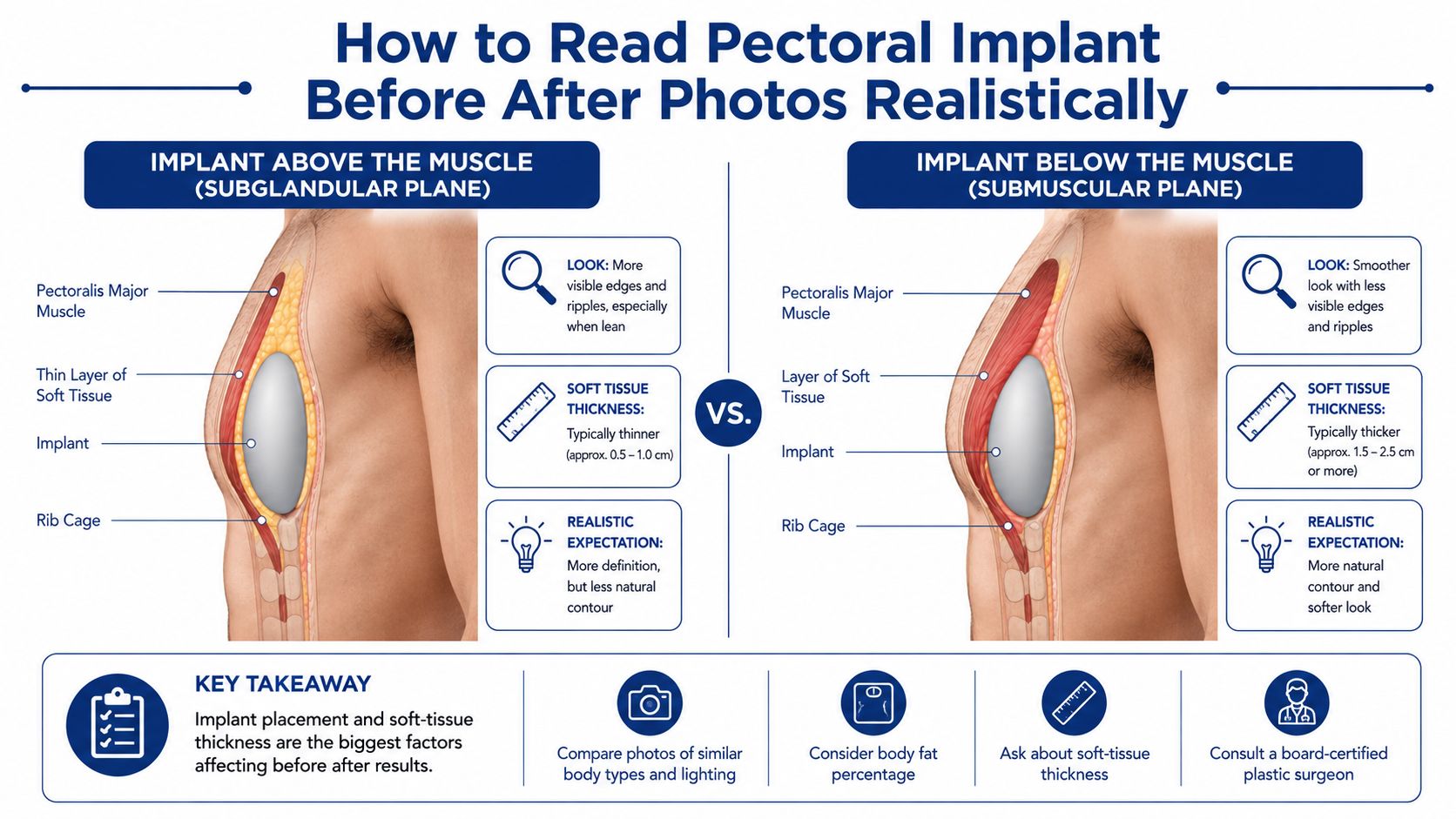
- Identify the plane: Ask whether the implant is prepectoral, in front of the muscle, or subpectoral, beneath the muscle.
- Study symmetry: Compare the lower borders, inner chest, upper poles, and relationship to the sternum, not just overall size.
- Ask about timing: Early photographs may show swelling, bruising, or a contour that has not yet settled.
Understand the placement tradeoff
The implant plane affects how the chest behaves. Prepectoral placement can reduce animation deformity, because the pectoralis muscle doesn't contract directly over the implant. The tradeoff is that thinner tissue coverage can make rippling or the upper implant border more visible. One clinical comparison reported visible rippling in 8.7% of prepectoral cases versus 4.4% in a comparator group, as discussed in this clinical review of prepectoral and subpectoral outcomes.
Subpectoral placement may provide more coverage and help disguise the implant edge, particularly in patients with limited soft tissue. However, muscle contraction can change the contour. A chest that appears smooth while relaxed may move differently during a push-up, bench press, or forceful contraction.
Red flags in a gallery
Be cautious when every result appears identical, every patient has the same pose, or the gallery shows only a relaxed front view. A gallery that excludes side views, contracted images, or patients with different body types gives you limited information.
The most important conclusion is simple: the outcome depends more on patient selection, tissue thickness, and implant plane than on implant volume alone. Ask the surgeon to explain what you're seeing and what the photograph cannot predict for your body.
Who Is a Good Candidate and What Are the Alternatives
Pectoral implants may suit a man who has a stable body shape, realistic expectations, and a chest contour that hasn't responded to training in the way he wants. Some patients seek correction of congenital flatness or asymmetry. Others have developed their chest muscles but still want more projection or a clearer outline.
Good candidacy also requires a careful discussion of goals. “I want a bigger chest” is less useful than “I want more upper-chest projection without a visible edge when I'm relaxed.” Specific goals help the surgeon decide whether an implant is appropriate or whether another treatment addresses the actual concern.
Chest enhancement options compared
| Option | Best For | Typical Outcome | Key Limitation |
|---|---|---|---|
| Pectoral implants | Men seeking structural projection or correction of persistent flatness | More defined, fuller chest contour | Requires surgery and introduces implant-related risks |
| Fat transfer | Men wanting modest softening or added contour using their own tissue | Subtle volume and smoother transitions | Results depend on available donor tissue and tissue behavior |
| Chest training | Men who haven't yet developed their natural muscle potential | Gradual improvement in muscle size and definition | Can't correct every congenital shape or structural asymmetry |
| Gynecomastia correction | Men whose concern is excess glandular tissue or a puffy nipple contour | Flatter, more proportionate chest | Doesn't provide the same type of structural projection as an implant |
Fat transfer can be a reasonable option when the goal is refinement rather than a firm, predetermined implant shape. Information about male chest fat transfer is available through Ideal Face & Body's guide to fat transfer for males.
Match the operation to the problem
Many men searching for pectoral implants are describing gynecomastia, a chest issue involving glandular tissue, fat, skin, or a combination of these. An implant adds projection, but it won't remove tissue that creates a puffy or uneven nipple area. In that situation, gynecomastia correction may be the more direct answer.
Training deserves an honest place in the conversation, too. If you haven't followed a consistent, well-designed chest program, surgery may be premature. On the other hand, exercise can't reshape the sternum or reliably correct every asymmetry. The right choice depends on whether the problem is muscle development, tissue excess, chest-wall structure, or a combination.
The Surgical Technique From Consultation to Placement
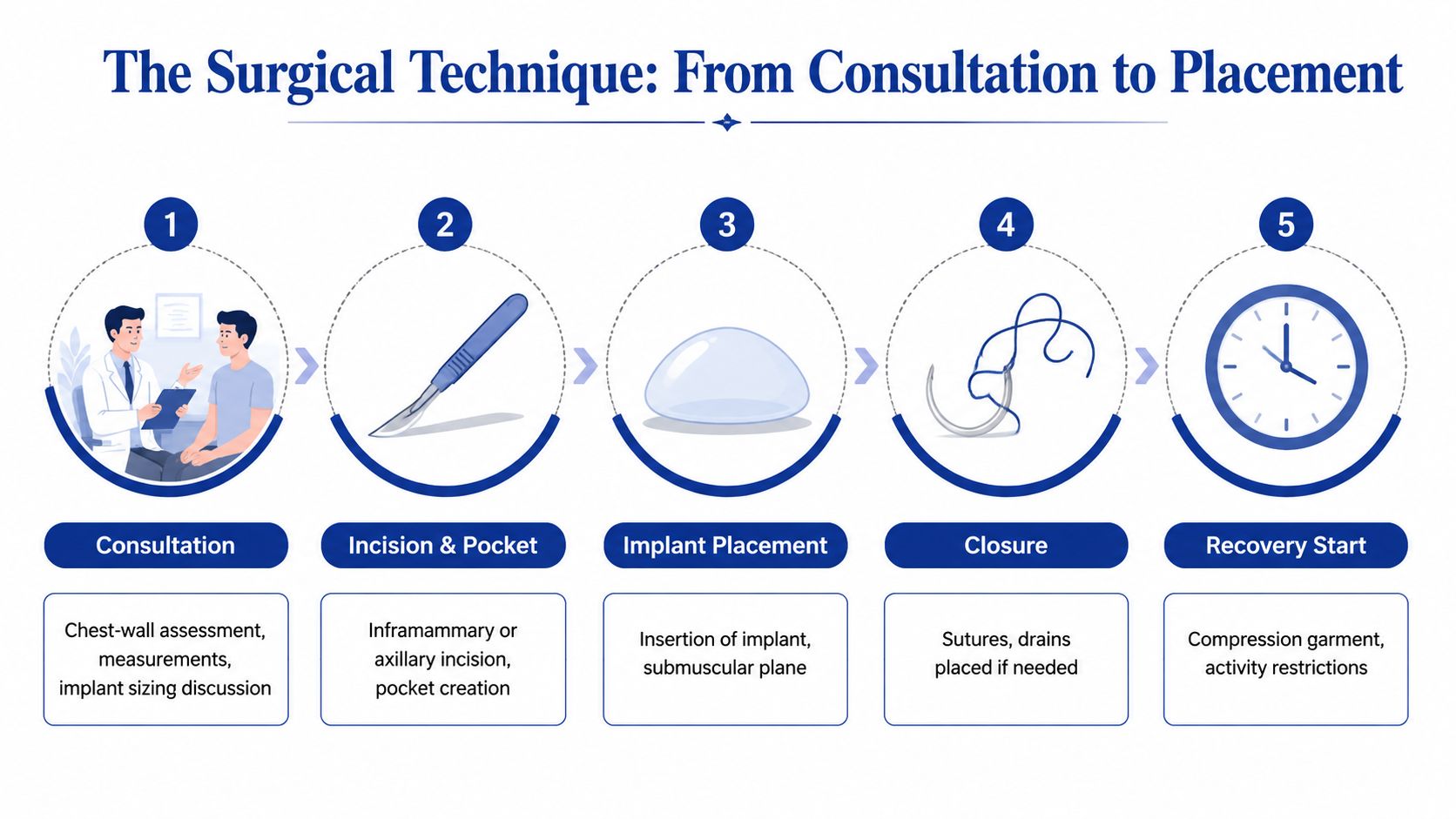
The process begins with examination, not with a photo comparison. During consultation, the surgeon evaluates chest width, rib and sternum shape, pectoralis muscle borders, existing asymmetry, tissue thickness, and skin quality. Measurements help determine the implant's dimensions, while a discussion of your goals helps define how much projection looks proportionate.
You'll also discuss the placement plane. The surgeon may recommend a prepectoral position when minimizing muscle-related movement is the priority, or a subpectoral position when additional coverage and a particular contour are more important. Neither plane is automatically right for every build.
What happens during surgery
The modern approach commonly uses an incision near the armpit, known as a trans-axillary incision. Through that access point, the surgeon creates a pocket designed to match the implant's shape and position. The implant is then placed either in front of the pectoralis muscle or beneath it, depending on the plan established during consultation.
The pocket must be precise. If it's too loose, the implant may shift or rotate. If it's too tight, the contour may feel restricted or look unnatural. The surgeon closes the incision after confirming the implant's position and symmetry. The procedure is generally performed as an outpatient operation, with aftercare instructions provided before you leave.
Why muscle movement matters
Subpectoral placement can affect function as well as appearance. A technical review found that animation deformity in subpectoral reconstruction has been reported at up to 76%, and long-term testing found subpectoral patients were significantly weaker in shoulder adduction, with altered pectoralis major muscle properties. These findings come primarily from reconstruction literature, so they shouldn't be treated as a direct prediction for every cosmetic patient. They do explain why muscle contraction belongs in the consultation, not just in the postoperative photo gallery. The evidence is summarized in this technical review of animation deformity and functional effects.
Recovery Timeline and Aftercare Week by Week
Recovery varies with the surgical plane, pocket dissection, individual healing, and the surgeon's instructions. The first photographs after surgery often show swelling and tightness rather than the final contour. Patients should judge progress gradually, not by comparing an early postoperative image with a fully settled gallery result.
First 48 hours
Expect swelling, tightness, bruising, and restricted arm movement. Take prescribed medication as directed, use cold therapy only as instructed, and keep your upper-body movements controlled. Sleeping with your upper body propped up may make the first nights more comfortable, but follow your surgeon's specific positioning advice.
Weeks one and two
Daily activity usually returns gradually. Desk work may be possible when discomfort and medication use allow, but lifting, pushing, pulling, and chest exercises remain restricted. Wear any compression garment exactly as directed, keep the incision clean and dry according to the aftercare plan, and attend scheduled follow-up visits.
Weeks three through six
Mobility generally progresses in stages. Gentle movement may be introduced when approved, but “feeling better” doesn't mean the pocket has finished healing. Avoid heavy lifting and chest training until your surgeon clears it.
Call the surgical team promptly if swelling suddenly worsens, one side changes rapidly, drainage increases, redness spreads, fever develops, pain escalates instead of improving, or the implant appears to shift. The final pectoral implants before-after comparison should wait until swelling has settled and the implant has had time to stabilize.
Risks and Complications You Should Know About
Pectoral implants have a defined set of possible complications. These include displacement or extrusion, hematoma, seroma, infection, capsule formation or contracture, visible implant edges, malposition, asymmetry, changes in sensation, numbness in the chest or upper arm, scarring, bleeding, and muscle spasms. The Aesthetic Society's safety guidance for pectoral implants notes that serious complications are infrequent, while also emphasizing that recognized risks can still require treatment.
Some problems may be managed without another operation. For example, a superficial infection may respond to oral antibiotics, and a fluid collection may sometimes require drainage. Deep-space infection can be more serious and may require implant removal, so patients should know which warning signs warrant immediate contact with the surgical team.
Position affects complication risk
Asymmetry may result from implant malposition or rotation. Careful pocket design helps reduce that possibility, while overdissection can create excess space and make movement more likely. The surgical reference on aesthetics of the male breast discusses the relationship between pocket control, malposition, and asymmetry.
A radiology review also identifies implant displacement with or without extrusion, hematoma, seroma, infection, and capsule formation among the recognized complication categories for male pectoral implants, as described in this review of male chest implant imaging and complications.
Ask before consenting: What would you do if the implant shifts, a fluid collection develops, or an infection reaches the pocket?
The goal isn't to make complications sound inevitable. It's to ensure you understand how your surgeon prevents, recognizes, and treats them.
Choosing Your Surgeon and Questions to Ask at Consultation
The surgeon you choose influences more than the incision. Look for board certification in plastic surgery, specific experience with male chest contouring, and a gallery showing relaxed, contracted, front, and side views. You want to see how the surgeon evaluates variation, not only the most polished examples.
Bring direct questions to the consultation:
- Experience: How many pectoral implant procedures do you perform annually?
- Placement: Which plane do you recommend for my build, and why?
- Symmetry: How will you address differences between my two sides?
- Movement: How might my chest look during contraction or exercise?
- Alternatives: Would fat transfer, training, or gynecomastia correction better address my concern?
- Revisions: What is your policy if malposition, visible edges, or another issue requires correction?
Men in the Beverly Hills area can schedule a consultation with Dr. Justin Yovino, a double board-certified plastic surgeon with experience in male chest procedures, including gynecomastia correction. Virtual consultations are available for out-of-town patients. If excess glandular tissue may be part of the issue, you can review this guide to the best gynecomastia surgeon considerations.
Ideal Face & Body no longer offers breast implant placement, implant-based breast augmentation, or breast implant revision procedures. Its current services include male chest correction and other body-contouring options, so ask during consultation which available approach matches your anatomy and goal.
If you're considering pectoral implants, bring your questions, preferred outcomes, and examples of results you find realistic to a consultation with Ideal Face & Body. Visit Ideal Face & Body to learn about available male chest contouring services and request a consultation with Dr. Justin Yovino.