You notice the change gradually. In one mirror, your jawline looks slightly softer. In another, the skin beside your chin seems to gather into small bulges that weren't there before. You pull the skin backward with your fingers, see a cleaner contour, and wonder why creams, massage, or tightening devices haven't produced the same effect.
That frustration makes sense, but the visible jowl is rarely a skin-only problem. Lower face lift jowls are usually the surface expression of changes involving fat compartments, connective tissue, retaining ligaments, muscle, skin, and facial volume. The right treatment depends on identifying which layers have changed and how much each layer contributes.
Table of Contents
- Why Jowls Form and Why That Matters
- The Anatomy Behind a Jowl
- Surgical and Adjunctive Options for Jowl Correction
- Who Is a Good Candidate for Jowl Surgery
- Awake Local Anesthesia Versus General Anesthesia
- What Recovery Actually Looks Like Week by Week
- How to Choose the Right Surgeon for Jowl Correction
- Key Takeaways and Next Steps
Why Jowls Form and Why That Matters
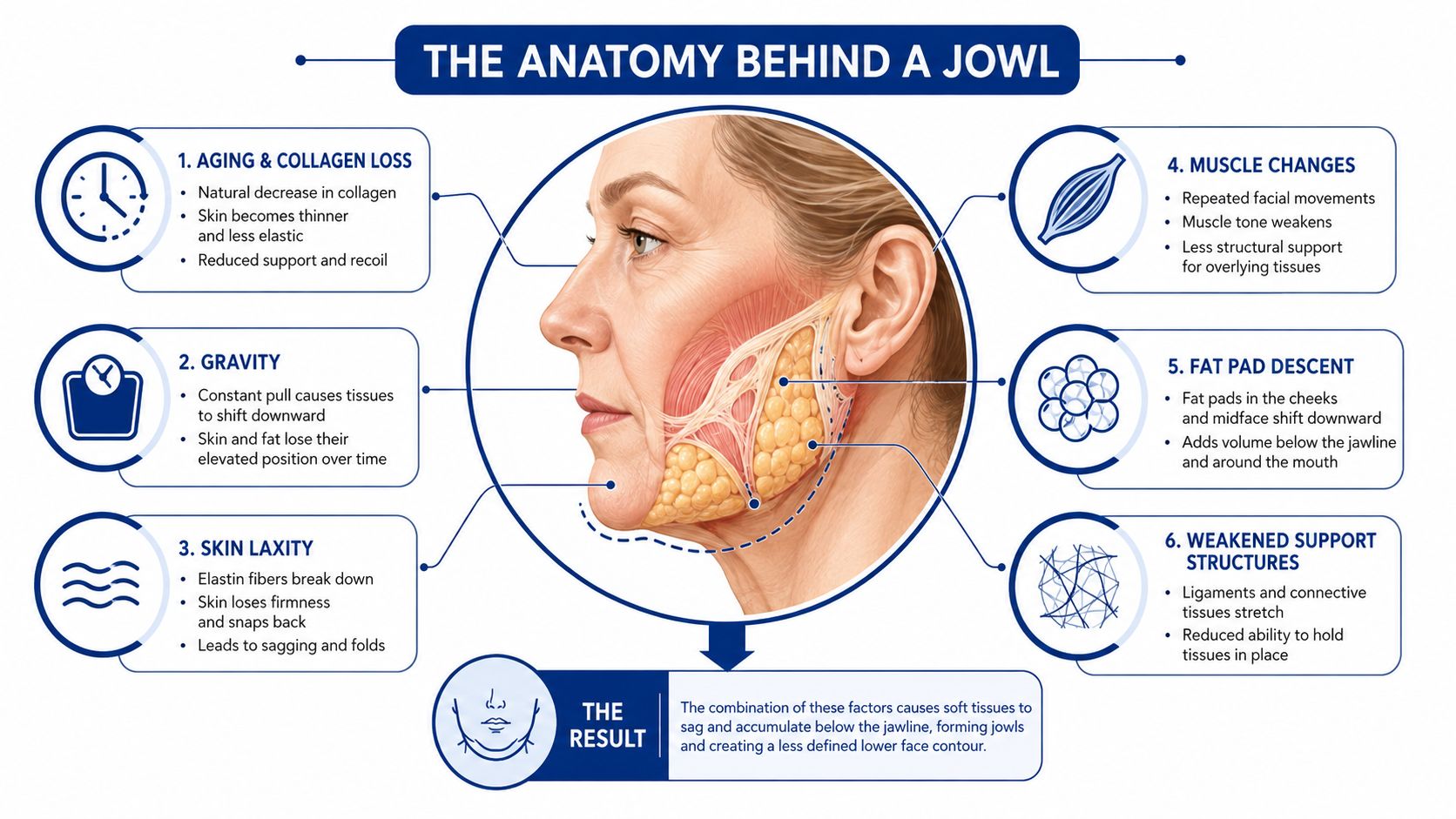
A jowl is best understood as a layered age-related change in the lower face, not as one wrinkle or one loose flap of skin. A 2008 anatomic study described the jowl as two distinct subcutaneous fat compartments above the mandibular border. The mandibular septum separates those compartments from neck fat, while the overlying skin helps define the contour visible in the mirror. The anatomic study of jowl formation also helps explain why surgeons now treat jowls as a structural issue rather than a vague cosmetic label.
Several changes can occur together:
- Skin loses elasticity, so it doesn't contract around the new contour as effectively.
- Fat redistributes, with some compartments descending and others becoming depleted.
- The SMAS and platysma support system relaxes, allowing deeper tissue to move downward.
- Retaining ligaments weaken or create fixed boundaries, making the jowl appear more distinct.
- Prejowl volume can diminish, leaving a hollow in front of the bulge.
- Skeletal support changes over time, which can make soft-tissue descent easier to see.
That combination explains why pulling the skin backward can create a temporary visual improvement but doesn't reproduce a durable surgical result. Skin tension changes the surface. A lift may need to reposition deeper tissue, release selected attachments, support the neck, and restore volume where the jawline has become hollow.
Practical rule: The treatment should follow the failed layer. Skin quality, tissue position, muscle tone, and volume deficiency aren't interchangeable problems.
Skin care still has value. Sun protection and consistent preventive habits can support skin quality, although they can't reposition descended tissue. For practical background on protecting the skin as it ages, Healtsy aging prevention tips can be a useful general resource.
The central question isn't “Which lift is best?” It's, “What is creating my jowl?” That answer separates a short-scar procedure from a deeper facelift, and a lifting procedure from fat grafting, neck contouring, or skin tightening.
The Anatomy Behind a Jowl
Think of the lower face as a layered support system rather than a single sheet. The superficial fat compartments are like cushions resting on a shelf. As the shelf and its attachments lose support, a cushion can slide toward the edge. The visible fullness isn't necessarily new fat. It may be familiar tissue in a different position.
The jowl has a specific anatomic pattern. Surgical anatomy research describes it as redundant subcutaneous tissue in the supra-platysmal plane, with fullness often most apparent near the posterior end of the mandibular ligament. Anteriorly, the labiomandibular crease helps tether the skin. Those attachments create a transition between the jowl and the chin, much like a seam that makes a fold more obvious. Surgical anatomy of the jowl clarifies why tightening surface skin may leave the underlying bulge.
The supporting layers
The SMAS, or superficial musculoaponeurotic system, acts like a structural scaffold beneath the skin. It connects facial muscles with surrounding connective tissue. When it becomes lax, the lower-face tissues can descend, producing heaviness along the jawline.
The mandibular retaining ligaments are more like anchor points. They hold skin and soft tissue in defined locations. As adjacent tissue moves, these anchors can create a sharp border between the jowl and the prejowl area rather than allowing a smooth transition.
The prejowl sulcus is the hollow immediately in front of the jowl. It can deepen when fat atrophies, facial volume shifts, or underlying skeletal support becomes less prominent. That hollow makes the tissue above it appear fuller, even when the jowl itself hasn't become dramatically larger.
The platysma is a thin sheet of muscle extending through the neck. Banding, laxity, or poor neck definition can make the lower face look heavier and can blur the line between jaw and neck. The 2024 anatomic literature also identifies gravitational descent, fat-pad descent, retaining-ligament laxity, skin ptosis, submandibular gland prominence, and facial fat loss as possible contributors. Aesthetic Surgery Journal anatomy discussion
Each layer can require a different response. A surgeon may recommend repositioning, selective release, platysma support, fat grafting, liposuction, or skin treatment. That's why no single procedure solves every jowl in the same way.
Surgical and Adjunctive Options for Jowl Correction
The most useful way to compare treatments is to match each option to the anatomy it can change. A short-scar lift may improve early laxity, but it won't provide the same access as a deeper operation. Fat grafting can soften a hollow, but it doesn't lift a descended jowel. Energy-based treatment can improve skin quality, but it can't reproduce structural repositioning.
| Procedure | Anatomic Target | Best Suited For |
|---|---|---|
| Short-scar mini lift | Skin and selected lower-face support tissues | Early jowling with reasonable skin elasticity |
| SMAS facelift | SMAS, lower-face soft tissue, mandibular border | Moderate laxity requiring deeper support |
| Deep-plane facelift | Deeper facial tissue planes and retaining structures | More established descent and complex lower-face laxity |
| Lower face and neck lift | Jawline, platysma, neck skin, and cervical laxity | Jowls combined with bands or submental fullness |
| Fat grafting | Prejowl sulcus and other depleted zones | Hollowing that exaggerates the jowl |
| Submental liposuction | Localized neck fat | Fullness beneath the chin with suitable skin recoil |
| Energy-based tightening | Skin and superficial collagen framework | Mild laxity or a complement to surgery |
Matching the procedure to the problem
A mini lift generally suits a patient with early jowling, localized laxity, and skin that still has useful recoil. It usually involves shorter scars and may be performed with local anesthesia and sedation, but the limited access also limits how much deeper tissue can be repositioned. Its durability depends heavily on whether the underlying laxity is mild enough for that approach.
A SMAS facelift addresses the support layer beneath the skin. An extended SMAS technique provides access to the anterior jawline and neck and is designed to reduce jowling, submental fullness, and platysmal banding. StatPearls' discussion of extended SMAS facelift technique describes why this approach can be useful when the problem extends beyond the skin.
A deep-plane facelift works through a deeper anatomic plane and can be considered when the surgeon needs broader tissue mobilization. Recent comparative evidence found extended deep-plane techniques performed better than standard deep-plane techniques for reducing jowls and cervical laxity, while another review found greater photographic correction when prejowl fat grafting was added to, or substituted for, mandibular ligament release. The comparative surgical evidence supports tailoring the operation to both descent and volume deficiency.
A lower face lift may also be combined with neck treatment. Clinical literature has described SMAS-platysma rotation flaps and platysmal transection for correcting jowls, submental laxity, and platysma bands. The surgical literature on SMAS-platysma support shows why the neck often belongs in the same conversation.
For mild laxity, skin care and energy-based treatment may delay surgery. A patient considering those options may find AloeCure's guide to firmer skin helpful for general skin-quality context. For localized chin or neck fullness, review chin and neck liposuction as a separate contouring option. Ideal Face & Body also offers facial lift and contouring procedures, including awake approaches, as part of its facial surgery services.
Who Is a Good Candidate for Jowl Surgery
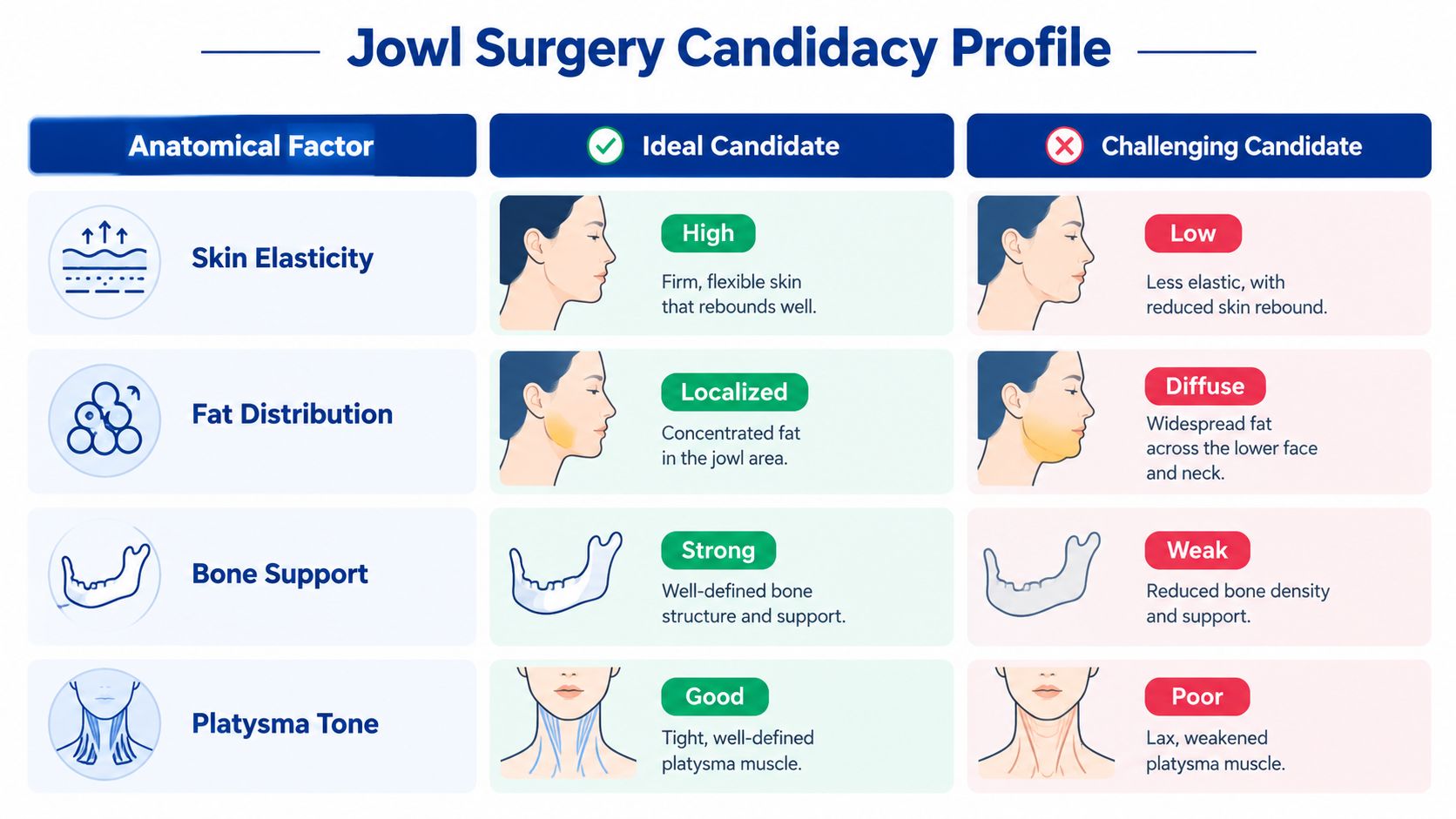
Candidacy isn't determined by age alone. It depends on the relationship between skin elasticity, tissue descent, fat distribution, bone support, and platysma tone, along with general health and expectations.
A person with early jowls and good skin recoil may be a candidate for a mini lift or a carefully selected awake procedure. The operation can focus on localized lower-face laxity, but the surgeon should be clear about what it won't address. If the deeper tissues have descended substantially, a short scar may not provide enough access.
Moderate laxity usually calls for a more detailed discussion. A SMAS or deep-plane facelift may be appropriate when the jawline has lost definition because the support layer and soft tissue have moved, not just because the skin has stretched. A neck lift becomes more relevant when platysmal bands, submental fullness, or a poorly defined neck angle accompany the jowls.
Weight-loss-related change deserves separate consideration. When the face has deflated, a lift alone may reposition tissue without restoring the volume that once supported the prejowl area. In that setting, the plan may involve lifting plus fat grafting, skin contraction, or contour refinement. The cause of the laxity matters because repositioning, volume restoration, and skin tightening solve different parts of the problem.
Health and expectations matter
A surgeon may postpone or decline elective surgery when a patient has uncontrolled hypertension, a clotting disorder, active smoking, or another medical issue that raises risk. The same applies to expectations that no operation can meet, such as demanding a perfectly permanent contour or assuming every crease will disappear.
Use this self-screen as a starting point, not a diagnosis:
- Skin snap: Does the skin contract after gentle pinching, or does it remain loose?
- Fat pattern: Is fullness concentrated under the chin, along the jowl, or spread across the lower face?
- Volume balance: Is there a hollow in front of the jowl that makes the bulge look stronger?
- Neck muscle: Do bands or vertical cords appear when the neck tightens?
- Health readiness: Can you safely pause smoking and manage existing medical conditions?
- Expectation quality: Are you seeking a refreshed contour rather than a completely different face?
A consultation should convert those observations into an anatomic plan. Mild cases may be redirected toward non-surgical care. More developed jowls usually require a candid discussion about scar placement, dissection depth, anesthesia, recovery, and the possibility of combining procedures.
Awake Local Anesthesia Versus General Anesthesia
The choice between awake local anesthesia and general anesthesia should follow the operation, not marketing language. Local anesthesia with oral or intravenous sedation can suit shorter, more focused procedures, including selected mini lifts and limited lower-face work. General anesthesia may be more appropriate when the surgeon plans deeper dissection, longer combined procedures, or extensive neck treatment.
| Factor | Awake Local with Sedation | General Anesthesia |
|---|---|---|
| Dissection depth | Often suited to focused or more superficial work | Supports deeper SMAS or sub-SMAS dissection |
| Patient experience | Patient remains responsive, usually with sedation | Patient is fully unconscious |
| Muscle relaxation | More limited | Complete relaxation supports longer operations |
| Procedure scope | Best for selected, narrower corrections | Better suited to extensive combinations |
| Recovery considerations | May avoid some effects associated with general anesthesia | Requires recovery from both surgery and anesthesia |
| Patient selection | Requires comfort with the setting and appropriate anatomy | Requires medical assessment for a deeper anesthetic plan |
An awake approach can offer a simpler recovery pathway and may allow real-time communication. It can also limit the length and depth of dissection. A surgeon can't safely promise that local anesthesia is suitable merely because a patient wants to avoid general anesthesia. The anatomy, procedure, facility, monitoring, sedation plan, and medical history all matter.
General anesthesia gives the surgeon a motionless patient and complete muscle relaxation. That can be valuable for a deep-plane facelift, extensive platysma work, or a combined lower-face and neck operation. It also involves more preoperative planning and greater physiologic demands, so the decision should be individualized rather than framed as a contest between “modern” and “traditional” care.
For readers specifically considering the awake pathway, facelift under local anesthesia explains how local anesthesia may fit selected facial procedures. Ask who administers sedation, where the procedure occurs, how the team monitors you, and what happens if the planned operation needs to change.
What Recovery Actually Looks Like Week by Week
Consider a representative patient who undergoes a lower-face procedure with or without neck treatment. The exact course varies with dissection depth, skin quality, adjunctive procedures, medications, and individual healing. A realistic recovery plan includes milestones, but it also leaves room for uneven swelling and temporary numbness.
The first days
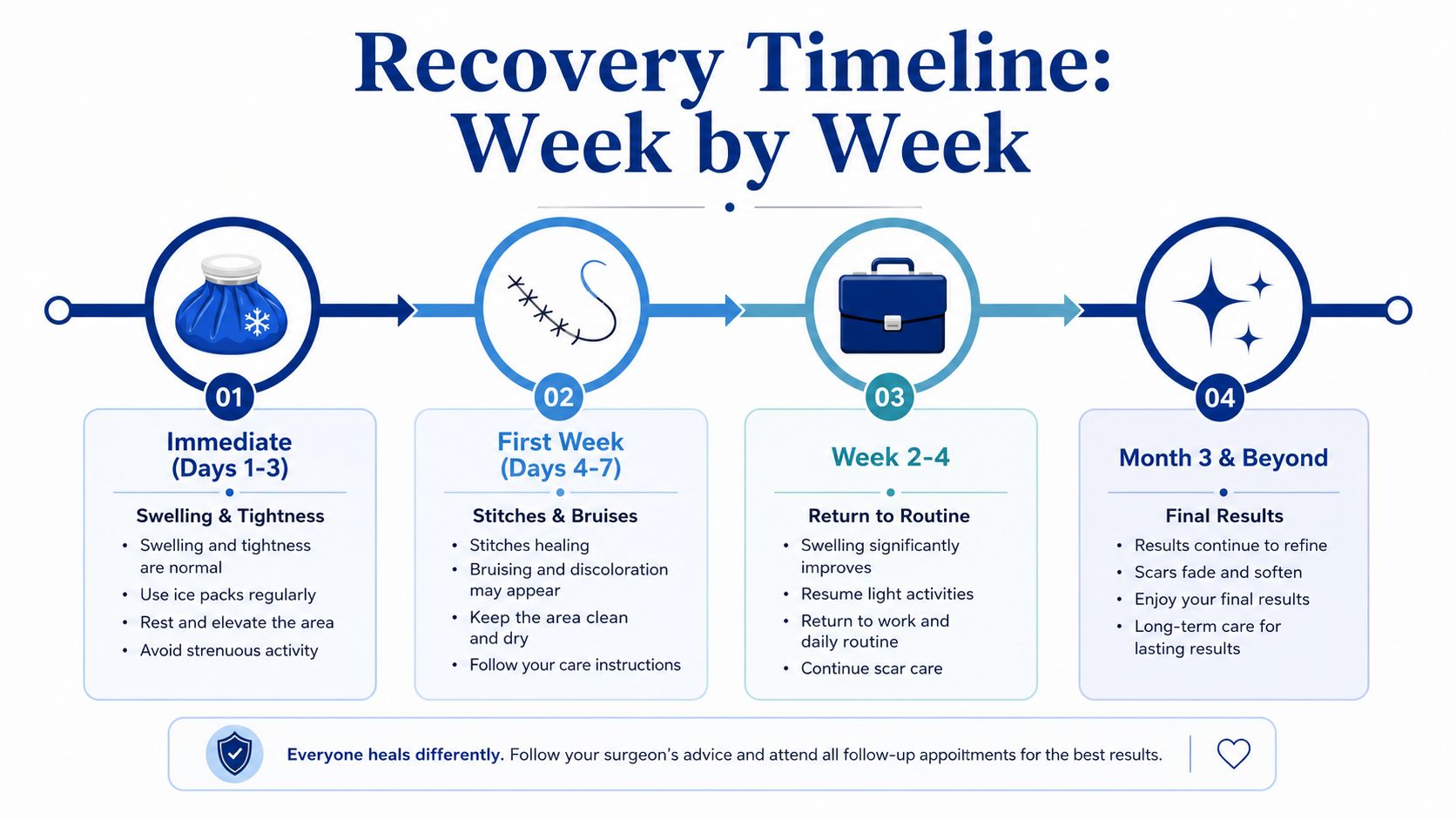
During days one through three, swelling, tightness, bruising, and mild drainage are common. The patient usually keeps the head raised, follows wound-care instructions, and avoids pressure on the incisions. Cold therapy may be recommended, but only as directed, because excessive pressure or temperature can irritate healing tissue.
By the first week, the surgeon may remove sutures, staples, or dressings according to the technique used. Bruising can change color rather than vanish all at once. Gentle walking is often encouraged, while bending, straining, and vigorous activity remain restricted.
Returning to ordinary life
During weeks two and three, many patients begin light social activity. Makeup may help camouflage residual bruising when the incisions are closed and the surgeon approves it. Lymphatic massage can sometimes be introduced, but it shouldn't begin without specific guidance, particularly after deeper dissection.
By weeks four through six, the surgeon may clear progressive exercise. Jawline definition becomes easier to judge, although numbness, firmness, and uneven swelling can persist. Nerves and skin sensation often recover gradually rather than on a fixed schedule.
The result continues to mature after the early social recovery period. Scar texture softens, residual swelling resolves, and the contour stabilizes over the following months. Final assessment may take six to nine months, particularly after extensive surgery. Facelift recovery time offers additional practical context for planning work and social commitments.
Sleep with the head raised if instructed, protect healing scars from sunlight, and avoid smoking. Contact the surgeon promptly for rapidly increasing swelling, severe or worsening pain, fever, drainage that concerns you, wound separation, breathing difficulty, or any symptom that feels out of proportion to the expected course.
How to Choose the Right Surgeon for Jowl Correction
Choosing a surgeon is a verification process, not a popularity contest. A polished website can't tell you whether the surgeon understands your specific jowl anatomy, performs the recommended operation regularly, or has a safe and consistent anesthesia system.
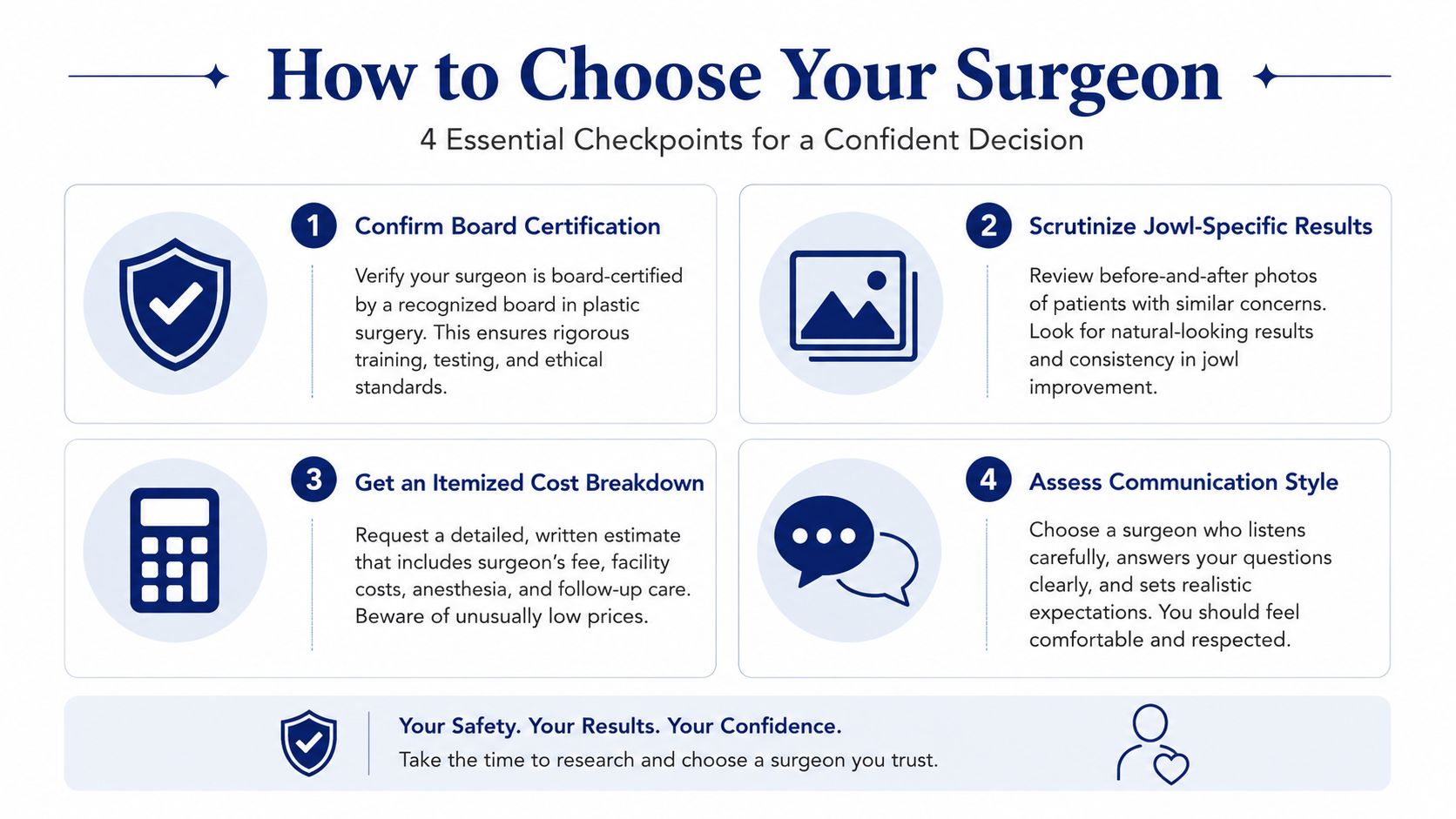
Start with four checks:
- Confirm certification. Look for American Board of Plastic Surgery certification or an equivalent facial-plastic credential recognized in your region. Confirm that the surgeon has appropriate hospital or accredited-facility privileges.
- Review jowl-specific results. Ask to see before-and-after photographs of patients with lower-face laxity, prejowl hollowing, and neck changes similar to yours. The gallery should show a meaningful range of patients, not only one ideal result.
- Ask about frequency. Find out how often the surgeon performs the exact procedure being recommended, whether that means a mini lift, SMAS facelift, deep-plane facelift, or neck lift.
- Verify anesthesia and facility details. Ask who administers anesthesia or sedation, where the operation occurs, how emergencies are handled, and whether the facility is accredited.
Questions that reveal the plan
Bring the same questions to every consultation:
- Approach: Which operation are you recommending, and why does it match my anatomy?
- Depth: Will you work on skin, SMAS, platysma, deeper planes, retaining ligaments, or several layers?
- Volume: Do I have prejowl hollowing that needs fat grafting or another form of restoration?
- Risk: What complications do you discuss most often, and how do you manage them?
- Revisions: How do you define and track your revision rate?
- Anesthesia: Who will monitor me, and what would make you change the anesthesia plan?
- Communication: Can I speak with a previous patient, where appropriate, or review comparable results?
Be cautious if a practice relies on heavy discounting, lacks clear facility information, or avoids direct answers about complications and revision surgery. If you're exploring non-surgical ways to manage facial discomfort while deciding whether cosmetic surgery is appropriate, non-surgical facial pain options may provide separate educational context, but those services aren't substitutes for evaluation of structural jowling.
Key Takeaways and Next Steps
Five principles should guide a thoughtful decision about lower face lift jowls:
- Jowls are layered. Skin, fat, SMAS, ligaments, platysma, facial volume, and skeletal support can all influence the contour.
- Candidacy is structural. Skin elasticity, fat distribution, neck muscle behavior, health, and expectations matter more than age alone.
- Treatment should be matched to anatomy. A mini lift, SMAS facelift, deep-plane facelift, neck lift, fat grafting, liposuction, and energy-based treatment each have different targets.
- Awake anesthesia isn't a universal shortcut. It can suit properly selected, focused procedures, but deeper or longer operations may require a different anesthetic setting.
- Technique branding matters less than execution. The surgeon should explain what tissue will move, what volume may need restoration, where scars will sit, and what recovery requires.
A good next step is to schedule two consultations with board-certified surgeons who regularly perform jowl-focused procedures. Bring the same questions to both appointments, compare their anatomic assessments side by side, and request computer imaging if the practice uses it to clarify expectations. Don't commit until you understand the proposed depth, anesthesia plan, adjunctive procedures, limitations, and recovery.
Ideal Face & Body offers facial procedures that address lower-face laxity, jawline definition, and neck contouring, including selected awake, local-anesthesia approaches. Visit Ideal Face & Body to review the practice's facial surgery options and request a consultation focused on your jowl anatomy and goals.