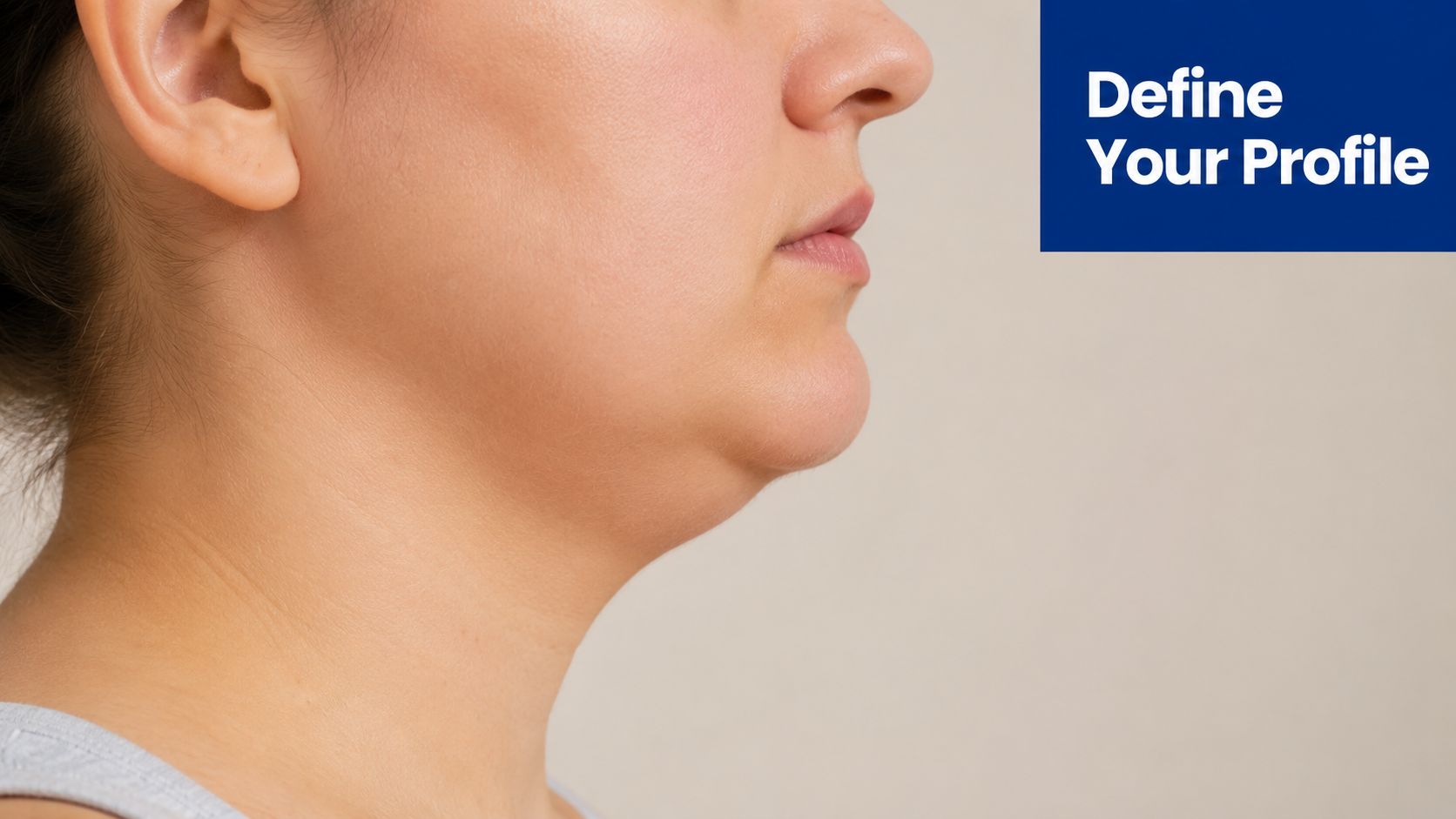
You may be exercising consistently, maintaining a stable weight, and still see a soft fold beneath your chin every time you look down or turn toward a mirror. That fullness can blur the jawline, shorten the appearance of the neck, and make the face look heavier than it is. The frustration is understandable, but the solution isn't always “remove more fat.”
Laser liposuction chin treatment is best understood as a contouring procedure with two coordinated actions. A surgeon reduces a localized fat pocket beneath the chin, then uses controlled thermal energy to encourage contraction in the overlying skin. The result depends on the relationship between fat thickness, skin elasticity, muscle banding, and underlying facial structure, not on fat removal alone.
Table of Contents
- What Laser Liposuction Chin Really Means
- How It Differs From Traditional Chin Liposuction
- Who Makes a Good Candidate for Chin Laser Lipo
- The Awake Office Experience Step by Step
- Recovery Timeline and When to Add a Lift
- Risks, Realistic Results, and Revision Thinking
- Practical Questions for Your Consultation
What Laser Liposuction Chin Really Means
The two actions beneath the skin
You may pinch a small fold beneath your chin and assume the answer is simple fat removal. The contour depends on more than that pocket. Laser liposuction chin treatment combines fat reduction with controlled heating, so the surgeon evaluates fat thickness, skin elasticity, muscle banding, and underlying facial structure before choosing an approach.
Laser-assisted lipolysis uses tumescent anesthesia, a small cannula, and an optical fiber to deliver energy into submental fat. A published technical series described a 1-mm microcannula with a 600-μm fiber, distributing energy through the treated layer after the area was numbed (published technical series).
The energy helps soften or disrupt fat for controlled suction. It also produces carefully managed heat in deeper skin layers, which may support dermal contraction. That is why the procedure can address fullness and mild skin laxity rather than volume alone.
The usual field runs from the submental crease toward the hyoid region, with blending along the jawline. Boundaries must match your anatomy. Removing too much from the center, or stopping abruptly, can leave a visible transition between treated and untreated neck tissue.
Practical rule: A pinchable fat pad may respond well to fat reduction. Loose skin, platysmal bands, or jowling can require an adjunct lift, because heating and suction cannot reliably reposition every structure.
Why the “laser” label can confuse patients
Laser energy is an assisting technology, not a replacement for anatomical judgment. Research on submental treatment includes noninvasive approaches, including a 2022 study of a 1060-nm diode laser involving 20 participants, with 95% women, a mean age of 34.55 ± 6.19 years, and mean baseline submental fat thickness of 0.51 ± 0.09 cm (2022 clinical study). Those findings describe a particular study group and device, not a guarantee for every chin.
A 2006 U.S. regulatory milestone marked the first FDA clearance of a laser lipolysis system. Later reviews describe the chin and neck as established areas for submental contouring, so the field is modern while its applications are familiar.
Readers seeking broader context on aesthetic care can visit the Maximum Health Products beauty blog. A focused overview of laser liposuction as a contouring option may also help clarify the technique. The consultation question is whether your anatomy needs refinement, tightening, or a structural lift.
How It Differs From Traditional Chin Liposuction
Traditional tumescent liposuction removes fat mainly through mechanical movement. After the cannula enters the fat layer, the surgeon uses controlled passes and suction to extract cells. Laser-assisted lipolysis adds photothermal energy before aspiration, warming and loosening localized fat so it can be handled with less mechanical effort.
The difference is similar to working with cold butter versus softened butter. A spoon can remove either one, but softened butter spreads and shapes more easily. Laser energy may make a small, resistant area easier to contour. It does not decide the amount removed, protect against overcorrection, or replace the surgeon's judgment about facial proportions.
Where the added energy may help
Heat can influence the tissue around the fat as well. Earlier laser-lipolysis research reported an 18% decrease in surface area in a small subset of patients, supporting a tightening effect in addition to volume reduction (clinical review of laser-assisted lipolysis). That potential matters when the skin can recoil after the chin becomes slimmer. Skin with limited elasticity may still require a lift or another tightening approach.
Laser energy may also assist with fibrous fat that feels firm during suction-only treatment. Smaller access points can permit detailed work in a narrow submental region, but the instrument size, wavelength, and technique differ among systems and surgeons. A small opening does not make tissue handling risk-free.
Why the chin demands restraint
The area beneath the chin has thin soft-tissue coverage and highly visible transitions into the jawline and neck. Leaving too much fat preserves fullness. Removing too much, or blending unevenly, can produce hollows, depressions, or asymmetry that shows in ordinary lighting.
Published pooled findings support measured contour refinement rather than unlimited removal. A systematic review reported a responder rate of approximately 70% to 75% across nonsurgical submental contouring modalities. A pooled analysis reported a mean reduction of 4.60 mm overall and 0.96 mm for laser lipolysis, with a 95% confidence interval of 0.37 to 2.30 mm (systematic review and pooled outcomes). These figures describe study results, not a promised change for an individual patient.
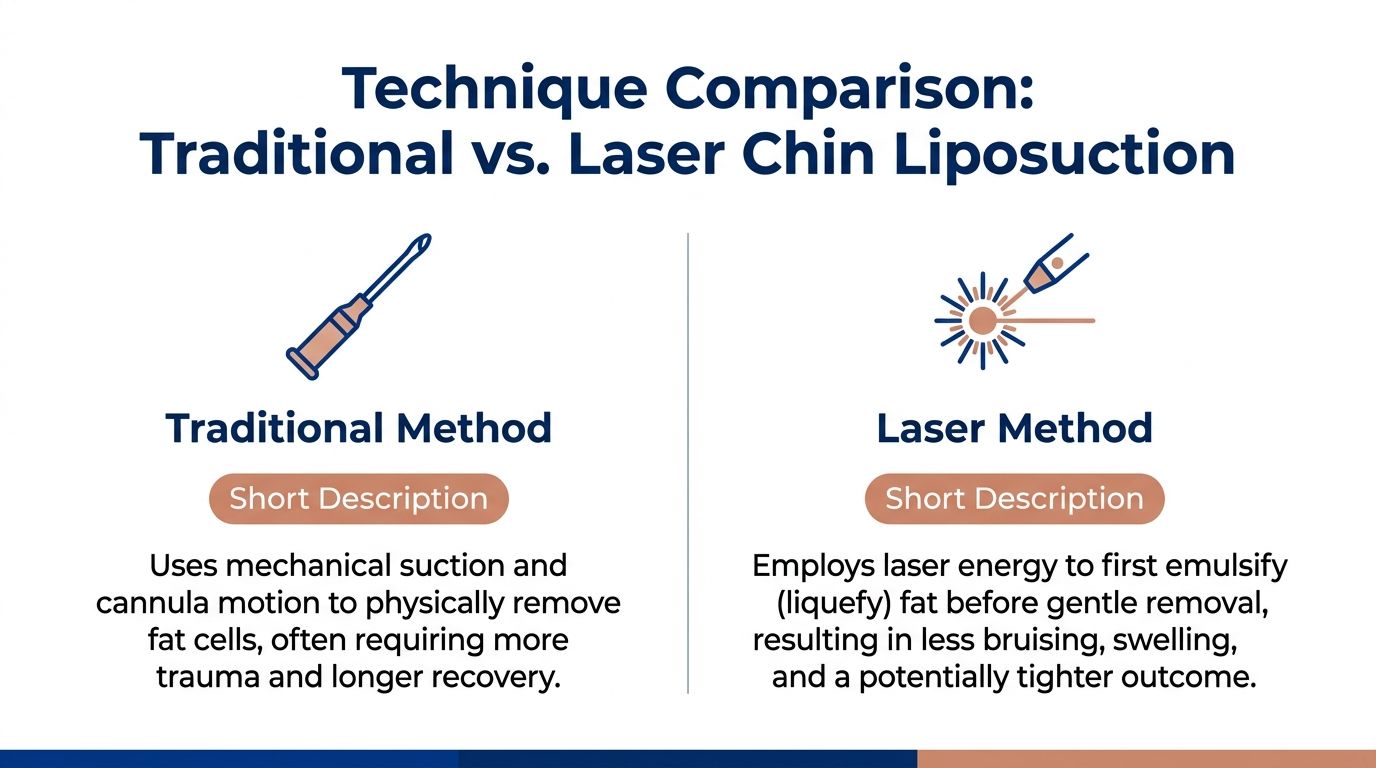
A comparison of traditional and laser liposuction can clarify the technical distinctions. The practical choice depends on the tissue problem. A patient with localized fat and responsive skin may benefit from laser-assisted contouring. Marked laxity or visible muscle banding may make an adjunct lift the more predictable plan.
Who Makes a Good Candidate for Chin Laser Lipo
Candidacy starts with identifying what creates the shadow under your chin. A surgeon examines the tissue while you sit upright, pinches the fat, assesses skin movement, watches the platysma during facial expression, and studies the jawline from several angles.
Fat thickness and distribution
A discrete, pinchable submental pad is generally more favorable than fullness that spreads broadly across the neck. A compact pocket can often be sculpted with controlled passes. Diffuse fullness may involve deeper structures or a wider neck contour problem, so isolated treatment may not address the full appearance.
Stable weight matters because this is a contouring procedure, not a weight-loss method. The best candidates usually seek refinement of one resistant area rather than a major change in overall body size.
Skin quality and recoil
After fat reduction, the skin has to redrape over a smaller contour. Skin with reasonable elasticity can contract smoothly. Skin affected by substantial sun damage, smoking-related tissue changes, or pronounced laxity has less reserve.
Age alone doesn't decide candidacy. A younger adult with inherited fullness may be an excellent candidate, while an older adult with early laxity may still benefit if the skin remains responsive. Conversely, a younger patient with marked loose skin may need a different plan.
Muscle bands and structural support
Visible platysmal cords are a separate problem from fat. Laser energy can improve the fat layer and may offer some tightening, but it won't reliably erase strong muscle banding. A submentoplasty or neck lift may deserve discussion when bands, loose central skin, deep jowls, or prior weight loss define the concern.
The same principle applies to bone structure. A small or recessed chin can make the neck look fuller even when the fat pad is modest. Removing fat without considering projection can produce an underwhelming result.
| Factor | Good Fit | Proceed With Caution | Wrong Tool |
|---|---|---|---|
| Fat pattern | Localized, pinchable fullness beneath the chin | Fullness extending broadly into the neck | Little fat with a primarily structural concern |
| Skin quality | Mild laxity with reasonable recoil | Noticeable laxity or significant sun damage | Excess skin requiring removal |
| Muscle | Minimal visible platysmal banding | Intermittent bands or early neck separation | Prominent cords needing muscle treatment |
| Expectations | Wants sharper contour and modest tightening | Expects a dramatic change | Expects weight loss or perfection |
| Health and recovery | Medically stable and prepared for aftercare | Healing risk factors requiring optimization | Poorly controlled conditions or inability to follow instructions |
Someone with unrealistic expectations, active hernias, poorly controlled medical conditions, or unwillingness to wear postoperative compression may not be ready for treatment. Good candidacy is as much about expectation and cooperation as it is about the size of the fat pocket.
The Awake Office Experience Step by Step
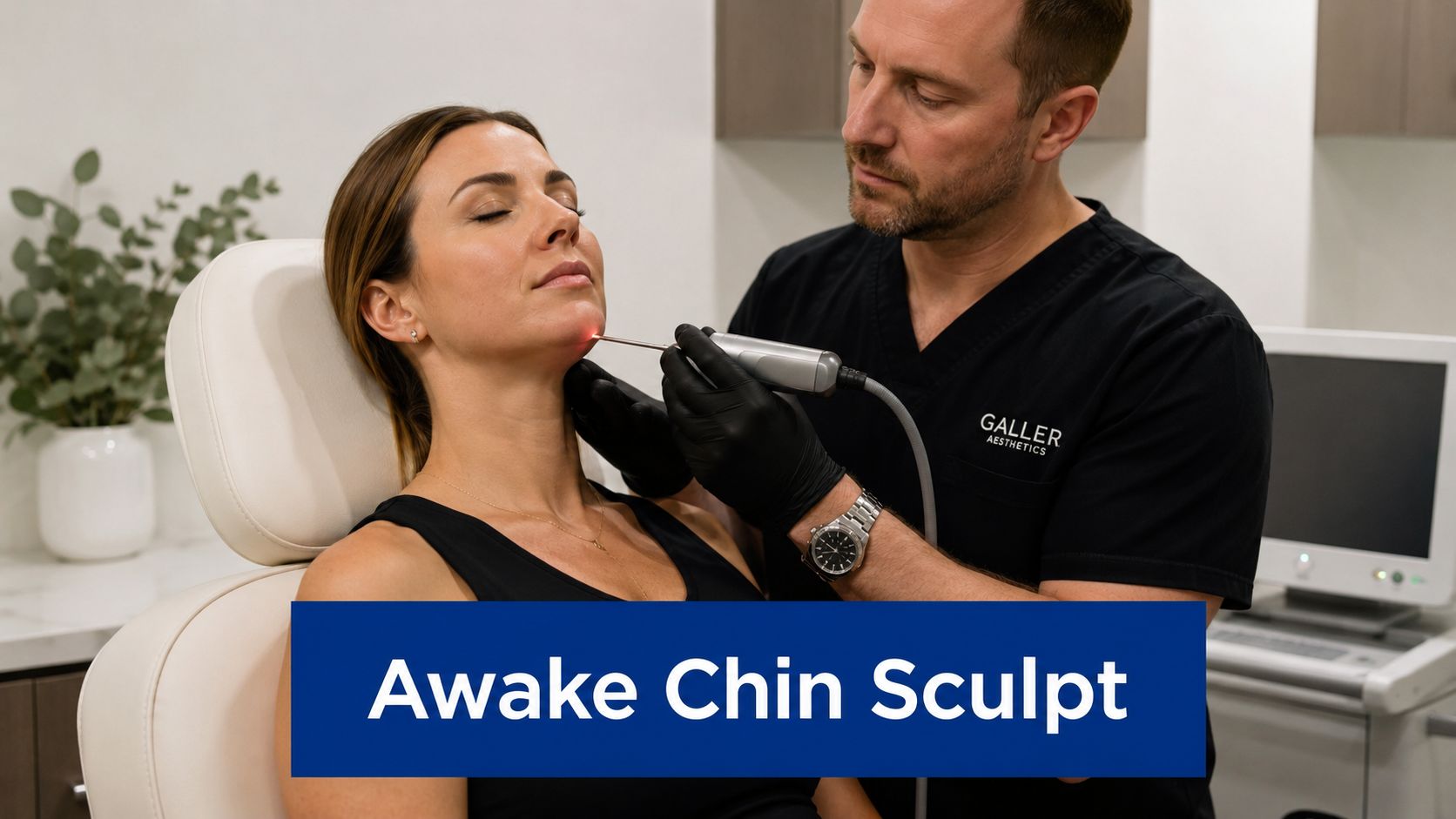
An awake appointment uses local anesthesia instead of unconsciousness. You remain alert, can describe sensations, and may sit upright during assessment. That position can help the surgeon judge symmetry and contour in a way a fully flat position cannot. The goal is communication and control, while keeping the procedure focused on both fat reduction and skin response.
Before the first pass
The team reviews your medical history, confirms the plan, photographs the area, and marks the treatment zones. Vitals are monitored, and oral sedation may be discussed when appropriate. Tumescent lidocaine solution is placed through a small access point beneath the chin.
You may feel cool or slightly warm fluid entering the tissue, followed by pressure as numbness develops. Local anesthesia aims for strong comfort, not the removal of every sensation. Movement, tugging, or pressure may remain as the cannula passes through the treatment layer.
During laser-assisted contouring
A small cannula carries the fiber through the fat. The technical series described earlier used a 1-mm microcannula and 600-μm fiber to distribute energy through subcutaneous tissue. The surgeon works methodically, treating central fullness and blending the result toward the jawline. The energy can soften fat and encourage tissue contraction, but it cannot correct every form of loose skin or prominent muscle banding.
You may notice mild pressure, pulling, or a faint smell produced by the interaction between energy and tissue. Staying awake lets you report discomfort and allows the surgeon to reassess the contour while you sit or raise your head. That feedback is useful because a sharper outline depends on even transitions, not on removing as much fat as possible.
Finishing and discharge
After the fat has been liquefied or softened, gentle aspiration removes it through a small port. The team applies a compression garment or custom wrap, reviews wound care, and checks that you are not unusually light-headed before discharge. A prospective study of neck and submental remodeling reported return to normal activities averaging 3.2 ± 1 days (prospective remodeling study).
Chair time varies with the treatment plan and office protocol. If sedation is used, do not drive yourself. Arrange a calm first evening at home and follow the office's instructions for compression and wound care.
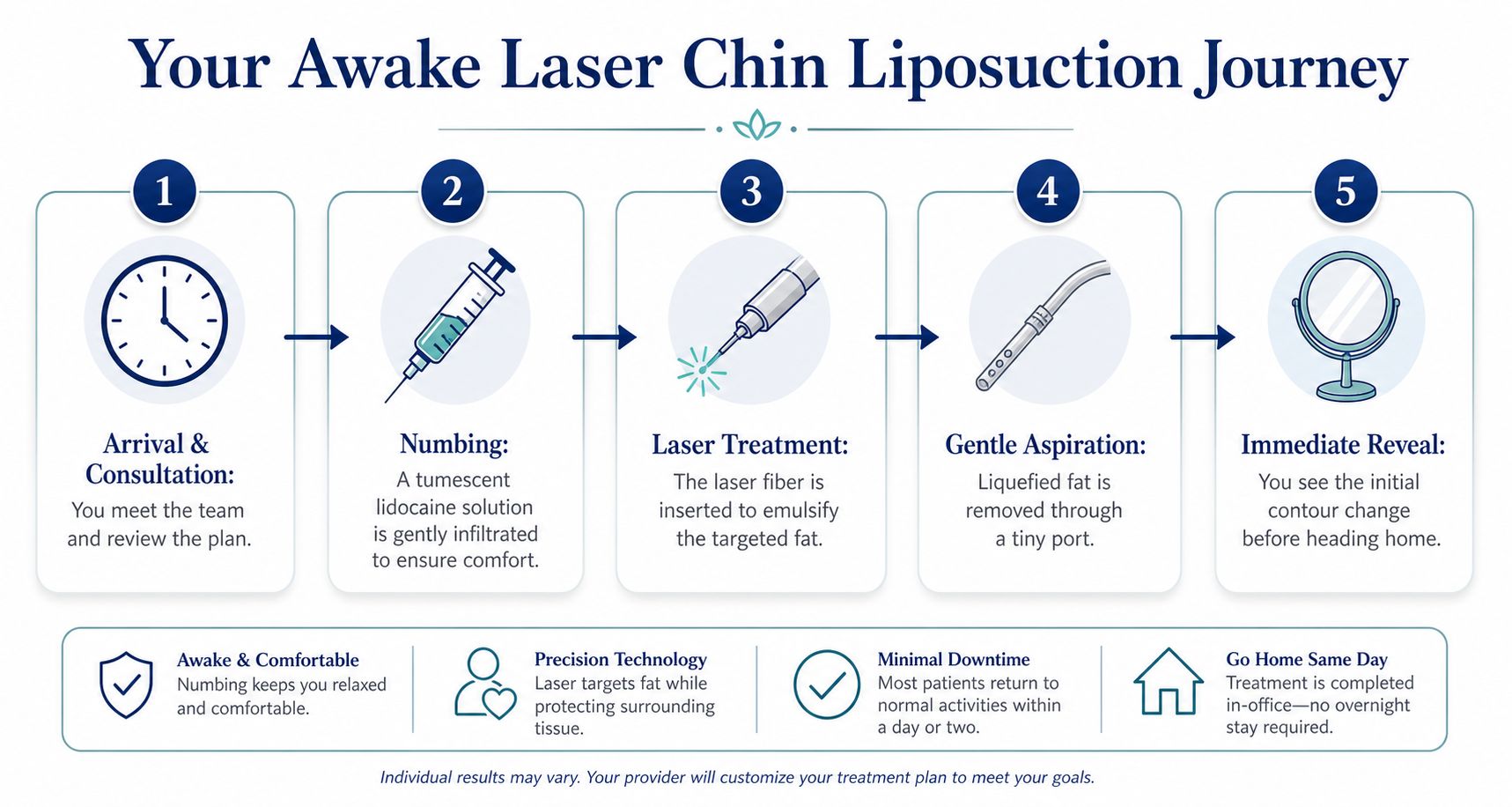
A practical overview appears in this guide to how laser liposuction is performed. The device is only one part of the process. Local anesthesia, careful marking, real-time communication, and conservative contour judgment determine whether the result looks balanced rather than hollow or uneven.
Recovery Timeline and When to Add a Lift
Recovery doesn't follow a single photograph or a promise of “minimal downtime.” The first days are dominated by swelling and support, while the later weeks reveal how the skin and deeper tissues are adapting.
The early days
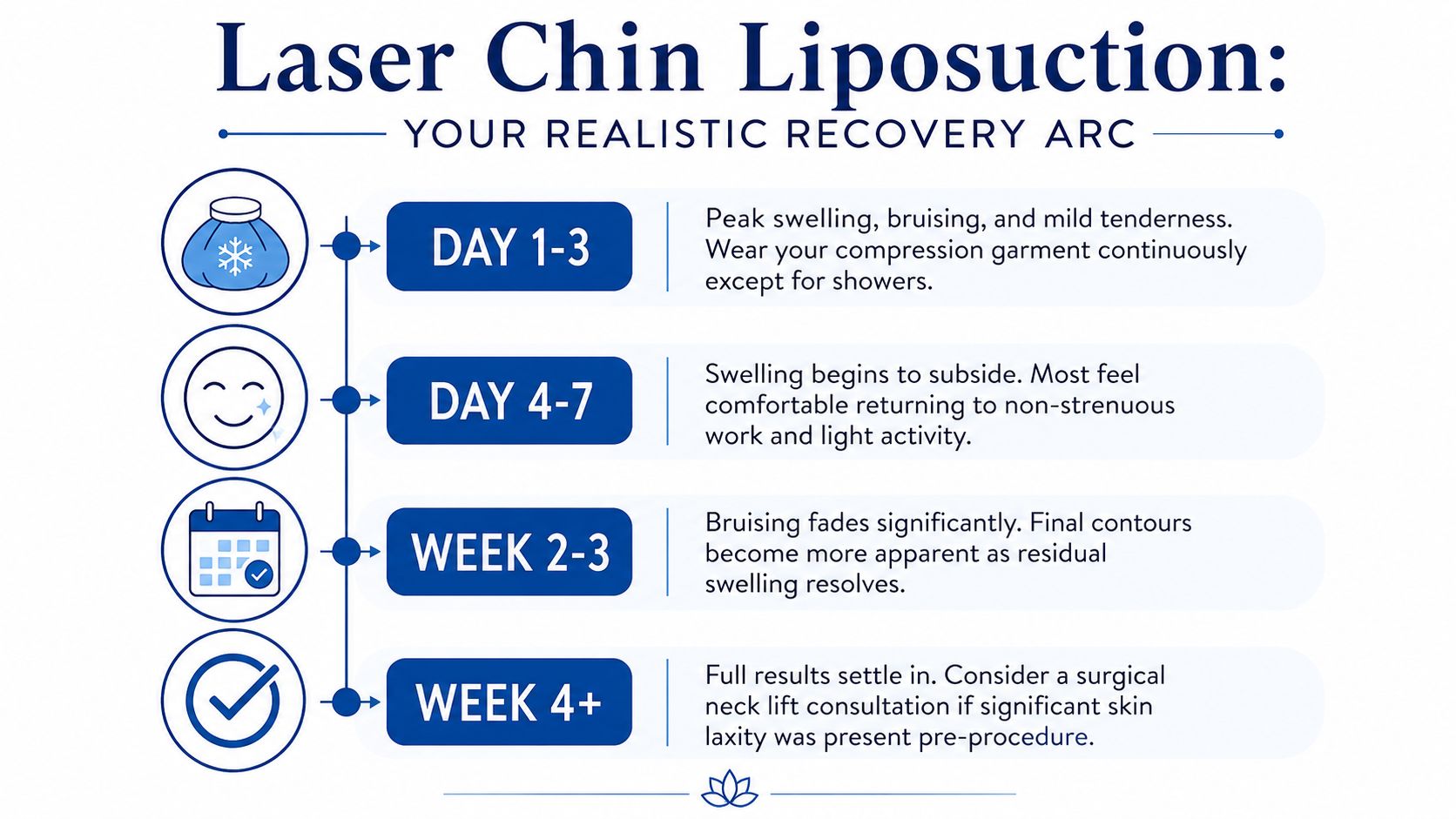
During days one through three, expect swelling, bruising, tenderness, and a sense of tightness. Compression is generally worn continuously except for showers, according to the treating practice's instructions. Rest helps, but gentle walking is often encouraged when medically appropriate.
Between days four and seven, bruising usually begins to fade. Swelling may feel less fluid-like and more firm beneath the skin. Light activity may resume, while strenuous exercise should wait until your surgeon clears it. Lymphatic massage, if recommended, should be performed by someone familiar with postoperative facial and neck care.
The settling phase
By week two, many patients feel more comfortable in social settings, although makeup may still be useful for residual bruising. Firmness and swelling can remain, so an early mirror check shouldn't be treated as the final verdict.
During weeks three through six, the contour becomes easier to read as inflammation resolves. A prospective series of 57 patients treated with a 1440-nm Nd:YAG system reported 97% overall satisfaction and a 34.6% improvement in a skin-laxity metric at six months (prospective 1440-nm Nd:YAG series). The timeline for an individual patient can differ, especially when skin laxity was present before treatment.
When a lift is the smarter choice
Laser liposuction is most logical when fat is the main visual problem and the skin has enough recoil to follow the new contour. A lift becomes more relevant when you have:
- Persistent skin laxity: Loose skin remains after the fat pinch is released.
- Platysmal banding: Vertical cords create neck lines that fat reduction won't correct.
- Deep jowls: Lower-face descent extends beyond a small submental pocket.
- Prior weight loss: The skin envelope is larger than the underlying tissue can support.
- Structural concerns: Chin projection or jaw anatomy limits definition.
A submentoplasty can address selected central neck issues. A neck lift offers broader tightening when skin and muscle separation are significant. A mini-facelift may be considered when jowls and lower-face descent are part of the same aging pattern. The right plan may be isolated laser liposuction, a lift, or a staged combination.
Risks, Realistic Results, and Revision Thinking
A responsible discussion separates ordinary healing issues from uncommon but serious events. Bruising, numbness, uneven swelling, temporary firmness, and small access-point scars can occur during recovery. These effects often improve as tissues heal, but they can make the early contour look irregular.
The more consequential risks involve the soft-tissue envelope. A scoping review identified hematoma as a principal reported complication and documented problems including submental depression, edema, hypertrophic scarring, scar contracture, cervical necrotizing fasciitis, and transient facial nerve paralysis (scoping review of complications).
What the evidence says about adverse events
A newer meta-analysis covering 2,085 procedures reported 270 adverse events, an event rate of 12.9% per procedure, with 74.8% classified as minor. The most common events were seroma, surface irregularity or asymmetry, and platysmal banding (meta-analysis of aesthetic submental liposuction).
Those numbers don't predict your individual outcome, and the evidence base remains heterogeneous. They do show why compression, conservative energy delivery, careful follow-up, and prompt reporting of worsening symptoms matter.
Potential complications include:
- Contour irregularity: Uneven removal can create visible depressions or asymmetry.
- Fluid collection: Seroma or hematoma may require observation, drainage, or further treatment.
- Thermal injury: Excessive or poorly controlled heat can injure skin.
- Pigment change: Hyperpigmentation may occur temporarily or persist.
- Nerve symptoms: Temporary or lasting weakness is uncommon but important.
- Skin compromise: Necrosis is rare and requires urgent management.
What “realistic results” means
Laser liposuction can sharpen the transition from chin to neck and reduce a localized fat pad. It cannot guarantee a sculpted jawline when loose skin, strong bands, jowling, or skeletal structure are the dominant limitations.
A 24-subject study of a 1440-nm Nd:YAG system reported 79% significant improvement at six months, with no reported burns, seromas, hematomas, infection, or nerve damage in that study group (lower-face and neck rejuvenation study). This is encouraging, but a small study shouldn't be treated as a universal promise.
Why revision deserves a place in the first conversation
Touch-up procedures aren't proof that the original treatment failed. Small areas can reveal residual fullness or asymmetry once swelling resolves, and some patients need a different operation when the original diagnosis was incomplete. Older laser-assisted lipolysis data reported a 0.93% complication rate across 537 cases and 3.5% touch-up procedures, although those figures weren't specific to the chin (laser-assisted lipolysis review).
Ask what a revision would involve, when the surgeon would consider it, and whether the issue would be residual fat, scar tissue, loose skin, or muscle. Marketing that promises laser lipo will solve every neck concern regardless of anatomy deserves skepticism.
Practical Questions for Your Consultation
A useful consultation should feel like a diagnostic conversation, not a sales presentation. Bring photographs or examples of the contour you prefer, but also describe what bothers you most: the double chin, jawline softness, loose neck skin, or visible bands.
Questions about diagnosis and technique
Ask the surgeon:
- What is creating the fullness? Is it superficial fat, deeper neck tissue, loose skin, muscle banding, chin projection, or a combination?
- How do you evaluate the fat layer? Will you use a pinch test, upright examination, standardized photography, or imaging when appropriate?
- What energy and cannula approach will you use? Ask how the surgeon controls heat and avoids over-treatment.
- How much awake experience do you have? The answer should address office-based local-anesthesia procedures, not only unrelated body areas.
- What happens if the skin doesn't retract enough? Ask whether a submentoplasty, neck lift, or another option would produce a more complete result.
Before-and-after photographs should show comparable lighting, head position, facial expression, and follow-up timing. Look for patients with a similar combination of fat thickness and laxity, not only the most dramatic examples.
Questions about recovery and revision
Ask how long compression is required, what symptoms warrant an urgent call, when massage or exercise may begin, and how follow-up visits are scheduled. You should also ask how the practice handles residual fullness, contour irregularity, or a result that requires touch-up.
Cost varies by anatomy, technique, facility arrangements, anesthesia choices, postoperative garments, and whether another procedure is added. Request a written explanation that separates the surgeon's fee from anesthesia, facility, garment, medication, and potential revision-related charges.
A strong consultation leaves you with a diagnosis, a plan, alternatives, limitations, and a recovery outline. If you only receive a device name and a promise of tightening, you haven't received enough information.
Ideal Face & Body offers awake, office-based contouring in Beverly Hills, CA, including PRECISION SCULPT laser liposuction for the chin, neck, and jawline, with treatment planning based on the relationship between localized fat and skin laxity. The practice is led by Dr. Justin Yovino, and Dr. Sarah Yovino provides physician-led aesthetic care.
Prepare three priorities before you arrive, such as sharper jawline definition, less submental fullness, or improved neck laxity. That short list helps the surgeon recommend the right tool, including when laser liposuction chin treatment alone isn't the most complete answer.
If you're considering laser liposuction chin treatment, Ideal Face & Body can assess your fat distribution, skin recoil, and neck structure during a personalized consultation in Beverly Hills, CA. Visit Ideal Face & Body to learn about awake contouring options and request a plan designed for your anatomy.