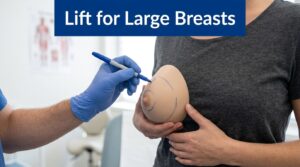
You're standing in the mirror after years of living with the same implants, and the question isn't abstract anymore. The bra feels different, your body feels different, and the breasts you wanted at one stage of life no longer match the life you have now. For many people, implant removal with lift becomes less about “should I remove them?” and more about “how do I keep a shape I can live with after they're gone?”
That second question is where the planning starts. Removal changes the volume, but the breast skin and tissue still have to be arranged into something that looks natural on your frame. A lift, or a different reshaping method, often determines whether the result feels settled and proportional, or empty and collapsed.
Table of Contents
- Why Patients Walk Into the Office Already Knowing the Answer
- What Implant Removal Actually Does to the Breast
- Same Operation or Two Surgeries Comparing Simultaneous and Staged Approaches
- Inside the Operating Room Techniques From Capsulectomy to Awake Mastopexy
- Alternatives to a Traditional Lift From Fat Transfer to Removal Alone
- Risks Recovery and the Scar Conversation Nobody Wants to Have
- Reading Before and After Galleries Like a Surgeon
- Putting It Together Your Three Decisions and the Next Step
Why Patients Walk Into the Office Already Knowing the Answer
A runner in her forties sits down and says the same thing many patients say in different words, “These implants don't belong to me anymore.” Maybe they once fit a fuller style, a postpartum body, or a younger self. Now they feel heavy, cold, or just disconnected from how she moves through the day.
That shift usually comes from several pressures at once. Lifestyle changes matter, and so do weight changes, aging, and a growing preference for smaller, more natural-looking breasts. For some people, concern about capsular contracture, BIA-ALCL awareness, or symptoms they associate with breast implant illness pushes the decision from “someday” to “now.”
Practical rule: when a patient has already been thinking about removal for months, the consultation usually turns on shape, not permission.
The part that catches many people off guard is that removing the implant solves only half of the problem. The skin envelope has usually been stretched for years, and that envelope doesn't magically spring back. Once the implant is gone, the breast can look deflated unless the surgeon also reshapes the remaining tissue and skin.
That's why the decision is usually two decisions layered together, remove versus reshape. The rest of the planning is about matching those two choices to the patient's anatomy, goals, and tolerance for scars, recovery, and possible staged surgery. Public conversation often treats explantation as a single yes or no question, but the shape decision is what determines whether the outcome feels intentional.
What Implant Removal Actually Does to the Breast
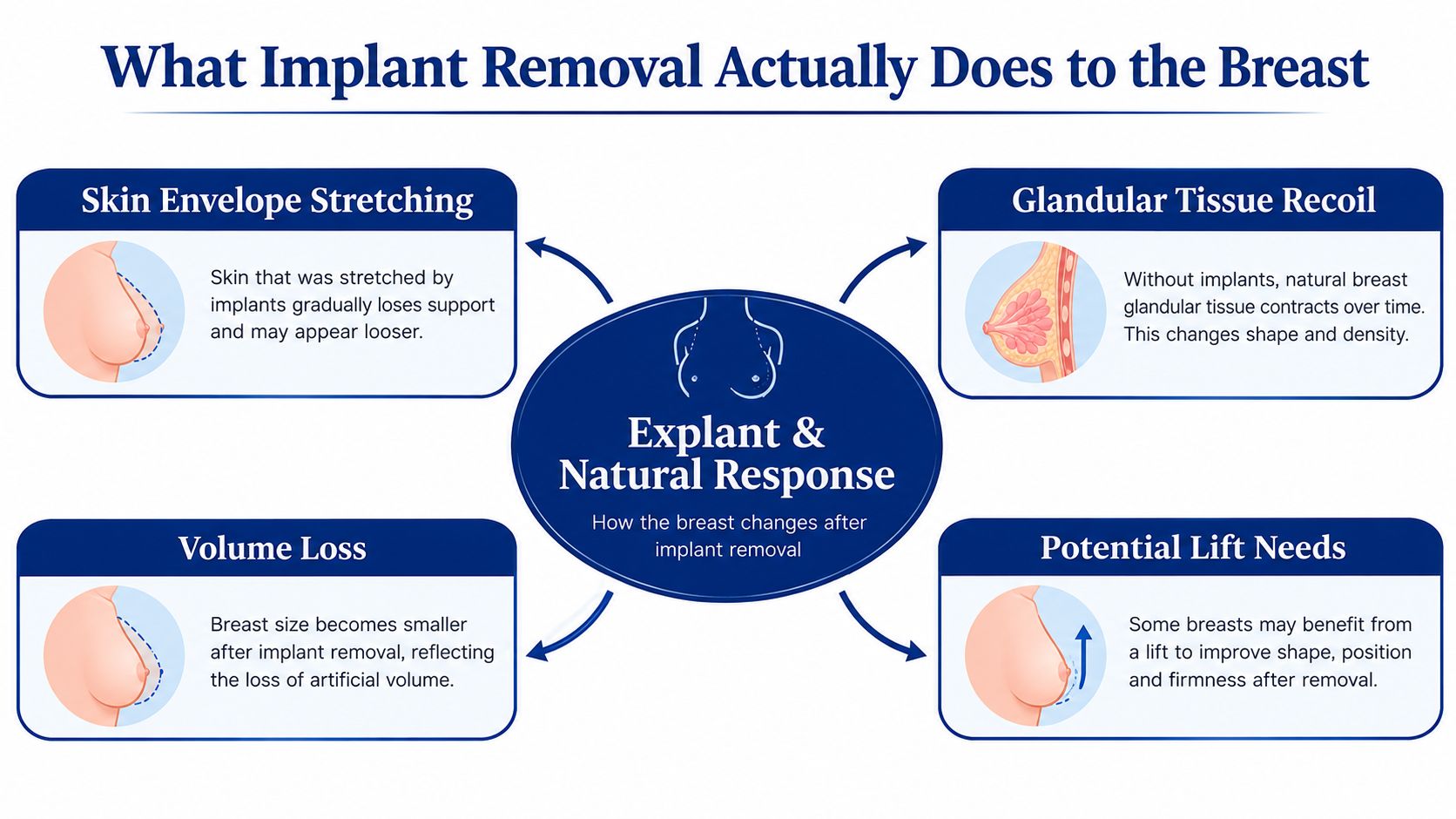
An explant is the operation that removes the implant from the breast pocket. What happens next is not a simple “bounce back.” Years of pressure can leave the skin stretched, the glandular tissue compressed, and the nipple-areola complex sitting lower than it used to.
A useful way to think about it is a balloon that's been inflated for too long. Once the air is released, the balloon doesn't return to a crisp, new shape. The breast can behave the same way, especially when the implants were larger, the skin was thin, or the patient has had pregnancies, weight swings, or natural aging layered on top of the augmentation.
What changes first
The most immediate change is volume loss, but the visual effect isn't only smaller size. The upper pole often flattens, the lower pole can hang, and the nipple may sit lower relative to the fold under the breast. That relationship matters more than cup size because the eye reads position and contour before it reads volume.
Ptosis, or sagging, can range from mild descent to a more obvious drop in the nipple and breast mound. Younger patients with smaller implants and firmer skin sometimes have a near-normal result after removal alone. Patients with long-standing augmentation and lax tissue are much more likely to need reshaping.
A breast lift doesn't “add” volume the way an implant does. It reorganizes what's already there so the skin and tissue sit in a better frame.
That's why the conversation about implant removal with lift is really a conversation about architecture. Removal takes away the internal support, and the lift rebuilds the outline by tightening the envelope and moving tissue where it belongs. The choice isn't cosmetic fluff, it's mechanical.
For a fuller surgical overview, the explant and reconstruction page at Ideal Face & Body's breast implant removal and reconstruction guide shows how these decisions fit into real operative planning.
Same Operation or Two Surgeries Comparing Simultaneous and Staged Approaches
Some patients want one surgery, one recovery, and one set of scars to heal. That's the appeal of doing explantation and mastopexy together. The large modern series matters here, because simultaneous implant removal with mastopexy has been reported with a 4.76% overall complication rate and a 4.63% revision rate in an 841-patient consecutive series, which supports the practicality of combining the two steps in selected patients (ASJ Open Forum series).
The case for staging is different. When the implant pocket is old, the tissue is thin, or the nipple blood supply looks vulnerable, a surgeon may choose to remove first and lift later. That split approach can protect perfusion when a more aggressive reshaping would put too much strain on the nipple-areola complex. In the outcomes literature, combined surgery can be safe, but careful selection still matters more than enthusiasm.
| Factor | Simultaneous one surgery | Staged two surgeries |
|---|---|---|
| Recovery | One recovery period | Two recovery periods |
| Shape correction | Immediate reshaping | Shape built in phases |
| Nipple safety | Depends on tissue and implant history | Often preferred when blood supply feels borderline |
| Scar burden | One operation, but same lift scars | Can mean fewer changes at once |
| Best fit | Good tissue quality, manageable ptosis | Thin tissue, large implants, higher-risk pockets |
The tricky part is that “more surgery” doesn't automatically mean “better result.” In a published series of 131 patients undergoing simultaneous explantation, capsulectomy, and mastopexy, the overall complication rate was 3.8% and the reoperation rate was 7.3% of procedures, with 90.4% of patients satisfied at first follow-up (ASJ study). Another cohort reported satisfaction staying high at later follow-ups after implant removal and capsulectomy, which is useful because shape preferences don't only get judged in the first few days.
The practical question is whether the tissue can support a lift safely in one sitting. If the answer is yes, simultaneous surgery often makes sense. If the answer feels borderline, staging is the more conservative path.
Inside the Operating Room Techniques From Capsulectomy to Awake Mastopexy
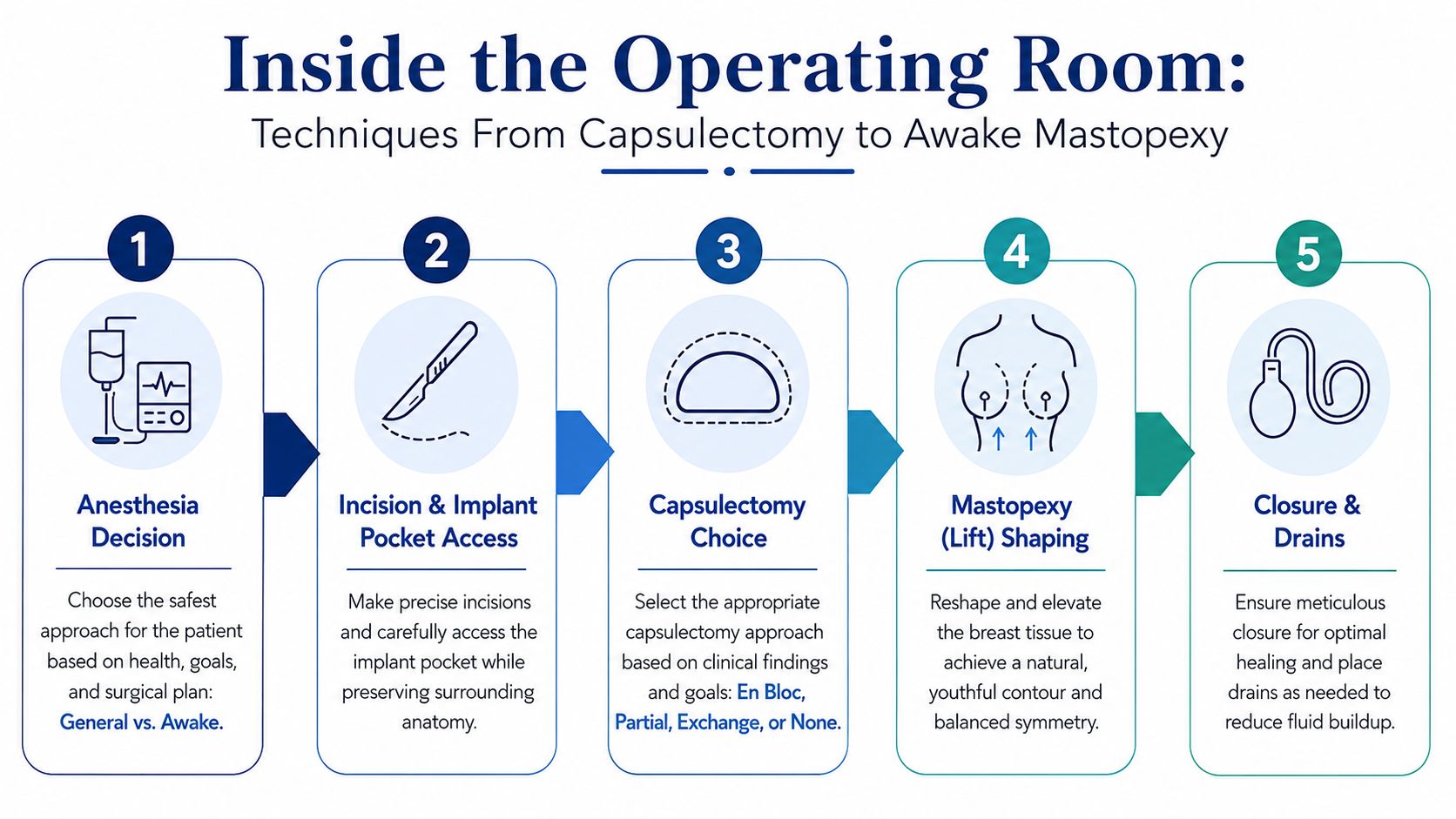
Implant removal doesn't always mean the same capsule plan. Some patients need total capsulectomy, where the surgeon removes the implant and capsule together. Others need a partial capsulectomy or a more limited cleanup. The decision depends on whether the capsule is diseased, contracted, or just part of the old implant pocket that can be safely left in place.
After the implant comes out, the surgeon judges the breast like a tailor looking at fabric after the padding has been removed. If the skin hangs, the nipple sits low, or the lower pole needs support, the lift pattern changes too. A smaller correction may use a donut-type pattern, a more moderate reshaping may use a lollipop pattern, and the most extensive reshaping usually needs an anchor pattern to manage extra skin.
Why awake surgery changes the experience
At Ideal Face & Body, the awake mastopexy approach uses tumescent local anesthesia with oral sedation so the patient can stay comfortable without general anesthesia. That matters because some motivated explant patients want shape control with less disruption to the rest of the day. They can hear conversation, avoid intubation, and leave with a shorter facility stay.
Real-time feedback also has value. When a patient is awake enough to participate, the surgeon can check nipple height and projection while shaping the breast, which is useful when the goal is to preserve a natural outline rather than force a fixed template. The right case is still the right case, though. Awake surgery is a tool, not a shortcut.
The visible difference between techniques is simple. The capsule plan decides how the old implant space is handled, and the mastopexy plan decides how the breast will sit after the implant volume is gone. When those two are coordinated well, the result looks like one operation rather than two separate ideas stitched together.
Alternatives to a Traditional Lift From Fat Transfer to Removal Alone
A formal lift isn't the only way to reshape after removal. Some patients do better with fat transfer, especially if they have donor fat available and want a softer volume restoration instead of tighter skin. Others do well with auto-augmentation, which uses the patient's own lower-pole breast tissue to rebuild upper fullness when there's enough native tissue left.
How the main alternatives differ
Fat transfer is often the best fit when the patient wants modest volume restoration and doesn't want implants back. In that pathway, the surgeon harvests fat from another area, processes it, and places it into the breast for contour. The trade-off is that the result depends on graft survival and available donor fat, so it's not a replacement for a large-volume implant.
Auto-augmentation makes more sense when the breast still has useful tissue to work with. The surgeon reshapes that tissue upward instead of importing new volume, which can be appealing for mild ptosis and a patient who wants a more natural feel.
Removal alone is the simplest option, but only when the envelope is tight, sagging is minimal, and the patient is comfortable with a smaller breast. That choice can be perfectly reasonable, it just isn't a shape-preservation strategy.
| Option | Volume Restored | Scarring | Best Candidate |
|---|---|---|---|
| Fat transfer | Modest, soft restoration | Small donor-site scars plus breast access scars | Patient with donor fat who wants no new implant |
| Auto-augmentation | Uses existing tissue, no foreign material | Lift-like scars if reshaping is needed | Patient with enough native tissue and mild ptosis |
| Removal alone | None | Least breast scarring | Tight envelope, minimal sagging, accepts smaller size |
For patients comparing shape-preserving methods after removal, Ideal Face & Body's breast lift years after implants page is a useful way to think about how timing and tissue quality affect the choice. In published clinical series, simpler explant paths sometimes score well for satisfaction in selected patients, so the smartest plan is the one that fits the anatomy instead of forcing a lift onto everyone.
Risks Recovery and the Scar Conversation Nobody Wants to Have
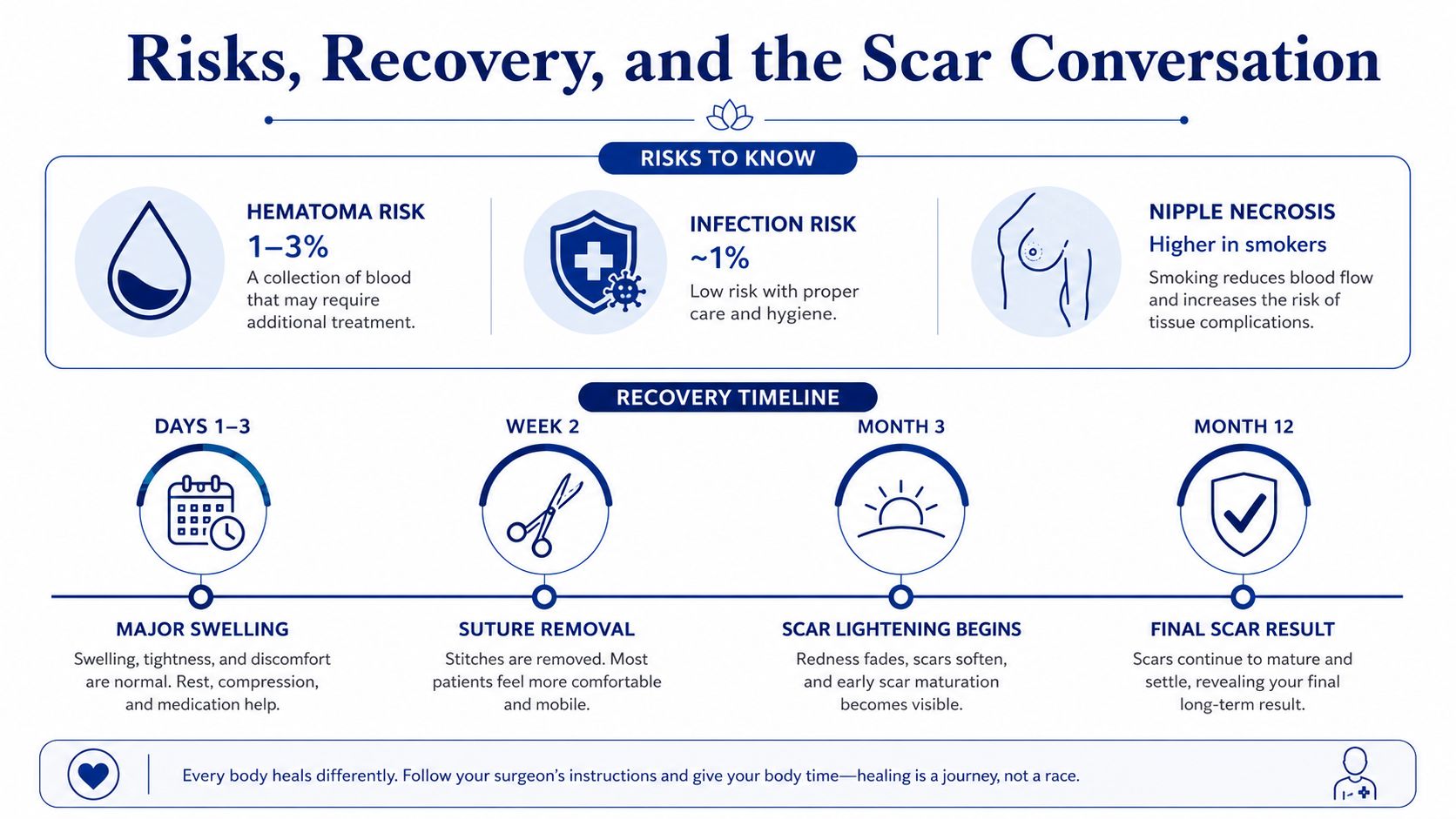
Combined explant-and-lift surgery is still surgery. Published series support a relatively low complication burden, but the risks are real. Hematoma, infection, contour irregularity, asymmetry, recurrent ptosis, and nipple-areola complications all stay on the table, and nipple necrosis is more concerning in smokers and in patients with very large implants.
The sensation conversation needs honesty too. Many patients notice temporary numbness after surgery, then gradual return over time. A minority report a longer-term change in sensation, and the risk feels more relevant when implants were large or in place for a long time.
What recovery usually feels like
Drain management, if drains are used, is short-term and practical. Most patients get back to desk work in about a week, then ease into light exercise after a few weeks, once swelling and tissue stiffness settle enough for movement to feel normal again. The breast keeps changing for months, and the final contour often isn't obvious until well after the early swelling is gone.
Scars are the price of the lift. Their location depends on the incision pattern, and their appearance changes in phases, from red and firm early on to lighter and flatter later. Scar quality depends on tension, skin type, incision care, and how much reshaping had to be done to close the breast in a supported way.
The scar fades, but it doesn't disappear. Good planning makes the scar look like part of the breast, not the thing that announces the surgery.
Published outcome data help balance the scar trade-off with the payoff. In one large series, simultaneous surgery reported low complication and revision rates, and satisfaction stayed high in follow-up studies. That doesn't erase scars, but it does explain why many patients accept them when the alternative is an empty or bottomed-out breast.
Reading Before and After Galleries Like a Surgeon
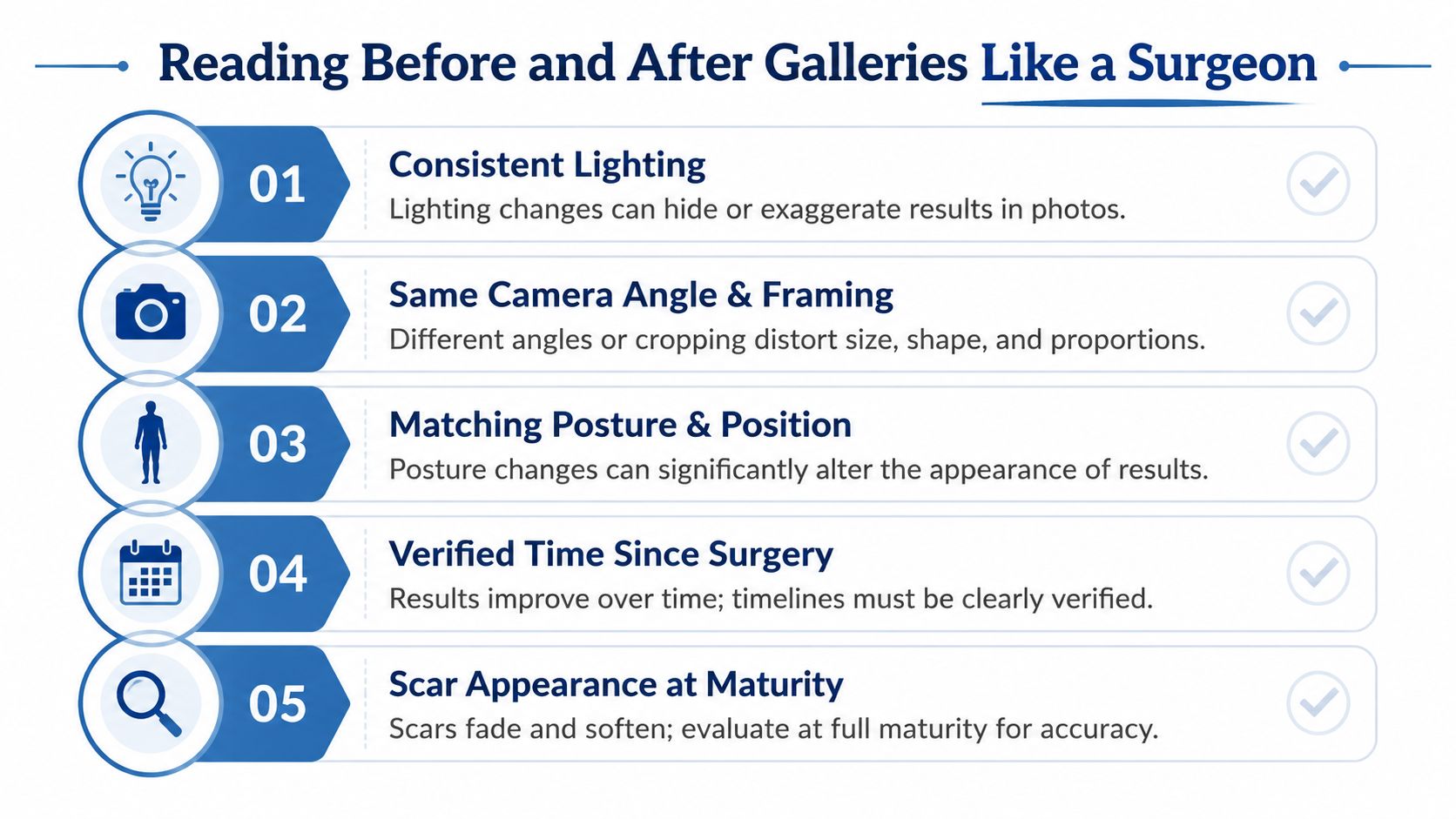
A gallery only helps if you know what to look for. The easiest mistake is focusing on cup size and ignoring the parts that reveal shape, like the lower pole, nipple position, and how the scar healed. Two photos can show the same volume and still tell very different stories.
Start with consistency. The lighting should match, the camera angle should match, and the patient should be standing in a comparable posture in both images. Then look for time since surgery, because a breast at a few weeks still looks swollen and a breast at mature healing tells a much more honest story.
What to inspect first
- Lower pole shape: look for a breast that has real support, not just a smaller outline.
- Nipple position: check whether the nipple sits in a believable position relative to the fold.
- Scar placement: see whether the incision pattern matches the degree of reshaping.
- Symmetry: compare both sides, not just one flattering angle.
- Healing honesty: ask for mature photos, not only early post-op images.
A strong gallery includes patients with a starting point similar to yours. If the images only show small implants and mild sagging, they won't tell you much about a heavier pocket or more stretched skin. Ask whether the surgeon shows revision cases and whether the images are unedited.
A final question matters more than people expect. Ask whether the mastopexy itself is done awake or asleep. That tells you a lot about the surgeon's workflow, the recovery experience, and how shape is being handled in real practice.
Putting It Together Your Three Decisions and the Next Step
Go back to the runner in her forties, or the mother of two, or the patient who just wants her body to feel like her own again. The path forward usually breaks into three decisions in order, remove, reshape, restore volume. The first decision takes the implant out, the second decides whether the breast gets lifted or otherwise reorganized, and the third decides whether fat transfer or auto-augmentation should replace some of the lost fullness.
That order matters because shape comes before decoration. A breast can be reshaped without being enlarged, but it can't be restored well if the skin envelope is ignored. That's why many patients end up comparing simultaneous surgery with staged surgery, or awake mastopexy with general anesthesia, instead of treating the operation as a simple explant.
If you're sorting through those choices, bring photos of the look you want, photos of the look you don't want, and a short list of the questions that matter most to you. Ask how your skin quality changes the plan, whether your nipple position suggests a lift, and whether removal alone would leave you with an empty contour. If a surgeon talks only about taking the implant out and skips the part about shape, that's a red flag.
For patients also thinking about pricing and planning, Ideal Face & Body's breast implant removal cost page reflects the same core issue, the operation is really about removing implants and deciding how the breast should be rebuilt afterward. The right answer isn't the same for everyone, but the right framework usually is.
Ideal Face & Body offers breast implant removal with lift planning, including awake, office-based approaches that focus on shape after explantation. If you're trying to decide whether removal alone, a lift, or volume restoration makes the most sense for your body, visit Ideal Face & Body to review the available options and take the next step with a thoughtful consultation.