You keep pinching the same soft spot on the back of your upper arm in the mirror, then wondering why workouts haven't changed it. That moment is usually where the question starts, because the issue isn't always “too much fat.” In many people, the arm has fat, laxity, and curved-surface contouring problems all at once, which is why upper arm liposuction has to be approached as a shaping procedure, not a simple emptying procedure.
Table of Contents
- Why Upper Arms Are Harder to Treat Than They Look
- What Upper Arm Liposuction Achieves
- Techniques Compared From Suction to Laser-Assisted
- The Patient Journey From Consultation to Compression
- Who Is a Good Candidate
- Risks, Complications, and the Revision Question
- Arm Liposuction Versus Arm Lift How to Choose
- Choosing the Right Practice and Surgeon
Why Upper Arms Are Harder to Treat Than They Look
A lot of people notice arm concerns the same way, by pinching the back of the arm in a dressing room mirror and thinking that removing the bulge should solve the whole problem. The upper arm does not behave like a flat surface. It is a long, visible, curved area with skin that can be thin, loose, or both, so even small contour errors stand out.
The arm shows every decision
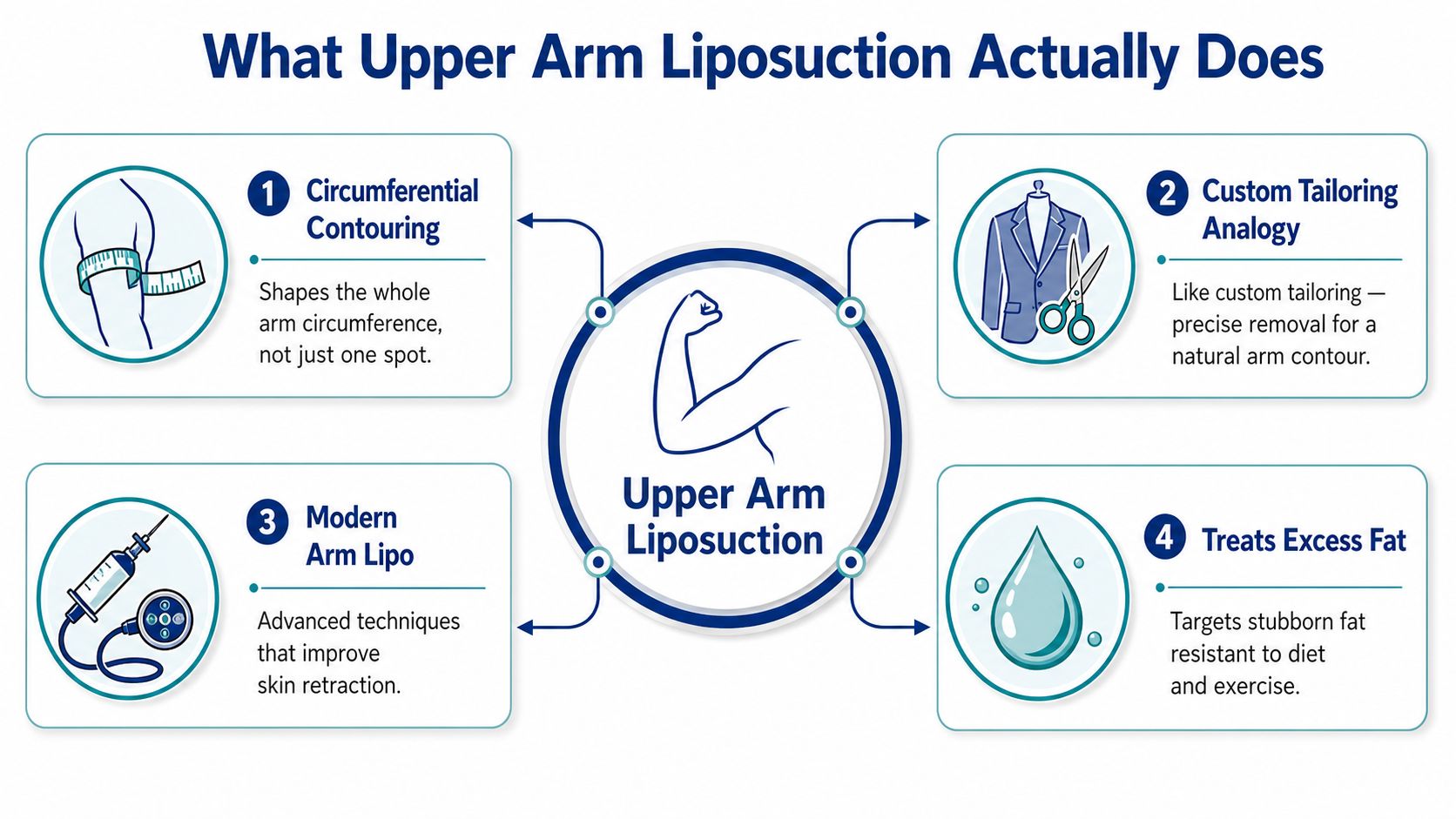
Upper arm liposuction is usually planned as circumferential contouring, not a single spot treatment. One expert review describes many cases as treating most of the brachial circumference while intentionally sparing the inner volar aspect, and using multiple tiny access points rather than a long line of scars. That approach matters because the goal is not only less volume, it is a smoother transition from shoulder to elbow.
Practical rule: if a spot on the arm is only one part of the problem, the final shape still has to look balanced from the side, front, and when the arm moves.
This is also why arms can age differently from the abdomen or thighs. On the upper arm, a modest amount of looseness can look more obvious because the skin drapes over a narrow cylinder. A patient may still have stubborn fat, but the skin envelope and the arm's natural curve decide whether liposuction will look clean or leave a hollow, irregular edge.
The same pattern shows up in other areas where soft tissue thickness and skin quality work against easy fixes. The Telomyx chest fat guide makes that point from a different anatomy, and the lesson carries over well. Before anyone talks about before-and-after photos, the question is whether the arm needs debulking, shaping, skin retraction, or some mix of all three.
What Upper Arm Liposuction Achieves
A patient with upper arm fullness usually wants one of two things, sometimes both. They want less bulk, and they want the arm to look better from every angle. Upper arm liposuction is designed for that second goal as much as the first, because the arm is a cylinder, not a flat panel. If fat is removed without respecting the full outline, the result can look narrow in one view and uneven in another.
What a successful result looks like
A good result usually looks cleaner, narrower, and more proportionate. The arm should taper more naturally from shoulder to elbow, and that change should still make sense when the arm hangs at the side or moves away from the body. The published technique literature describes hidden, tiny access points and a contouring strategy that treats much of the arm's circumference rather than focusing on a single isolated mound (arm liposuction textbook chapter).
That distinction between debulking and reshaping matters. Debulking removes fat. Reshaping tries to keep the remaining contour smooth, avoid a scooped-out look, and reduce the chance of trading one problem for another. In practical terms, the surgeon is watching symmetry, the transition zones, and how the skin will drape after the fat is reduced. For a closer look at how suction-based and laser-assisted approaches differ, see the difference between traditional lipo and laser lipo.
Why access points matter
Modern arm liposuction usually uses several very small entry sites, not one long incision. That lets the surgeon work along the arm's length, adjust the angle of treatment, and avoid a visible chain of scars. It also helps spread contouring more evenly, which matters because a small overcorrection on an arm is easier to notice than on a larger, flatter area.
The goal is a sleeve that sits better and a profile that feels lighter. In motion, the arm should look natural, not artificial. That is the aim, along with a shape that fits the rest of the body instead of drawing attention to the procedure.
Techniques Compared From Suction to Laser-Assisted
The technology choices matter because the upper arm is a shape problem as much as a fat-removal problem. A 2024 systematic review of arm contouring studies found that laser lipolysis with or without suction produced a pooled mean arm circumference reduction of 2.95 cm across 199 patients, with a 3.39 cm mean reduction in the suction-assisted subgroup and 2.04 cm in the non-suction subgroup, and the overall reduction was statistically significant (P <.001) but quite variable across studies (I^2 = 82.0%) (systematic review).
Why energy was added to arm lipo
Traditional suction-assisted liposuction removes fat mechanically. Energy-assisted and laser-assisted methods add a second goal, helping the tissue behave better after fat is removed. In plain language, surgeons use energy because they want more skin retraction and less contour irregularity, not just more suction. The evidence doesn't prove one method is universally superior, but it does support the idea that energy can be useful when skin behavior matters as much as fat volume.
The arm is unforgiving. If skin quality is weak, the procedure has to do more than remove volume, it has to help the envelope redrape.
A published arm-contouring protocol shows how this is often done in practice. The sequence starts with tumescent infiltration, then uses ultrasound or radiofrequency-assisted emulsification, then finishes with cannula aspiration. In one local-anesthesia series, the RFAL device was set to 38 to 40°C with 35 W power, and surgeons then completed residual fat removal with 2.7-, 3-, and 4-mm cannulas while keeping compression in place for 4 weeks (RFAL arm-contouring series).
That staged approach explains the appeal of awake laser techniques in the middle group of patients. The goal isn't to brute-force more fat out. It's to use controlled energy to loosen tissue and support some tightening, then finish the contour carefully so the arm doesn't look hollow or uneven. For a simple explainer on how these methods differ, the internal guide on traditional lipo and laser lipo is a helpful companion.
The Patient Journey From Consultation to Compression
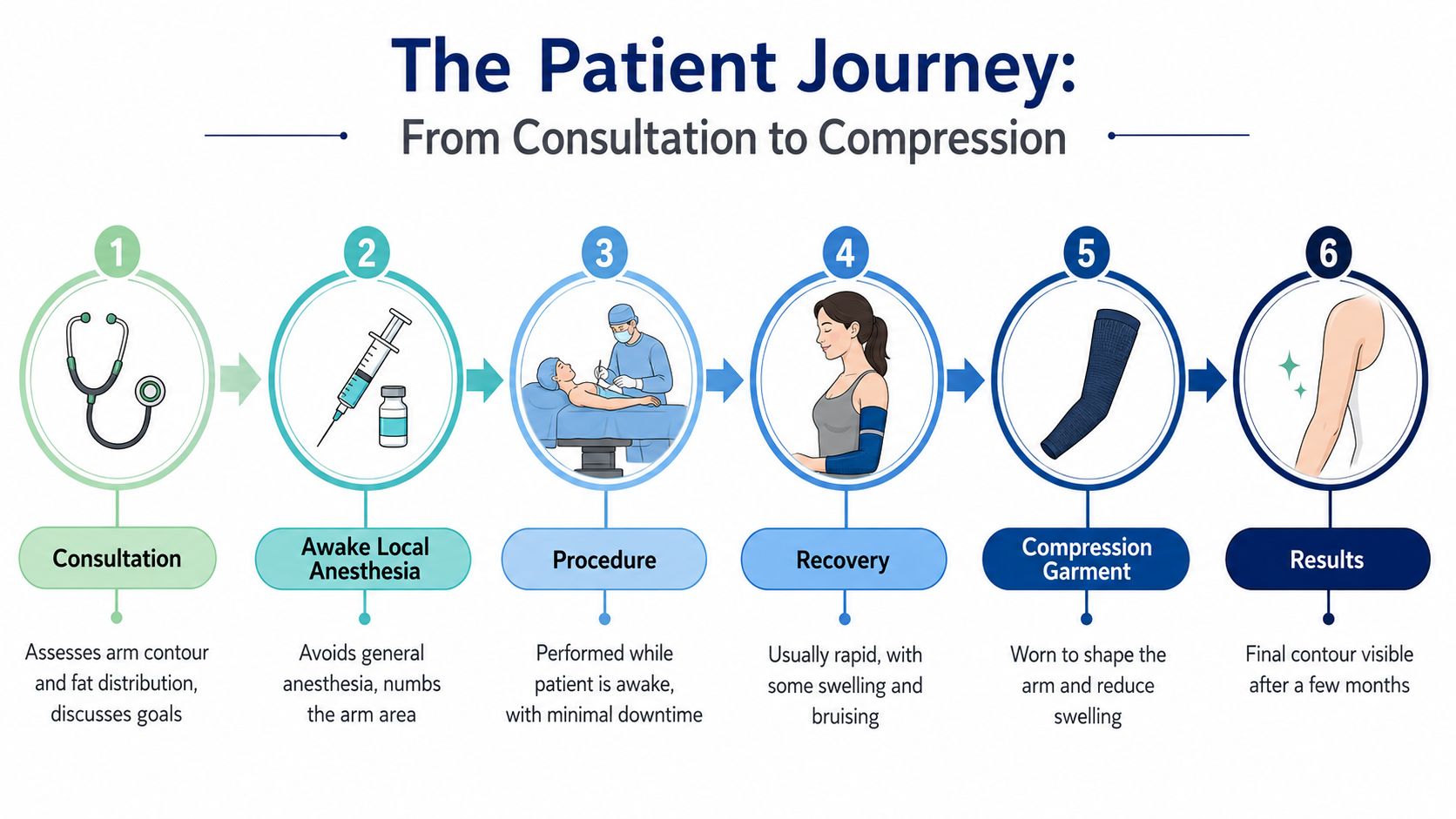
The experience usually starts before anyone talks about an operating room. The consultation is where the surgeon studies arm shape, skin quality, and how fat sits along the arm's length, because awake upper arm liposuction only makes sense when the plan matches what the arm can realistically give back. In office-based, awake treatment, the experience is built around local anesthesia and a shorter recovery path, not around sleeping through a hospital-style operation.
What awake treatment feels like
Tumescent fluid is placed first, and patients typically feel pressure rather than sharp pain once anesthesia has taken effect. That matters because awake surgery changes the rhythm of the procedure. The surgeon can adjust contouring while the patient stays out of general anesthesia, and the team can focus on careful, incremental shaping rather than rushing.
The published upper-arm series reported an average operative time of 71.7 minutes (PubMed study). That gives a realistic sense of the timeframe. It's not an all-day event, but it's also not a quick cosmetic “touch-up” in the casual sense. The time is spent refining contour, checking symmetry, and avoiding irregularity.
Why compression matters after the procedure
Compression is not an afterthought. It helps the skin settle, supports the new contour, and reduces the space where swelling can collect. In the RFAL arm-contouring series, compression was maintained for 4 weeks (RFAL arm-contouring series). That's a concrete reminder that the procedure ends in the room, but the shaping continues afterward.
The first phase of recovery usually includes swelling and bruising, then a gradual softening of the arm as the tissues settle. A practical recovery guide for patients considering arm liposculpture is the preparing arm liposculpture guide, because the win comes from matching the surgery to the aftercare. A beautifully placed contour can still look puffy if compression and activity limits are ignored.
Who Is a Good Candidate
Candidate selection sits on a spectrum, not a simple yes-or-no test. A 2024 retrospective analysis of 50 patients undergoing upper arm rejuvenation surgery reported average follow-up of 7.5 months, and arm circumference reduction rates of 6.8% in mild cases, 15.1% in moderate cases, and 17.3% in severe cases (PubMed study). Those figures point to a practical truth, the starting anatomy shapes the result as much as the technique does.
The middle group matters most
Some people have enough fat that liposuction makes sense, yet enough skin looseness that liposuction alone will not fully solve the problem. That is the middle group that deserves the most careful conversation. They are not clear-cut arm-lift patients, but they are also not the best “fat only” candidates. For them, the primary question is how much looseness they can accept if they skip a lift, and how much tightening they should reasonably expect from an energy-assisted approach.
The same literature that supports arm contouring also keeps expectations grounded. Energy methods can improve retraction, but the evidence is still mixed and the results vary from patient to patient. In the published upper-arm series, 68.3% showed improved skin laxity in a large cohort of 458 cases (PubMed study), which is encouraging, but it does not mean every loose arm will retract neatly.
Awake laser techniques can fit this gap well for selected patients, because they sit between simple suction and a full excisional lift. They can reduce bulk and help the skin contract at the same time, which is useful when the arm needs more refinement than liposuction alone can provide, but not enough excess skin to justify a larger scar.
Signs that matter in a consult
A candidacy discussion usually turns on a few practical observations.
- Skin quality: Thin, crepey, or very stretched skin raises the chance that liposuction alone will not finish the job.
- Fat distribution: Localized fullness with decent skin behavior is more favorable than diffuse laxity.
- Patient goals: Some people want a lighter arm in sleeves. Others want a more dramatic reshaping. Those are different targets.
- Tolerance for trade-offs: If someone wants to avoid a scar at all costs, they may accept less tightening. If they want the cleanest contour, they may need a different operation.
Practical question to ask yourself: do you want less volume, or do you want a tighter outer envelope too?
A useful way to think about recovery and movement goals is the post-surgery fitness safety tips guide, because the safest candidate is also the patient who can follow the aftercare plan. If contour is only part of the goal, Ideal Face & Body's revision liposuction guide can also help set expectations for patients who are weighing whether a first operation is likely to achieve the result they want, or whether later refinement may be part of the path.
Risks, Complications, and the Revision Question
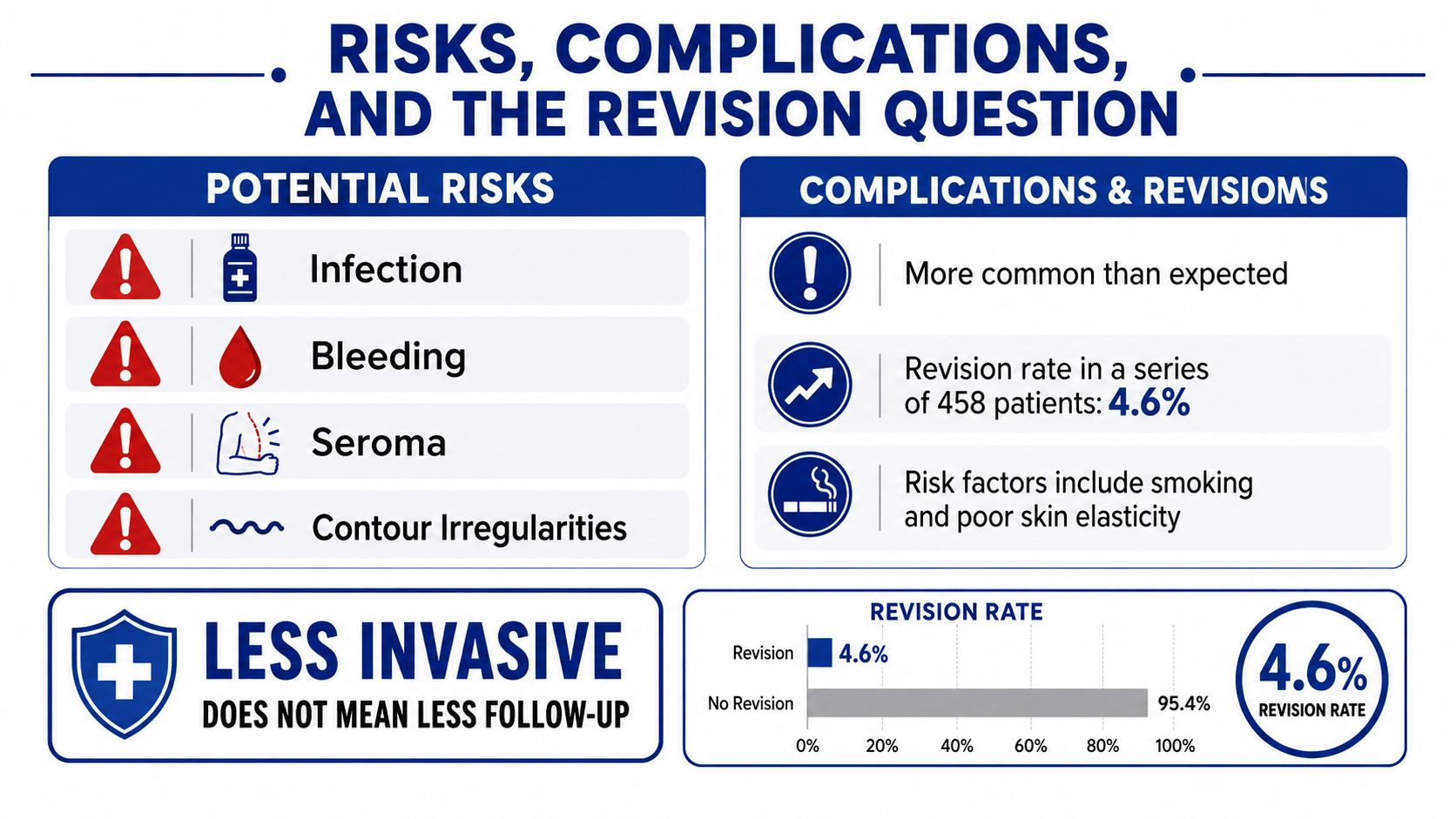
A common assumption says less invasive surgery always means less follow-up burden. Upper arm liposuction does not work that way. It can be efficient and well tolerated, but the arm still needs careful judgment because the core issue is often contour quality, not simple fat removal.
A useful way to frame the decision is as circumferential contouring. The surgeon is not just thinning one stripe of fat. The goal is to shape the arm from front to back so the result looks balanced in motion and at rest, which is why the middle group of patients matters so much. Some patients are too loose for liposuction alone, while others are not loose enough to justify a full arm lift. Awake laser techniques often fit that middle space because they can address fullness and offer some tightening without committing the patient to a larger scar.
What published series actually reported
Published series generally describe a low rate of serious problems, but they also show that small contour issues still happen. In one large 458-patient series, the reported issues were minor and self-limited, including localized nodules at 0.8%, incision pigmentation at 0.6%, and mild temporary limitation of arm abduction at 0.4%. That is reassuring, but it does not mean the operation is trivial. Arm contouring literature still describes infection, seroma, contour irregularity, sensory or motor nerve injury, repeat liposuction, and loose skin that may later need RF treatment or skin excision (arm lipocontouring chapter).
The larger point is that revision usually starts with shape, not safety. A patient may heal without a medical complication and still feel that the arm looks wavy, under-corrected, or uneven from side to side.
Who is at higher risk
The pattern is fairly consistent. Poor skin quality, the wrong indication, and aggressive technique all raise the chance of an outcome that looks unfinished or uneven. Thin skin that does not retract well can reveal small irregularities that were not obvious before surgery. Heavy bruising, swelling, and an early “too flat here, still full there” appearance can also make a result look worse before it settles.
That is why the revision question matters. A patient may avoid a long scar by choosing liposuction, but if the skin does not redrape well, the trade-off can become RF tightening, revision liposuction, or eventually a lift anyway. For patients who want a plain-language overview of how revision is approached, the revision liposuction guide is a helpful place to review the usual next steps before a consultation.
The core counseling point is simple. A smaller operation is not automatically a simpler outcome. Sometimes it only changes the kind of follow-up a patient may need, and the literature is candid about that nuance even when marketing language is not.
Arm Liposuction Versus Arm Lift How to Choose
The cleanest way to think about the choice is scar versus skin. Upper arm liposuction uses small hidden access points, while brachioplasty uses a longer inner-arm scar to remove extra skin directly. Neither option is “better” in every case, because the right answer depends on how much loose skin is really there and what the patient can live with after healing.
Decision criteria that matter
The 2024 circumferential arm liposuction series reported 99.0% satisfaction and no serious complications in the published cohort (PubMed study). That makes circumferential liposuction an attractive option for many people, especially when the main issue is fullness with manageable skin behavior. But the technique literature still warns that no single approach has proven superiority for all arm-contouring cases, especially when laxity is part of the problem.
A simple decision framework looks like this:
- Choose liposuction first when: fullness is the main complaint, skin still has some snap, and the patient wants to avoid a long scar.
- Choose an arm lift when: excess skin is the dominant issue and direct removal is needed to achieve a clean contour.
- Consider energy-assisted liposuction when: the arm sits in the middle, with fat plus some looseness, and you want a chance at more tightening without immediately moving to a lift.
Recovery and cost realities
Recovery is usually easier after liposuction than after a lift, but it's still real recovery, with swelling, compression, and activity limits. If an arm lift is needed, the scar trade-off buys direct skin removal and more predictable tightening. If liposuction is enough, you may avoid a long scar, but that doesn't mean there's no aftercare or that the final contour will be identical in every skin type.
Cost considerations vary by case, technique, and the amount of correction needed, so the conversation should stay individualized rather than numeric. The best decision is the one that matches your skin, your goals, and your tolerance for either a scar or a possible second step.
Choosing the Right Practice and Surgeon
A patient can have enough fat for liposuction, enough looseness for an arm lift, or a mix of both that sits in the middle. The right practice should help you sort that out by looking at the arm as a full cylinder, not just a patch of pinchable fat on the back side. That is where judgment matters as much as technique.
Good upper arm liposuction depends on more than technique names. You want a surgeon who can judge circumferential contour, explain skin trade-offs clearly, and show real before-and-after galleries from cases that resemble yours. Double board certification in plastic surgery, awake local-anesthesia capability, and a consistent office-based process all matter because they often show up in how the consultation is run, not just in marketing language.
The middle group deserves special attention. These are patients who do not fit cleanly into the simple liposuction bucket, yet who may not need a full arm lift either. For that group, awake laser-assisted techniques can fit the gap by offering contouring with some tightening potential, while still keeping the conversation honest about what skin can and cannot do.
Ideal Face & Body offers awake, office-based procedures in Beverly Hills, CA, including arm-focused contouring, virtual and out-of-town consultations, and documented patient results. Dr. Justin Yovino and the team's approach is built around local anesthesia and careful contour planning, which makes it relevant for patients who want to discuss whether they belong in the liposuction, energy-assisted, or arm-lift category.
If a practice cannot explain what happens when the skin does not retract as expected, the consultation is not deep enough.
A productive visit should cover the fat pattern, skin quality, scar tolerance, recovery timeline, and the backup plan if the result needs refinement. That conversation should also include whether the arm needs circumferential shaping, because side-view improvement alone can leave the arm looking incomplete from the front or from above. If you leave with those answers, you are not just shopping for a procedure, you are making a real decision about how your arms should look and heal.